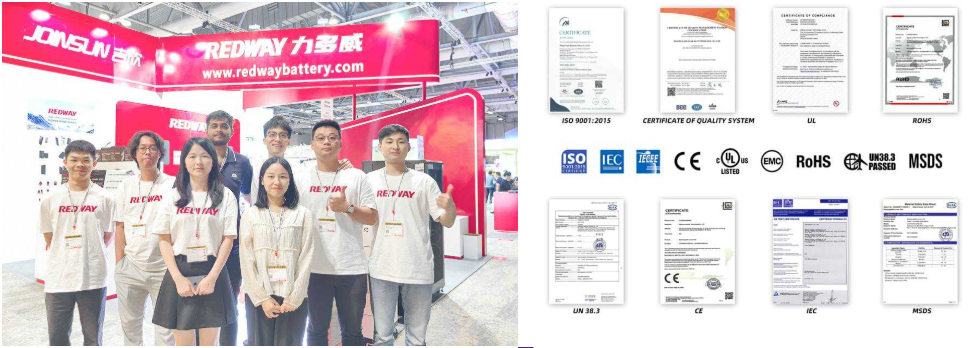
A distributor’s QA engineer notices that golf cart battery datasheets from several suppliers list standards beside the pack specifications. Some of those standards are cell-level tests, and the engineer wants to know how to tell what applies to the finished battery.
Many standards test only the cell, while others test a complete battery pack with its BMS and enclosure. A cell-level result is useful evidence about the cells inside, but it does not show how the finished pack behaves. Ask the supplier to mark each listed standard as cell, module or pack, and request the documents: the cell maker’s reports for cell-level items and the pack-level report for the finished battery, with matching models.
How to tell cell from pack
- Read the scope. The report names the item tested: a cell type, a module or a battery model.
- Check the name. Cell-level reports usually carry the cell maker’s name and cell model.
- Look for the BMS. Pack tests include the protective controls; cell tests do not.
- Ask directly. Request a table marking each standard as cell, module or pack.
Why it matters
- Dealers and customers may read a cell-level logo as a pack approval.
- Pack behaviour depends on the BMS, wiring, enclosure and assembly, not only the cells.
- Transport needs its own evidence; see our UN 38.3 and SDS article.
Documents to request
For the cells: the cell maker’s data sheet and test reports. For the pack: the safety test report for the battery model, and the factory’s quality system certificate. Our UL 2580 article explains a pack-level standard, and our incoming inspection article covers cell checks.
Redway holds relevant qualifications and certifications for its batteries; details are available from sales on request. Redway’s batteries are designed and tested to UL-related standards; the report is typically issued in the customer’s name, and scope is confirmed at quotation. Redway’s compliance documentation page gives background.
Risk limits
This article is general guidance for QA teams, not a compliance opinion. Confirm requirements for your market with a qualified adviser.
Additional perspectives
Keep cell and pack documents in separate folders per model. Audits go faster when the levels are not mixed.
Redway Tech Editorial Team – QA engineer perspective
Train sales staff to say ‘cell-level’ or ‘pack-level’ when quoting a standard. It avoids promises we cannot support.
Redway Tech Editorial Team – Distributor perspective
Ask us for a standards table per model. We can show which document backs each line.
Redway Tech Editorial Team – Supplier quality perspective
Specifications are taken from Redway product pages as of October 2026. Where a figure isn’t published, this article says so. Confirm current specifications for your model with Redway before ordering. This article is general guidance, not a site-specific engineering assessment.
Related products
- 48V 100Ah LiFePO4 Lithium Golf Cart Battery OEM (BMS 200A)
- 48V 150Ah LiFePO4 Lithium Golf Cart Battery Factory
- 48V 160Ah LiFePO4 Lithium Golf Cart Battery Manufacturer (BMS 200A)
- 36V 100Ah LiFePO4 Lithium Golf Cart Battery Factory
- 48V 100Ah Lithium Golf Cart Battery OEM Factory
Related topics
- Battery Certification, Compliance & Documentation
- Lithium Cell Chemistry, Manufacturing & Components
- Cell Matching & Quality
- Golf Cart Battery Safety & Protection
- Battery Manufacturing & Quality Control
- Golf Cart Battery Brands, OEM & Suppliers
- Quality Management
- Battery Supplier Audits & Production Capacity
- 48V Golf Cart Battery Systems
- About Redway
Continue learning
Golf Cart Batteries
Related reading