An equipment maker wants a private-label LiFePO4 pack for a new machine and asks a factory for “a price for a 48V battery”. The quote that comes back has caveats on almost every line.
Send the factory enough to design to: the application and duty cycle, voltage window and energy, continuous and peak current, charging method, physical envelope and mounting, operating temperatures, communication needs, target certifications and markets, annual volume and commercial terms. Separate the requirements you know from your assumptions. A quote can only be as firm as the brief.
Recommended RFQ contents
- Application: the machine, its use, hours per day, and where it operates (indoors, outdoors, marine, cold storage).
- Electrical: nominal voltage and the allowed voltage window of your controller or inverter, required energy (Wh) or runtime, continuous and peak discharge current with durations, and regenerative or charge current.
- Charging: the existing charger or the charging profile you plan to use, and charge time targets.
- Mechanical: maximum dimensions, weight limits (or minimum weight for counterbalanced machines), terminal type and position, mounting and IP needs.
- Environment: operating and storage temperatures, and whether self-heating is needed.
- Communication: CAN or RS485 protocol, display, Bluetooth or remote monitoring.
- Compliance: target markets and the certifications you need.
- Commercial: sample quantity, annual volume, Incoterm, branding and packaging.
What Redway publishes as a starting point
Redway’s product pages list OEM/ODM support with custom logo, configurable options such as Bluetooth, WiFi, GPS, LCD, active balance and self-heating, and certifications that vary by model (IEC 62619 is listed on some product pages; confirm per model with the factory). OEM custom orders have no MOQ by default (1 piece), although some specific products carry a 10-piece minimum. Listed terms include about 20 days’ delivery for catalog items, FOB/EXW/CIF and T/T/L/C/PayPal. Custom engineering lead times aren’t published. Ask for them. See OEM services.
Certification and logistics lines
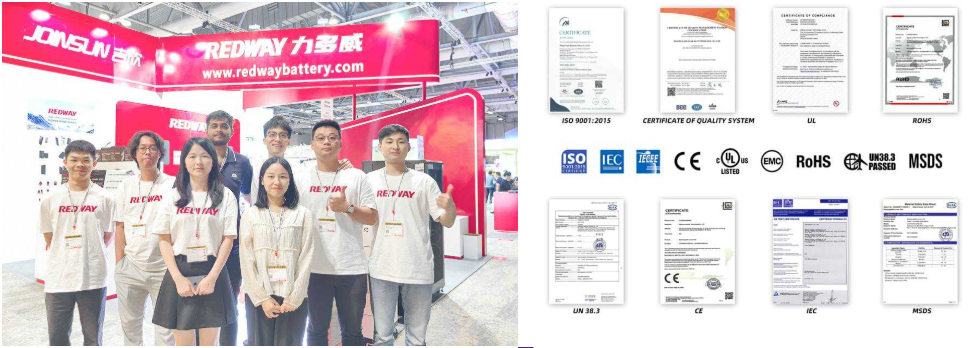
Redway’s About page lists UN 38.3 and Grade-A cells (CATL, EVE), along with UL1973, UL2580 and IEC62133; scope is confirmed per model and order. Redway’s batteries are designed and tested to UL-related standards (for example UL 2580 for EV batteries). The test report is typically issued in the customer’s name, and scope and applicable standards are confirmed at quotation. The factory operates under ISO 9001/14001 management systems, and the certificate is available on request. Its OEM/ODM page says no minimum order quantity is required, with better prices at higher volumes. State your target markets so the factory can tell you which certificates exist for the configuration and which need new testing. Ask for a test report under your own company name and check the standard number, model and date. IEC 62619 is listed on some product pages; confirm per model with the factory if your market requires it.
Risk limits
A quote for a custom pack isn’t approval to produce. Tie production to an approved drawing and specification revision and to sample test results. Don’t let unknown values (for example, a peak current you guessed) quietly become the design basis. Mark them as open. Our OEM/ODM process guide explains the stages.
Additional perspectives
Ask for the quote to separate unit price, tooling or development costs, certification testing costs and packaging. Factories often bundle these differently, and a low unit price can hide a large one-off fee.
Redway Tech Editorial Team – Procurement perspective
Send a duty cycle, not just a capacity: typical and peak current, run time, charge window and temperature range. A factory can size cells and BMS from a duty cycle; from ’48V 100Ah’ it can only guess.
Redway Tech Editorial Team – Engineering perspective
List the destination countries and transport modes (sea, air, road) at RFQ stage. Air freight and some markets need specific test reports and labelling, and adding them after design freeze is slow and costly.
Redway Tech Editorial Team – Compliance perspective
Specifications are taken from Redway product pages as of October 2026. Where a figure isn’t published, this article says so. Confirm current specifications for your model with Redway before ordering. This article is general guidance, not a site-specific engineering assessment.
Related products
- 48V 100Ah Lithium Golf Cart Battery OEM Factory
- 60V 100Ah Lithium Battery Factory B2B OEM
- 72V 200Ah Lithium Battery ODM Factory B2B
- 24V 100Ah Lithium LiFePO4 Battery (ULTRA)
- 48V 200Ah 5U Rack-mounted LiFePO4 Lithium Battery (PM-LV51200-5U)
Related topics
- Battery OEM, Manufacturing & Buying
- Lithium Battery Suppliers, OEM & Sizing
- Battery Brands, Warranty & Buying
- Forklift Battery Brands, OEM & Suppliers
- Golf Cart Battery Brands, OEM & Suppliers
- Rack Battery OEM, Brands & Suppliers
- RV Battery Brands, OEM & Suppliers
- Battery OEM Cost, Tooling & Project Management
- Battery Import, Shipping & Warranty Support
- Battery OEM Customization & Engineering
Continue learning
Battery OEM & Buying
Back to Battery OEM & Buying →
Related reading