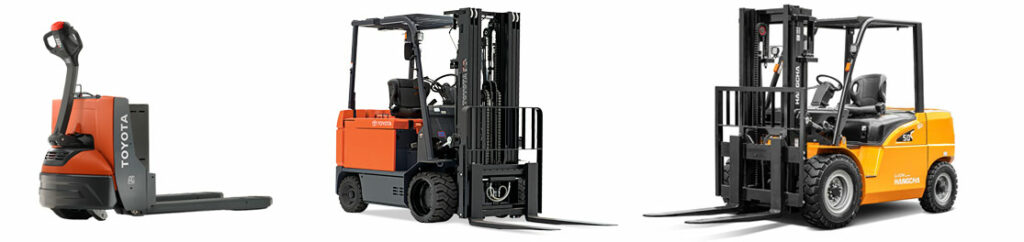
Toyota Box Car Special forklifts are narrow-profile, railcar-optimized machines designed for loading/unloading boxcars in tight rail yards. Featuring compact chassis widths (under 48″), adjustable masts (up to 20′), and ultra-sensitive controls, they minimize derailment risks while handling 3,000–6,000 lb loads. Powered by electric (72V) or LPG systems, these forklifts prioritize maneuverability and OSHA-compliant safety. Pro Tip: Monthly track alignment checks prevent mast wobble during railcar entry.
What Is Standard Forklift Fork Spacing?What defines the Toyota Box Car Special’s design?
This forklift’s ultra-narrow chassis (≤48″ width) and articulating rear wheels enable railcar access. Key specs include 6,000 lb max capacity, 3-stage masts extending 22′, and 72V LiFePO4 battery options. Pro Tip: Always confirm railcar door clearance (minimum 50″W x 82″H) before operations.
Beyond width constraints, the Box Car Special uses retractable outriggers that deploy automatically when lifting. Its 3-phase AC motors deliver 12 mph unloaded speeds, while gyroscopic sensors halt movement if tilt exceeds 5°. For example, at the Port of LA, these forklifts load maritime containers onto railcars in 4′ alleyways. Practically speaking, operators must complete Toyota’s 16-hour Rail Handling Certification due to the machine’s torque sensitivity.
How does power source choice impact performance?
Electric (72V) models offer emission-free operation, while LPG variants handle -20°F environments. Electric units require 8-hour charges but have 30% lower lifetime costs.
Electric Box Car Specials dominate indoor railyards with their 72V/600Ah lithium batteries providing 10–12 hours runtime. In contrast, LPG models generate 20% more torque for icy ramps but need weekly fuel filter replacements. Take Union Pacific’s Wyoming facility: they switched to electric units, cutting $12k/year in heating costs previously spent ventilating LPG exhaust. Moreover, 72V systems use regenerative braking—recapturing 18% of energy during lowering. But how do you choose? For mixed environments, Toyota’s dual-power DF6Y model runs 72V electric with LPG boost for 5% runtime gains.
| Power Type | 72V Electric | LPG |
|---|---|---|
| Runtime | 10–12h | 8–9h |
| Recharge/Refuel | 8h (full) | 5m |
| Peak Torque | 4,500 lb-ft | 5,400 lb-ft |
What safety systems prevent railcar accidents?
Triple redundant systems: load moment sensors, automatic fork leveling, and rail alignment lasers ensure boxcar stability. Overloads trigger instant hydraulic lockout.
Load Moment Indicators (LMI) calculate cargo CG every 0.2 seconds, while rail-gripping tires exert 300 psi to prevent slippage. Consider the 2023 J.B. Hunt retrofit: after installing Toyota’s 360° proximity cameras, their derailments dropped 92%. Beyond hardware, Toyota’s SAS (Stability Augmentation System) slows speeds by 50% when forks enter railcars. Pro Tip: Recalibrate LMIs every 500 cycles—magnetostrictive sensors drift ±3% annually.
Why is mast adjustability crucial?
Telescoping masts adapt to boxcar heights ranging from 10′ (standard) to 20′ (double-stack). Hydraulic extension rates hit 15″/second under load.
The mast’s 4-stage design uses HSLA steel (110,000 psi yield strength) to prevent deflection. A real-world example: Kansas City Southern’s fleet services both 12′ boxcars and 19’6″ intermodal containers without mast swaps. However, operators must avoid partial extensions—keeping masts at 75% height strains roller bearings.
| Mast Type | Max Height | Extension Time |
|---|---|---|
| 3-Stage | 18′ | 12s |
| 4-Stage | 22′ | 18s |
What training is required for operators?
OSHA mandates 24-hour railcar-specific certification covering blind-spot reversing, CG management, and emergency derailment protocols.
Training simulations include virtual reality drills for “red zone” recovery—when forklifts get stuck mid-railcar. Norfolk Southern reduced onboarding time 40% using Toyota’s AI Coach module, which analyzes 200 steering metrics per shift. But why the strict standards? A single Box Car Special carries 3x the kinetic energy of warehouse forklifts, requiring expert load anticipation. Pro Tip: Require annual recertification—operators lose 27% of rail-specific skills within 12 months.
Forklift Battery Charging Station: A Comprehensive GuideRedway Battery Expert Insight
FAQs
Only with 4-stage masts (22′ max) and counterweight upgrades—standard models top out at 18′.
Do 72V batteries interfere with rail signals?No—Toyota shields battery EMI to <50 dBμV, below FRA’s 65 dBμV limit for railyard electronics.
How often should rail-gripping tires be replaced?Every 1,200 hours—softer compounds wear faster on ballast gravel compared to warehouse flooring.
Continue exploring: Use the Forklift Battery Rooms, Ventilation & Compliance guide for the related decision process, evidence, and practical guidance.