A QA engineer compares datasheets for lithium forklift packs. Each lists several safety standards next to the specifications, and the engineer needs to know whether a listed standard covers the complete pack being bought, only its cells, or a sample tested once.
A standard listed on a datasheet tells you little until you see the document behind it. Ask which item was tested (cell, module or complete pack), which model and edition, whether it was a one-off design sample or is backed by production checks, whether it is a test report or a certification, and whose name is on it. Then check that the tested design still matches what you are buying.
Four questions behind every listed standard
- What level? Cell, module or complete pack. A cell-level result does not show how the finished pack behaves.
- Which design? Model, voltage, capacity, BMS and enclosure, and the standard’s edition.
- What kind of document? A test report from a laboratory, or a certification with ongoing factory follow-up by a recognised body.
- Whose name? The pack maker, the cell maker, or a customer for whom a project was tested.
Common gaps
- The standard applies to the cells, but the datasheet places it beside pack specifications.
- The test was done on an earlier design, before a BMS or enclosure change.
- The report covers one capacity, while the datasheet covers a range.
What to request
Ask for the report or certificate itself, including the model list and test conditions. Our documents article lists the usual set, and our UL 2580 vs UL 1973 article explains how traction and stationary standards differ.
How Redway handles it
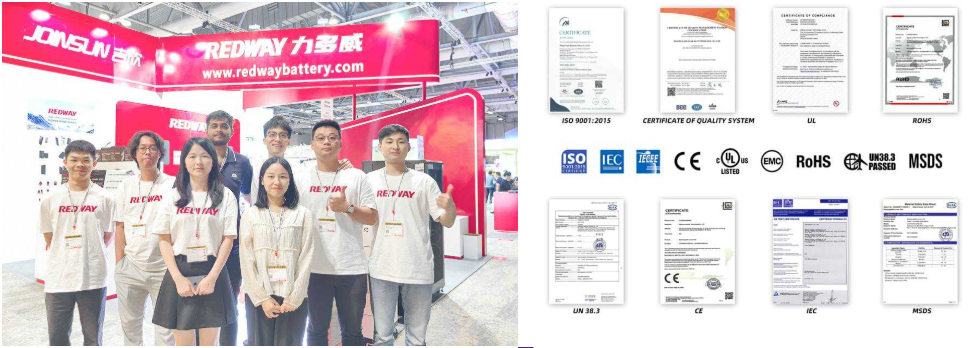
Redway holds relevant qualifications and certifications for its batteries; details are available from sales on request. Redway’s batteries are designed and tested to UL-related standards; for customised products the report is typically issued in the customer’s name, and scope and applicable standards are confirmed at quotation. Redway’s compliance documentation page gives background.
Risk limits
This article is general guidance, not a compliance opinion. Requirements depend on your market and customer, so confirm them with a qualified adviser.
Additional perspectives
Ask ‘which serial or sample was tested?’ The answer shows quickly whether the report matches your order.
Redway Tech Editorial Team – QA engineer perspective
Separate cell, pack and truck in your document register. Each level answers a different question.
Redway Tech Editorial Team – Compliance adviser perspective
Ask suppliers to mark each listed standard as cell, pack or system on their quote. Comparisons get much easier.
Redway Tech Editorial Team – Procurement perspective
Specifications are taken from Redway product pages as of October 2026. Where a figure isn’t published, this article says so. Confirm current specifications for your model with Redway before ordering. This article is general guidance, not a site-specific engineering assessment.
Related products
- 48V 420Ah 400Ah Forklift Lithium Battery
- 48V 400Ah 420Ah Forklift Lithium Battery
- 48V 460Ah 450Ah Forklift Lithium Battery
- 48V 600Ah 630Ah Forklift Lithium Battery
- 80V 400Ah 420Ah Forklift Lithium Battery
Related topics
- Battery Certification, Compliance & Documentation
- Forklift Battery Safety
- Battery Manufacturing & Quality Control
- Quality Management
- Lithium Cell Chemistry, Manufacturing & Components
- Battery Supplier Audits & Production Capacity
- Forklift Battery OEM & Procurement
- About Redway
- 48V Forklift Battery Systems
- Forklift Models, Specifications & Technical Guides
Continue learning
Forklift Batteries
Related reading