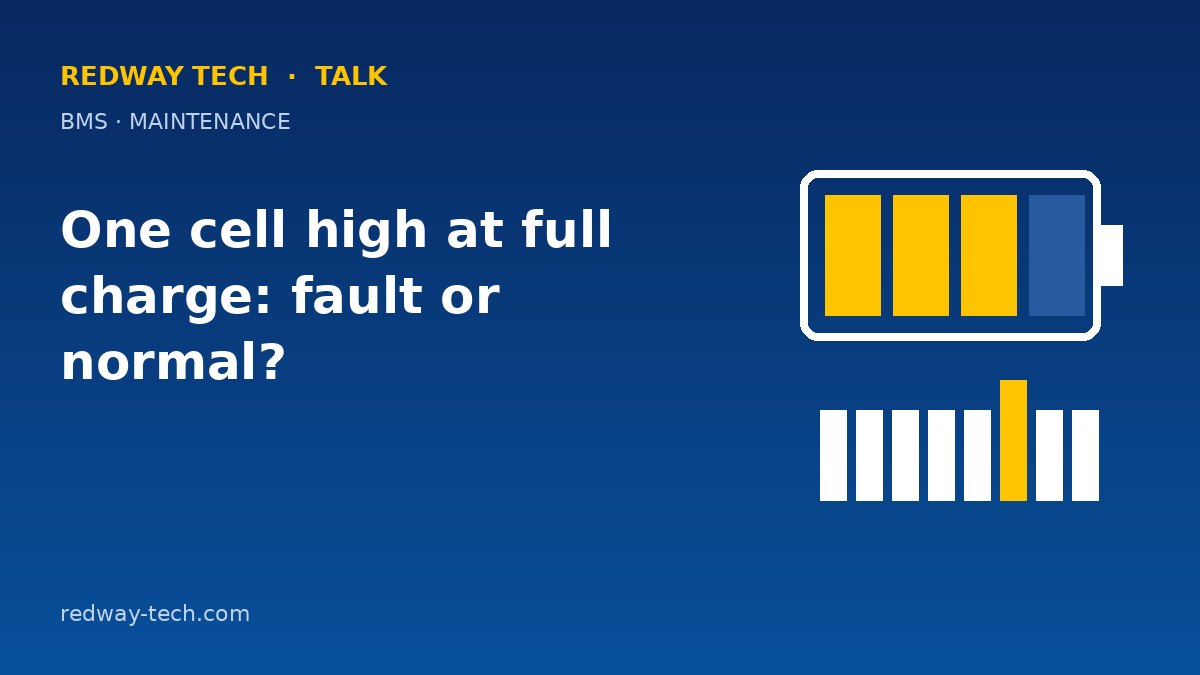
A home solar user opens the battery’s Bluetooth app during the last part of charging. Fifteen cells read almost the same, but one sits noticeably higher and the BMS stops charging soon afterwards.
It isn’t automatically a fault. LiFePO4 cells stay close together through the flat middle of their charge curve and then separate at the top, where voltage rises steeply. The first cell to get there shows higher. It becomes a concern when the spread grows over several charge cycles, when charging regularly stops early and usable capacity falls, or when the same cell is also the lowest near empty.
Why the spread shows up at the top
Close to full, a small difference in a cell’s state of charge becomes a visible voltage difference. Most BMS boards balance passively by bleeding a little current from the highest cells, and only above a set voltage. If charging ends quickly, there is little time for balancing. Redway lists active balancing as an optional upgrade on several models, including the 12V ULTRA series.
Normal vs worth investigating
- Likely normal: the spread appears only in the last minutes of charging, settles at rest, and capacity is unchanged.
- Imbalance: the spread is getting larger each week, the BMS stops charging early on cell over-voltage, and the state of charge reaches 100% while delivered capacity falls.
- Possible weak cell: the same cell is the highest at full and the lowest near empty, and sags more than the others under load.
Steps
- Check that the charge voltage matches the datasheet, for example 58.4V maximum on Redway 51.2V rack modules.
- Let the system finish a complete charge and hold near full so the BMS has time to balance, within the manufacturer’s settings.
- Record cell voltages at the same point over several cycles, with screenshots including the time and current.
- Note when charging stops and the delivered Ah on the next discharge.
- Send the log to the supplier if the trend is getting worse.
Risk limits
Don’t open a sealed battery to balance cells by hand. That can void the warranty and creates a safety risk. Don’t raise BMS cell limits or charge voltages beyond the datasheet. Background is in Charging, BMS & Pack Design.
Additional perspectives
Check cell balance at the same point in the charge each month rather than reacting to a single screenshot. If your system always stops short of full, for example because the inverter is set to charge to 90%, schedule an occasional full charge if the manufacturer allows it, so balancing can happen.
Redway Tech Editorial Team – Maintenance perspective
For large-capacity banks or systems that are rarely charged to full, ask whether active balancing or a higher balancing current is available. Passive balancing currents are small compared with the capacity of large cells. Redway lists active balance as an option on some models. Confirm availability for the exact model you’re ordering.
Redway Tech Editorial Team – Selection perspective
If you expect to raise a claim, gather evidence first: serial number, firmware or BMS version, charge settings, and dated cell-voltage logs at full and near empty. A claim backed by a trend is easier to assess than one screenshot. Redway lists a 3-year warranty on models such as the 12V ULTRA. Check the terms for your model.
Redway Tech Editorial Team – Warranty claims perspective
Specifications are taken from Redway product pages as of October 2026. Where a figure isn’t published, this article says so. Confirm current specifications for your model with Redway before ordering. This article is general guidance, not a site-specific engineering assessment.
Related products
- 12V 100Ah Lithium LiFePO4 Battery (ULTRA)
- 48V 200Ah 5U Rack-mounted LiFePO4 Lithium Battery (PM-LV51200-5U)
- 48V 150Ah 4U Rack-mounted LiFePO4 Lithium Battery (PM-LV51150-4U for Telecom)
- 24V 100Ah Lithium LiFePO4 Battery (ULTRA)
Related topics
- LiFePO4 & Lithium Battery Technology
- Battery Charging & Chargers
- BMS, Safety & Maintenance
- Thermal Management & Enclosure Sizing
- Capacity vs Charge Rate Trade-offs
- Measuring Capacity Properly
- Forklift Charging Systems & Troubleshooting
- Forklift BMS, Fleet Monitoring & Telematics
- Forklift Fast & Opportunity Charging
- Golf Cart BMS, Monitoring & State of Charge
Continue learning
Battery Knowledge
Related reading