A logistics manager must move several lithium forklift packs from China to a warehouse in Europe. A single pack can weigh a few hundred kilograms, and the forwarder asks whether to book sea, air or road for the final leg.
Sea is the normal choice for heavy forklift packs; air is rarely practical; road is used for the inland legs. All three treat a lithium-ion pack above 100 Wh as Class 9 dangerous goods (UN3480). For air, the standard instruction limits a package to 35 kg net and 30% state of charge, which a pack of a few hundred kilograms cannot meet without special approval. For sea and road, packs over 12 kg use packing instruction P903 or large-packaging instruction LP903, with terminal protection and securing.
How the three modes compare
- Sea (IMDG Code). Needs a dangerous-goods declaration and a container packing certificate (IMDG section 5.4.2). Large batteries are secured in a rigid case, crate or on a pallet or handling device, protected from short circuit. Check that the carrier accepts the cargo and ask for its dangerous-goods cut-off date.
- Air (IATA). UN3480 under packing instruction 965 Section IA is forbidden on passenger aircraft. On cargo aircraft the limit is 35 kg net per package, the state of charge must not exceed 30%, and UN-specification packaging is required. Redway’s 48V 460Ah pack is listed at about 339 kg, so air freight is not a routine option.
- Road (ADR in Europe). Batteries above 12 kg gross use P903, or LP903 in large packaging, and must be protected against short circuit. The driver needs the dangerous-goods transport document and the vehicle needs the required marking.
What to settle with the supplier
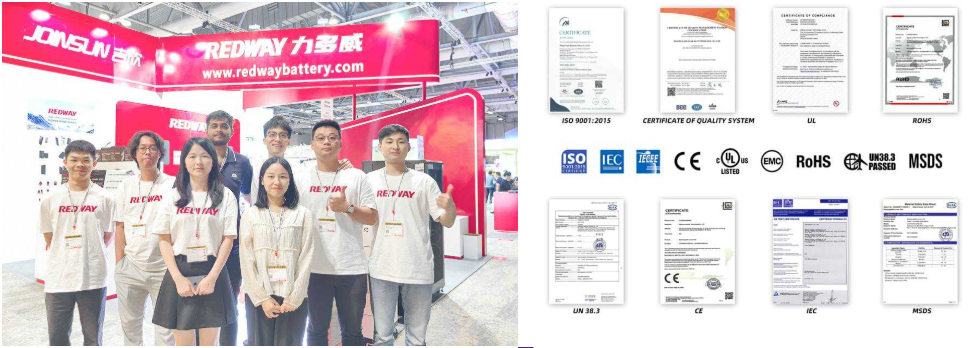
Redway’s product pages list sea, air and land shipment and 10FT to 60FT container sizes, with FOB, EXW or CIF terms. For each pack ask for gross weight, case dimensions, packing method, and the UN 38.3 test summary for the exact model. Our EXW, FOB or CIF explainer shows who carries the risk at each stage, and the import and shipping page gives background.
Practical booking tips
Ask your forwarder to check that the carrier and the ports on your route accept lithium-ion batteries before you finalise the price, since acceptance rules differ. Request a quote that lists dangerous-goods surcharges, container size, and the cut-off date. Keep the supplier’s weight and dimensions on the packing list identical to the booking, because a mismatch can delay loading.
Risk limits
Dangerous-goods rules are amended on a regular cycle and carriers add their own acceptance rules, so confirm the current edition and carrier policy with your forwarder before booking. A damaged or defective battery follows separate, stricter rules (special provision 376 under ADR). This article summarises public rules and is not a compliance opinion.
Additional perspectives
Ask the forwarder to quote sea and road legs together, and to confirm in writing that they hold dangerous-goods capability for Class 9 on both. For urgent replacement packs, ask whether a smaller shipment split into lighter packages is possible under the air limits, and who would approve it.
Redway Tech Editorial Team – Logistics perspective
Plan for a 300-kilogram-plus pack: the forklift or crane that unloads it, the floor space for quarantine, and the lifting points. Inspect the case on arrival and photograph any damage before signing the delivery note.
Redway Tech Editorial Team – Warehouse and receiving perspective
Keep one shipping file per consignment: declaration, packing certificate, UN 38.3 summary, packing list and invoice, all showing the same model names and weights. Mismatches between documents are a common reason for a carrier to hold cargo.
Redway Tech Editorial Team – Compliance perspective
Specifications are taken from Redway product pages as of October 2026. Where a figure isn’t published, this article says so. Confirm current specifications for your model with Redway before ordering. This article is general guidance, not a site-specific engineering assessment.
Related products
- 48V 600Ah 630Ah Forklift Lithium Battery
- 48V 560Ah 550Ah Forklift Lithium Battery
- 48V 460Ah 450Ah Forklift Lithium Battery
- 83V 80V 400Ah 420Ah Forklift Lithium Battery
- 48V 420Ah 400Ah Forklift Lithium Battery
Related topics
- Battery Import, Shipping & Warranty Support
- Lithium Mining, Regulation & Transport
- Battery Wholesale, Pricing & Logistics
- Battery Certification, Compliance & Documentation
- Forklift Battery Handling & Changing Equipment
- Forklift Battery Safety
- Forklift Battery OEM & Procurement
- Forklift Battery Replacement & Conversion
- Battery OEM Cost, Tooling & Project Management
- Forklift Brands, Models & Battery Fitment
Continue learning
Forklift Batteries
Related reading