A dealer is importing lithium golf cart batteries and wants to fill a container. The forwarder asks for pack size, weight, quantity per pallet and dangerous-goods details. The dealer has only the figures on the product page.
Check both volume and payload, because for heavy packs payload can be the limit. Using the 51.2V 105Ah figures on Redway’s 48V 100Ah golf cart page (500 x 355 x 247 mm, 43.2 kg), one bare pack takes about 0.044 m³. A standard 20ft dry container offers about 33 m³ and 28,200 kg payload, a 40ft about 67 m³ and 28,800 kg (Maersk figures). Payload then caps a 20ft at roughly 650 packs and a 40ft at roughly 665, so a 40ft load is limited by weight long before it is limited by volume. Real counts will be lower once cartons, pallets and gaps are included.
The arithmetic, and its limits
- Volume. 0.5 x 0.355 x 0.247 m = 0.044 m³ per bare pack. That gives a theoretical ceiling near 750 packs in a 20ft and 1,500 in a 40ft before packaging.
- Payload. 28,200 kg / 43.2 kg = about 650 packs in a 20ft; 28,800 kg / 43.2 kg = about 665 in a 40ft. The smaller container is nearly as heavy a load as the larger one.
- Packaging. Carton and pallet weights and sizes are not published for Redway models. Ask for the packing list with dimensions and gross weight before you order [to confirm with the factory].
Treat this as a screening calculation, not a loading plan. Road weight limits in your country can be lower than the container’s rated payload, and dimensions vary by container and shipping line.
Packing and documents
Redway’s product pages list 10FT, 20FT, 40FT and 60FT shipments and FOB, EXW or CIF terms. A 5.37 kWh pack ships as a fully regulated Class 9 dangerous good (UN3480). For sea freight, expect a dangerous-goods declaration and a container packing certificate under IMDG Code section 5.4.2, which confirms the container was clean, the packages were inspected and secured, and the container was correctly marked and placarded. Packs must be protected against short circuit and packed so they cannot shift. The manufacturer must also make the UN 38.3 test summary available.
Practical steps: palletise and band the packs, protect terminals, load heavy pallets low and centred, take photos during loading, and record the seal number. Our import and shipping page gives more background.
Risk limits
Dangerous-goods rules change with each IMDG amendment, and carriers add their own acceptance rules. Confirm with your forwarder before booking. Figures here come from one pack model and one carrier’s published container specifications. This article is general guidance, not a loading plan.
Additional perspectives
Ask for the draft packing list, with pallet dimensions and gross weight, before you place the order, and compare it with the container’s payload and your inland road limits. Ask your forwarder for the dangerous-goods cut-off date, which can be earlier than for general cargo.
Redway Tech Editorial Team – Logistics manager perspective
Plan the unloading: pallet weight against your forklift capacity, dock space and quarantine space. On arrival, inspect every package, note damage on the delivery receipt, photograph it, and set any damaged pack aside from the others until the supplier has been told.
Redway Tech Editorial Team – Receiving dealer perspective
Your broker needs the commercial invoice, the packing list and the dangerous-goods documents to match each other, and will confirm the tariff classification for your country. Keep the UN 38.3 test summary and a copy of the container packing certificate in the shipment file.
Redway Tech Editorial Team – Customs and compliance perspective
Specifications are taken from Redway product pages as of October 2026. Where a figure isn’t published, this article says so. Confirm current specifications for your model with Redway before ordering. This article is general guidance, not a site-specific engineering assessment.
Related products
- 48V 100Ah LiFePO4 Lithium Golf Cart Battery OEM (BMS 200A)
- 48V 150Ah LiFePO4 Lithium Golf Cart Battery Factory
- 48V 160Ah LiFePO4 Lithium Golf Cart Battery Manufacturer (BMS 200A)
- 36V 100Ah LiFePO4 Lithium Golf Cart Battery Factory
- 48V 50Ah LiFePO4 Lithium Golf Cart Battery B2B
Related topics
- Battery Import, Shipping & Warranty Support
- Battery Wholesale, Pricing & Logistics
- Lithium Mining, Regulation & Transport
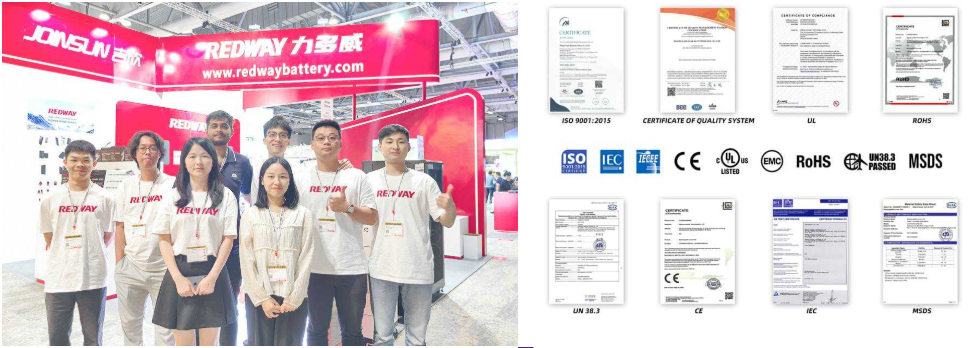
- Battery Certification, Compliance & Documentation
- Golf Cart Fleet & Commercial Battery Systems
- 48V Golf Cart Battery Systems
- Golf Cart Dealers & Vehicle Buying
- Golf Cart Battery Brands, OEM & Suppliers
- Battery OEM Cost, Tooling & Project Management
- Golf Cart Models & Battery Fitment
Continue learning
Golf Cart Batteries
Related reading