
Redway battery guides
Golf Cart Batteries
Start with the equipment and duty cycle. This hub routes buyers from compatibility through energy, charging, safety, maintenance and OEM validation.
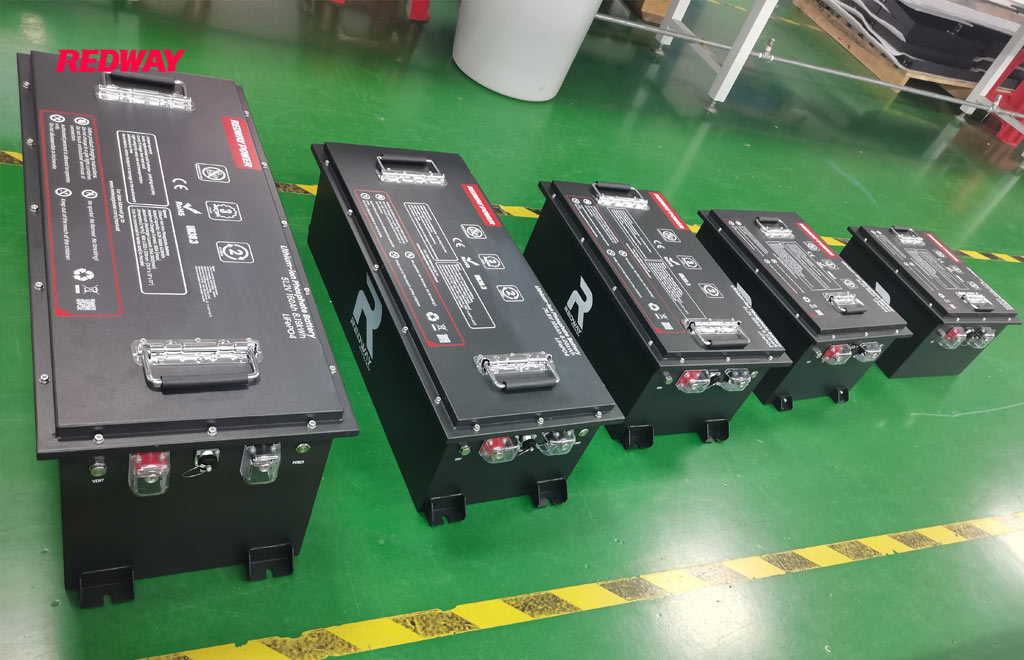
Before you choose
Golf cart battery selection starts with the cart and its route. A suitable pack must fit the electrical system and installation space while supporting passenger load, terrain, accessories and charging access. Compare a lithium conversion as a complete system change.
The equipment, battery and charger have to be approved as one operating system. Nominal voltage establishes compatibility, usable energy covers the working period, and continuous plus peak current keep the machine moving under its hardest load. Dimensions, terminal position, cable reach and restraint determine whether those electrical ratings can be installed safely. The charger then has to replenish the used energy inside the real downtime available, without creating excessive heat or an avoidable queue.
Information to collect before a golf cart battery upgrade
| Decision | What to establish |
|---|---|
| Cart and system | Cart model, system voltage, controller and existing wiring. |
| Installation | Battery space, mounting, terminal arrangement and connections. |
| Route | Distance, gradients, passengers, payload and accessories. |
| Charging | Existing charger, charging location and available time. |
| Fleet use | Daily utilisation, downtime, service arrangements and replacement plan. |
Choosing a battery
Identify the cart model and existing battery system before comparing replacement packs. Physical fit, connections, controller requirements and the charger can matter as much as the chemistry on the label.
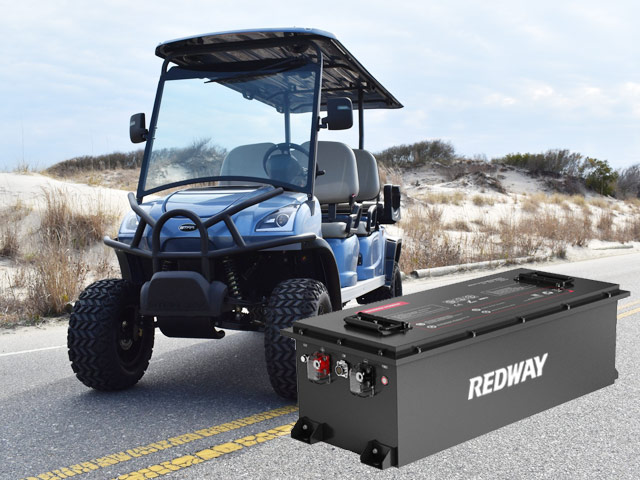 Selected article
Why Choose Lithium Golf Cart Batteries?
Selected articleWhy Switch to 48V Lithium Golf Cart Batteries?
Explore the complete topic
- What is the best 60V 100Ah LiFePO4 battery set for golf carts from a China-based OEM?
- How Much Lighter Are LiFePO4 Golf Cart Batteries Than Lead-Acid?
- Why Are Lithium Batteries Best For Golf Carts Today?
- 36V battery for golf cart, choose lead acid battery or lithium batteries?
- 36V LiFePO4 Golf Cart Battery – Long-Lasting Power
- 36V Deep Cycle Lithium Golf Cart Batteries
- How Many Cycles Do Golf Cart Batteries Last?
- What To Do With A Dead Battery In EZGO Golf Cart?
- Golf Cart Battery Installation, Wiring & Conversion
- Golf Cart Battery Brands, OEM & Suppliers
- Lithium vs Lead-Acid Golf Cart Batteries
- Golf Cart Battery Applications, Custom Builds & Upgrades
- Club Car, EZGO & Yamaha Battery Compatibility
- Golf Cart Battery Testing, Life & Replacement
- Golf Cart Battery Cost & Buying Guide
- Golf Cart & LSV Laws, Licensing and Road Use
- 6V Golf Cart Deep-Cycle Batteries
- 8V Golf Cart Deep-Cycle Batteries
- 12V Golf Cart Deep-Cycle Batteries
- Golf Cart Battery Manufacturing & Supply Chain
- Golf Cart Models & Battery Fitment
- Golf Cart Dealers & Vehicle Buying
- Golf Cart Accessories & Modifications
- LiFePO4 Golf Cart Battery Technology
- International Golf Cart Battery Markets
- Golf Cart Ownership Reference
- Contact
Voltage & runtime
A range target needs an operating context. Hills, passengers, payload, accessories and the daily route affect energy use; compare capacity alongside voltage, usable energy and the reserve needed before recharging.
Selected articleWhat Are Golf Cart LiFePO4 Battery Voltage and Capacity Specs?
Selected articleHow Many Amp Hour Battery Do You Need For A Golf Cart?
Build the battery around the operating system
Voltage, usable energy, peak current, fit, charging and validation must describe the same equipment and work schedule.
A useful specification keeps every decision connected
Fleet decisions should be tested against the hardest normal day rather than a catalogue average. Record payload, grades, travel distance, lifting time, accessories, temperature and idle periods. For a replacement program, include the oldest equipment still expected to remain in service. For an OEM program, add communications, compliance markets, enclosure protection, production tests and warranty handling. These details turn a headline capacity into an acceptance plan that both buyer and supplier can verify.
Total cost should use the same system boundary. Include usable energy, charging losses, planned maintenance, unplanned downtime, service labour, spare-battery requirements, freight, commissioning and expected replacement cycles. A higher initial price can be the lower-cost result when it removes watering, battery exchanges or charging-room congestion; a lower price can remain rational when utilisation is light and the existing infrastructure already fits. The correct answer comes from the operating model, not from chemistry alone.
Explore the complete topic
- Top 72 Volt Lithium Golf Cart Batteries Ranked
- Upgrade Your Ride: 36 Volt Lithium Battery for Golf Cart
- Lithium Golf Cart Batteries 48V 100Ah | Peak Performance
- Golf Cart Battery Sizing, Voltage & Range
- Golf Cart Fleet & Commercial Battery Systems
- Golf Cart Range, Speed & Performance
- 36V Golf Cart Battery Systems
- 48V Golf Cart Battery Systems
- 72V & High-Voltage Golf Cart Batteries
Charging & care
A cart battery and its charger must share compatible operating limits. Use the chemistry-specific instructions for charging, storage and maintenance, and review the installation when changing from lead-acid to lithium.
Selected articleWhich Chargers Fit Golf Cart Batteries?
Selected articleHow To Charge A Golf Cart Battery Safely?
Explore the complete topic
- How Much Does It Cost to Charge a Golf Cart?
- How Does The Club Car Precedent Charge Port Standard Work?
- The Ultimate Guide to Golf Cart Batteries: Tips, Types, and Maintenance
- How Does a Portable Golf Cart Charger Function?
- Golf Cart Battery Charging & Chargers
- Golf Cart Battery Maintenance, Storage & Winter Care
- Golf Cart Battery Troubleshooting & Repair
- Golf Cart BMS, Monitoring & State of Charge
- Golf Cart Battery Safety & Protection
Common questions
Golf Cart Batteries FAQ
What should be checked first for Golf Cart Batteries?
Start with the equipment, duty cycle and electrical limits. Voltage, current, dimensions, charging window and environment eliminate unsuitable options before price or brand comparisons begin.
How should an OEM validate Golf Cart Batteries?
Freeze the specification, test sample packs in the hardest normal operating condition and record charge, discharge, temperature, communications and mechanical fit before production approval.
Does LiFePO4 always replace lead-acid directly?
No. Chemistry can improve usable energy and maintenance, but charger profile, BMS current, cable sizing, compartment fit, ballast and communications still require system-level confirmation.
What information should be sent for a quotation?
Send equipment model, voltage, compartment dimensions, continuous and peak current, shift or route, charging access, temperature, compliance markets and annual volume.