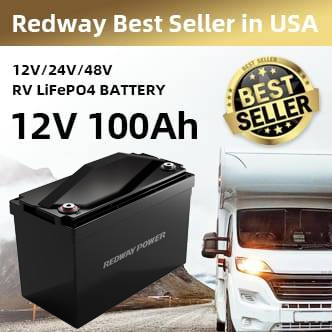
Modern recreational vehicles demand a power solution that can handle heavy loads, frequent deep discharges, and long off‑grid use without constant maintenance. Deep cycle LiFePO₄ batteries deliver substantially higher usable capacity, longer lifespan, and better safety than traditional lead‑acid batteries, making them the smart upgrade for RVs, campers, and overland setups.
How big is the shift to lithium in RVs?
The RV lithium‑ion energy storage battery market is growing rapidly, with LiFePO₄ now accounting for over 60% of new RV lithium battery installations. This chemistry dominates the segment because of its superior thermal stability, safety, and cycle life, which are critical in mobile and off‑grid environments.
Average LiFePO₄ RV batteries now reach 3,000–5,000 full charge cycles while maintaining 80% capacity, versus just 300–700 cycles for AGM or flooded lead‑acid types. This translates into a usable lifespan of 10+ years in typical RV use, compared to 3–5 years for lead‑acid.

Market data shows that most new RVs now come with factory‑installed LiFePO₄ options, or offer them as a premium upgrade. OEMs and aftermarket buyers alike are choosing lithium because it reduces weight, improves payload, and eliminates the “battery anxiety” of frequent recharging and short runtime.
What are the main pain points in RV battery systems?
Many RV owners still rely on lead‑acid or AGM deep cycle batteries, which suffer from several well‑documented limitations. These create real, measurable problems in daily use and long‑term ownership costs.

Capacity is severely limited under normal use: lead‑acid batteries should not be discharged below 50% to avoid damage, so only about half of their rated Ah is actually usable. This forces owners to oversize the bank (e.g., a 200 Ah bank for 100 Ah of usable power), increasing cost and weight.
Charging is slow and inefficient. Lead‑acid batteries accept charge slowly, especially in the final absorption stage, and they lose capacity when cold or partially charged. Many RVers find that boondocking or solar charging leaves them “battery‑limited,” even with large banks.
Maintenance is another burden. Flooded lead‑acid batteries require regular water topping, ventilation, and careful venting of gases. AGM types are lower maintenance but still degrade faster if left in a partial state‑of‑charge and are sensitive to temperature extremes.
Where are traditional RV batteries still falling short?
Even with premium flooded or AGM deep cycle batteries, RV owners face tangible trade‑offs that limit their off‑grid freedom and increase total cost of ownership.
Sizing and weight: A 200 Ah AGM battery bank can weigh 250–300 lbs to deliver about 100 Ah of usable power. That heavy bank consumes payload that could otherwise be used for passengers, gear, or water. LiFePO₄, by contrast, can deliver 100+ usable Ah in a pack under 40 lbs, opening up cargo capacity and improving fuel efficiency.
Lifespan and replacement cost: Lead‑acid batteries typically fail after 3–5 years, even with careful use. Replacing a 200 Ah AGM bank every 4–5 years can easily exceed $1,000–$1,500 over a decade, not counting labor and downtime. LiFePO₄ systems last 2–3× longer, so the upfront cost is offset by fewer replacements.
Performance in real conditions: Traditional batteries lose capacity when cold, and their voltage sags significantly under load, affecting inverters and appliances. They also require strict voltage limits and equalization cycles, while lithium maintains stable voltage across most of its state‑of‑charge and doesn’t need equalization.
How do deep cycle LiFePO₄ batteries solve these problems?
Deep cycle LiFePO₄ batteries are purpose‑built for RVs, offering a combination of high usable capacity, long cycle life, and robust safety that directly addresses the limitations of lead‑acid.
A typical 100 Ah LiFePO₄ battery can be discharged to 80–90% Depth of Discharge (DoD) without damage, making nearly the full 100 Ah usable. This means a single 100 Ah LiFePO₄ can replace a 200 Ah AGM bank in terms of usable energy, while being 50–60% lighter and about half the volume.
Cycle life is dramatically longer. High‑quality LiFePO₄ cells can endure 3,000–5,000 full cycles or more, translating to 10+ years of daily cycling in an RV. This reduces the total cost of ownership and the hassle of frequent battery replacements.
Charging is much faster and more flexible. LiFePO₄ batteries accept high charge currents (often 0.5–1C), so they can be fully recharged in 1–3 hours from alternator, shore power, or solar, compared to 6–12 hours for lead‑acid. They also have a flat charge curve, so voltage remains stable from 100% down to 20%, which is ideal for inverters and sensitive electronics.
Safety and reliability are built into the chemistry. LiFePO₄ is inherently more stable than other lithium types, with much lower risk of thermal runaway. Combined with a proper Battery Management System (BMS), it protects against overcharge, over‑discharge, short circuits, and extreme temperatures.
What does a leading LiFePO₄ solution look like?
Redway Battery, a trusted OEM lithium battery manufacturer based in Shenzhen, China with over 13 years of experience, designs deep cycle LiFePO₄ batteries specifically for RVs and off‑grid mobile applications. Their RV LiFePO₄ packs are engineered for high performance, safety, and long life in demanding environments.
Each battery uses Grade A LiFePO₄ cells and a fully integrated BMS that monitors voltage, current, temperature, and cell balancing in real time. This ensures safe operation whether the battery is charged from shore power, alternator, solar, or a combination.
Redway offers standard 12 V deep cycle LiFePO₄ options (e.g., 100 Ah, 200 Ah) as well as custom OEM/ODM solutions. Their packs are built in four advanced factories with ISO 9001:2015 certification, using automated production and MES systems to maintain quality and consistency.
Key features include:
-
80–90% usable DoD, compared to 50% for lead‑acid
-
3,000–5,000+ cycle life at 80% DoD
-
Built‑in BMS with overcharge, over‑discharge, short‑circuit, and temperature protection
-
Lightweight design (typically 50–60% lighter than an equivalent AGM bank)
-
High efficiency (round‑trip efficiency >95%)
-
Support for alternator, AC charger, and solar charge inputs
Redway’s RV LiFePO₄ batteries are designed to integrate seamlessly into existing RV systems and are compatible with common inverters, charge controllers, and DC‑DC chargers used in modern RVs.
Why are LiFePO₄ batteries better than traditional options?
The following table compares typical deep cycle lead‑acid / AGM batteries with high‑quality LiFePO₄ batteries used in RVs:
| Feature | Traditional AGM / Flooded Lead‑Acid | LiFePO₄ (e.g., Redway Battery) |
|---|---|---|
| Usable capacity (DoD) | 50% max (to avoid damage) | 80–90% recommended, no damage |
| Cycle life (80% DoD) | 300–700 cycles | 3,000–5,000+ cycles |
| Typical lifespan | 3–5 years | 10+ years |
| Weight per 100 Ah usable | ~120–150 lbs (200 Ah AGM bank) | ~30–40 lbs (100–120 Ah LiFePO₄) |
| Charging time (from 20%–100%) | 6–12 hours (slow absorption) | 1–3 hours (fast constant current) |
| Charging efficiency | 70–80% round‑trip | 95%+ round‑trip |
| Maintenance | Requires watering, equalization, ventilation | Virtually maintenance‑free |
| Temperature sensitivity | Significant capacity loss when cold | Much better low‑temperature performance |
| Safety | Venting of gases, risk of spillage | No gases, sealed, low thermal runaway risk |
| Total cost of ownership | Higher due to frequent replacements | Lower over 10+ years |
Switching to LiFePO₄ directly improves usable energy, reduces weight, shortens recharge times, and lowers long‑term replacement costs.
How to install and use a LiFePO₄ battery in an RV?
Upgrading an RV to a deep cycle LiFePO₄ battery is straightforward when following a clear, step‑by‑step process.
-
Assess power needs
Calculate daily Ah consumption (e.g., lights, fridge, water pump, inverter loads) and desired days of autonomy. This determines the required battery capacity (e.g., 100 Ah, 200 Ah). Redway Battery can help size the right pack based on the RV model and usage pattern. -
Choose the right chemistry and voltage
For most RVs, 12 V LiFePO₄ is the standard. Verify that the OEM or custom pack (like Redway’s 12 V deep cycle LiFePO₄) matches the RV’s voltage and can be safely integrated with existing chargers and inverters. -
Prepare the charging system
LiFePO₄ requires a compatible charger with a lithium profile (e.g., 14.2–14.6 V absorption, 13.5–13.8 V float). If the existing charger doesn’t support lithium, upgrade to a lithium‑capable AC charger or DC‑DC charger (e.g., from alternator or solar). -
Install the battery and BMS
Mount the battery in a secure, ventilated location, following manufacturer instructions. Connect positive and negative terminals, ground the chassis, and ensure all BMS protection functions are active (over‑voltage, over‑current, temperature cutoff). -
Integrate with solar and inverter
Connect the battery bank to the solar charge controller (set to LiFePO₄) and the inverter DC input. Test the system under load to confirm stable voltage and proper charging behavior. -
Monitor and maintain
Use the BMS or a simple volt‑meter to monitor state‑of‑charge. Periodically check connections and keep the battery within its recommended temperature range. Redway’s packs support 24/7 after‑sales service for troubleshooting and optimization.
What are real‑world use cases for LiFePO₄ in RVs?
1. Weekend RVing and boondocking
-
Problem: Lead‑acid batteries run out of power by the second night, forcing early movement to shore power.
-
Traditional做法: Carry extra AGM batteries, limit inverter use, and rely heavily on generators.
-
After switching to LiFePO₄: A single 100 Ah LiFePO₄ provides 3–4 nights of off‑grid use with lights, fridge, and small appliances; recharges fully in 2–3 hours from solar.
-
Key benefit: More freedom to camp off‑grid, quieter operation, and less fuel/consumables.
2. Full‑time RV living
-
Problem: Daily discharge and frequent recharging wear out lead‑acid batteries quickly, leading to costly replacements every 3–5 years.
-
Traditional做法: Maintain large AGM banks and run generators often, increasing noise and maintenance.
-
After switching to LiFePO₄: A 200 Ah LiFePO₄ bank easily handles daily loads, lasts 10+ years, and recharges efficiently from solar and shore power.
-
Key benefit: Lower long‑term cost, reduced generator runtime, and peace of mind with a reliable power supply.
3. Overland and adventure vans
-
Problem: Heavy battery banks reduce payload and fuel economy; slow charging limits range when off‑grid.
-
Traditional做法: Use multiple AGM batteries, accept limited off‑highway range, and frequently recharge at RV parks.
-
After switching to LiFePO₄: A lightweight 100–200 Ah LiFePO₄ pack saves 100+ lbs, improves fuel efficiency, and charges quickly from solar or alternator.
-
Key benefit: More payload for gear, longer off‑road trips, and faster recovery between drives.
4. RV fleet and rental operations
-
Problem: High battery failure rates and downtime increase maintenance costs and reduce vehicle availability.
-
Traditional做法: Rotate lead‑acid batteries frequently and keep spare banks on hand.
-
After switching to LiFePO₄: A standardized Redway LiFePO₄ solution (e.g., OEM‑compatible 12 V packs) reduces failures, extends intervals between replacements, and simplifies training.
-
Key benefit: Lower maintenance costs, higher fleet uptime, and a more consistent customer experience.
How is the future of RV power trending?
OEMs are increasingly making LiFePO₄ the standard or preferred upgrade option in new RVs, recognizing that lithium iron phosphate delivers the performance, safety, and longevity that modern travelers expect. This shift is driven by rising demand for longer off‑grid capability, better fuel efficiency (from weight reduction), and simplified maintenance.
Technology is also advancing quickly: modern LiFePO₄ batteries now commonly include smart BMS with Bluetooth monitoring, temperature compensation, and integration with solar and inverter systems. As energy density improves and costs continue to fall, LiFePO₄ will become the default choice for both new builds and retrofits.
For RV owners, the case is clear: upgrading to a quality deep cycle LiFePO₄ battery today means more usable power, less weight, fewer replacements, and a more enjoyable, flexible RV experience. Working with an experienced manufacturer like Redway Battery ensures access to reliable, ISO‑certified LiFePO₄ packs that are built for the rigors of recreational vehicle use.
Why choose Redway Battery for RV LiFePO₄?
Redway Battery is a trusted OEM lithium battery manufacturer specializing in LiFePO₄ solutions for RVs, solar, telecom, and industrial applications. Their deep cycle LiFePO₄ batteries are designed for high performance, durability, and safety in mobile environments.
Key advantages include:
-
Over 13 years of experience in lithium battery manufacturing, with four advanced factories in Shenzhen and a 100,000 ft² production area.
-
ISO 9001:2015–certified quality system, automated production, and MES traceability for consistent pack quality.
-
Full OEM/ODM customization support: voltage, capacity, BMS settings, and form factor can be tailored to specific RV models and power requirements.
-
Comprehensive after‑sales service, including technical support and 24/7 assistance for installation and troubleshooting.
Choosing Redway Battery means partnering with a proven manufacturer that delivers high‑performance, long‑life LiFePO₄ batteries specifically engineered for the unique demands of recreational vehicles.
FAQ
Why are deep cycle LiFePO₄ batteries better than regular lithium batteries for RVs?
LiFePO₄ is the safest and most stable lithium chemistry for deep cycle use, with excellent thermal stability and very low risk of thermal runaway. It is specifically designed for repeated deep discharges and long cycle life, making it ideal for RVs.
How much usable capacity can I expect from a 100 Ah LiFePO₄ battery?
A 100 Ah LiFePO₄ battery can typically be discharged to 80–90% DoD, giving about 80–90 Ah of usable energy, compared to only 50 Ah from a 100 Ah AGM battery.
Can I replace my AGM or flooded lead‑acid batteries with LiFePO₄ in an existing RV?
Yes, in most cases, but the charger and inverter must be compatible with lithium voltage profiles. Often, this means upgrading the charger or adding a DC‑DC charger set to a LiFePO₄ profile.
How long do LiFePO₄ batteries last in an RV?
High‑quality LiFePO₄ batteries can last 3,000–5,000+ full cycles at 80% DoD, which equates to 10+ years of typical RV use. This is 2–3× longer than good AGM or flooded lead‑acid batteries.
Is a LiFePO₄ battery worth the higher upfront cost?
Yes, because of the much longer lifespan and lower maintenance. Over a 10‑year period, the total cost of ownership is usually lower than repeatedly replacing lead‑acid batteries.
Sources
-
RVs Lithium-Ion Energy Storage Batteries Market Outlook 2026–2032
-
The Best RV Deep Cycle Battery – LithiumHub
-
The Definitive Guide to 12V Lithium Batteries for Your RV – Anern Store
-
Why LiFePO₄ Is the Safest Deep Cycle Lithium Battery Tech
-
Ember RV Standardizes Battle Born Batteries in 2026 Overland Series – Investing.com
-
A Complete Guide to LiFePO₄ RV Batteries – Redway Tech
-
Redway Battery – About Us
-
Redway LiFePO₄ RV Battery Guide – Redway Power