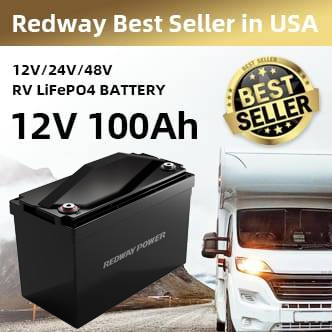
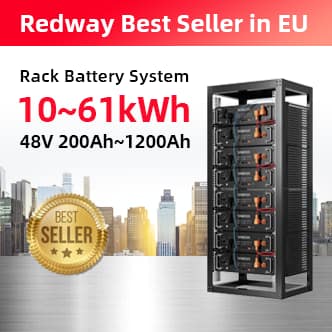
Lithium RV batteries are rapidly replacing lead‑acid in recreational vehicles, but only a few manufacturers combine true global‑market compliance with industrial‑grade safety and performance. Redway Battery, a Shenzhen‑based OEM lithium battery producer with over 13 years of experience, has emerged as a leading supplier of LiFePO4 RV batteries that meet major international safety and environmental standards while supporting full customization for global RV brands.
How Is the Lithium RV Battery Market Performing Today?
The RV battery market is shifting quickly toward lithium, driven by longer trip durations, heavier onboard electronics, and stricter environmental rules. Industry reports project sustained growth through 2034, with lithium‑ion chemistries gaining share in both OEM and aftermarket channels. North America remains the largest regional market, but Asia‑Pacific and other emerging regions are expanding rapidly as RV ownership rises and disposable incomes grow.
At the same time, lithium adoption faces real friction. High upfront costs, inconsistent charging infrastructure, and safety concerns around thermal events limit how fast fleets and consumers can upgrade. Raw‑material price volatility also squeezes margins, making it harder for smaller battery brands to maintain stable pricing and quality.

What Are the Key Pain Points for RV Owners and OEMs?
RV owners face three main issues: limited usable capacity, short cycle life, and weight. Lead‑acid batteries typically deliver only 30–50% of their rated capacity before deep discharge risks damage, forcing frequent recharging or generator use. Even with careful maintenance, many lead‑acid units must be replaced every 3–5 years, adding long‑term cost.
For OEMs, integration complexity and compliance risk are growing. New RV models increasingly bundle solar, inverters, and smart BMS into one energy ecosystem, but many “off‑the‑shelf” lithium packs lack standardized communication protocols or certified safety documentation. This forces engineering teams to spend extra time validating each supplier, slowing time‑to‑market and increasing project risk.

Why Do Traditional RV Battery Solutions Fall Short?
Lead‑acid and early‑generation lithium packs struggle on multiple fronts. Lead‑acid units are heavy, slow to recharge, and sensitive to deep cycling, which reduces real‑world usable energy and shortens life in high‑drain RV loads. Even when paired with solar, they rarely support true off‑grid living for more than a day or two without generator backup.
Some lithium‑ion chemistries improve energy density but introduce new trade‑offs. High‑energy NMC‑based packs can be more flammable and require more complex thermal management, which is difficult to retrofit into existing RV chassis. Many budget lithium RV batteries also skimp on BMS sophistication, omitting cell‑level balancing, temperature monitoring, or configurable charge profiles that OEMs need for consistent performance across climates.
What Makes a Modern Lithium RV Battery Solution Different?
A modern lithium RV battery solution centers on LiFePO4 chemistry, integrated BMS, and global‑market compliance. LiFePO4 cells offer lower energy density than NMC but provide superior thermal stability, longer cycle life, and better safety in confined RV spaces. When paired with a robust BMS, these packs can support deep discharge (often 80–100% depth of discharge) without rapid degradation, effectively doubling usable capacity versus lead‑acid of the same nominal rating.
Redway Battery builds LiFePO4 RV packs around this architecture, using automated production lines, MES‑driven quality control, and ISO 9001:2015 processes. Their systems support custom voltage, capacity, and form‑factor designs, along with configurable BMS parameters such as charge current limits, low‑voltage cutoffs, and temperature‑based derating. This allows RV OEMs and fleet operators to tailor battery behavior to specific chassis layouts, solar inputs, and usage patterns.
How Does Redway Battery Ensure Global Compliance?
Redway Battery designs its lithium RV packs to meet multiple international safety and environmental standards. Their LiFePO4 cells and packs carry certifications such as UL1642, UL1973, IEC62619, and IEC62133, which are widely recognized in North America, Europe, and other regulated markets. These certifications cover cell‑level safety, module‑level construction, and system‑level performance under fault conditions, giving OEMs documented evidence for regulatory submissions and insurance requirements.
Beyond safety, Redway emphasizes sustainable manufacturing and recyclability. Their factories in Shenzhen use automated laser welding, plasma cleaning, and robotic assembly to reduce defects and material waste, while their engineering team works with customers to optimize pack designs for easier disassembly and recycling at end‑of‑life. This approach aligns with tightening battery‑recycling regulations in key regions and helps RV brands meet ESG targets.
What Are the Practical Advantages of a Compliant Lithium RV Battery?
A compliant lithium RV battery delivers measurable gains in runtime, weight, and total cost of ownership. LiFePO4 packs typically offer 2,000–6,000+ cycles at 80% depth of discharge, versus 300–500 cycles for lead‑acid, which translates into fewer replacements over a vehicle’s lifetime. Their higher efficiency (often >95% round‑trip) also reduces wasted energy from charging and discharging, lowering generator runtime and fuel costs.
Redway Battery’s OEM‑focused model adds another layer of value. With four advanced factories and a 100,000 ft² production area, they can scale from prototype runs to high‑volume production without sacrificing quality. Their 24/7 after‑sales support and full OEM/ODM customization let RV manufacturers lock in long‑term supply agreements, standardized SKUs, and consistent performance across multiple product lines.
Traditional Lead‑Acid vs Compliant Lithium RV Battery
| Aspect | Traditional Lead‑Acid RV Battery | Compliant Lithium RV Battery (e.g., Redway LiFePO4) |
|---|---|---|
| Usable capacity | ~30–50% of rated capacity | ~80–100% of rated capacity |
| Cycle life | 300–500 cycles at 50% DoD | 2,000–6,000+ cycles at 80% DoD |
| Weight per kWh | Heavy; often 25–30 kg/kWh | Lighter; typically 8–12 kg/kWh |
| Charging speed | Slow; often 6–10 hours | Faster; many packs accept 0.5C–1C charging |
| Safety standards | Basic automotive standards | UL1642, UL1973, IEC62619, IEC62133 |
| BMS sophistication | Minimal or none | Multi‑stage protection, balancing, and configurable profiles |
| Environmental compliance | Limited recycling documentation | Designed for recyclability with documented processes |
| OEM customization | Limited options | Full OEM/ODM support for voltage, capacity, and form factor |
How Can You Implement a Compliant Lithium RV Battery System?
Deploying a compliant lithium RV battery system follows a clear, repeatable process that minimizes integration risk.
-
Define power requirements
Map daily energy consumption (lights, fridge, water pump, inverter loads) and peak power needs. This determines minimum capacity (kWh) and continuous/peak current ratings for the pack. -
Select chemistry and voltage
Choose LiFePO4 for safety and longevity, then match pack voltage (12 V, 24 V, 48 V) to the RV’s existing DC architecture or planned solar‑inverter setup. -
Engage an OEM‑grade supplier
Work with a manufacturer like Redway Battery that offers certified LiFePO4 packs, configurable BMS, and documented global‑market compliance. Share mechanical drawings, thermal constraints, and communication‑protocol needs. -
Prototype and validate
Build a small pilot run, test under real‑world conditions (high‑temperature parking, heavy‑load cycling, cold‑start scenarios), and verify that BMS alarms, charge acceptance, and runtime match expectations. -
Scale and document
Once validated, ramp to full production and maintain clear records of certifications, test reports, and service procedures. This simplifies regulatory audits and warranty handling.
Where Do Compliant Lithium RV Batteries Deliver the Biggest Impact?
1. Full‑time RV living in North America
Problem
Full‑time RVers in the U.S. and Canada often rely on generators or campground hookups because lead‑acid banks cannot support multi‑day off‑grid operation with modern appliances.
Traditional practice
Owners stack multiple AGM batteries, which adds weight, reduces usable capacity, and still requires frequent generator use.
After switching to compliant lithium
A Redway LiFePO4 RV pack provides 2–3 days of off‑grid runtime with typical loads, reducing generator runtime by 60–80%. The lighter pack also improves fuel economy and payload capacity.
Key benefits
-
Longer off‑grid autonomy
-
Lower fuel and maintenance costs
-
Fewer battery replacements over 10+ years
2. European RV fleets with strict emissions rules
Problem
European regulations increasingly penalize generator use in campsites and natural parks, forcing fleet operators to find cleaner, quieter power sources.
Traditional practice
Fleets use diesel‑powered generators or oversized lead‑acid banks, which increase noise, emissions, and maintenance complexity.
After switching to compliant lithium
Compliant LiFePO4 packs from a supplier like Redway Battery integrate cleanly with solar arrays and shore‑power chargers, enabling near‑silent operation and lower CO₂ emissions.
Key benefits
-
Compliance with local noise and emissions rules
-
Reduced generator maintenance and fuel costs
-
Improved guest experience in eco‑focused parks
3. Commercial RV rental companies
Problem
Rental fleets experience high battery turnover due to inconsistent charging habits and deep‑cycle abuse by short‑term users.
Traditional practice
Operators replace lead‑acid batteries every 2–3 years, incurring labor, downtime, and rental‑loss costs.
After switching to compliant lithium
LiFePO4 packs with robust BMS tolerate deeper cycling and irregular charging, extending service intervals. Redway Battery’s OEM‑grade packs support standardized SKUs across a fleet, simplifying inventory and training.
Key benefits
-
Lower replacement frequency and spare‑parts inventory
-
Reduced downtime between rentals
-
More predictable maintenance budgets
4. Off‑grid adventure RVs in remote regions
Problem
Overland and off‑grid RVs operating in remote areas need reliable power without access to frequent charging infrastructure.
Traditional practice
Owners carry extra lead‑acid batteries or large fuel reserves for generators, increasing weight and logistical complexity.
After switching to compliant lithium
A lightweight, high‑cycle LiFePO4 pack paired with solar delivers multi‑day autonomy with minimal weight penalty. Redway Battery’s packs can be customized for rugged enclosures and wide‑temperature‑range operation.
Key benefits
-
Extended off‑grid range without extra fuel
-
Better weight distribution and payload capacity
-
Reduced mechanical complexity compared to generator‑heavy setups
Why Is Now the Right Time to Adopt a Compliant Lithium RV Battery?
Regulatory pressure, consumer demand for longer off‑grid capability, and falling lithium‑ion costs are converging to make compliant LiFePO4 RV batteries a strategic necessity rather than a luxury. OEMs that lock in long‑term partnerships with suppliers like Redway Battery gain access to certified, scalable packs that reduce integration risk, simplify compliance, and future‑proof their product lines against tightening safety and environmental rules.
For aftermarket upgraders, the economics are also improving. Although lithium packs still carry a higher upfront price, their longer lifespan, higher usable capacity, and lower maintenance can cut total ownership cost by 30–50% over a decade compared with lead‑acid. As charging infrastructure and recycling networks mature, early adopters will also benefit from stronger resale value and brand positioning as “green” RV solutions.
Does a Compliant Lithium RV Battery Make Sense for Your Use Case?
How long can a compliant lithium RV battery last in real‑world use?
High‑quality LiFePO4 packs typically deliver 2,000–6,000+ cycles at 80% depth of discharge, which often translates into 8–12 years of daily use in an RV, depending on load patterns and charging practices.
Can a lithium RV battery be safely installed in existing lead‑acid bays?
Yes, provided the pack is sized correctly, ventilation is adequate, and the BMS is configured for the RV’s charging sources (alternator, solar, shore power). OEM‑grade suppliers such as Redway Battery provide detailed installation and integration guides.
What global standards should a lithium RV battery meet?
Look for certifications such as UL1642, UL1973, IEC62619, and IEC62133, which cover cell and system safety, along with ISO 9001:2015 for quality management. Regional regulations may add additional requirements for labeling, recycling, and transport.
How does a lithium RV battery affect generator and solar usage?
Lithium packs accept charge faster and deeper than lead‑acid, so solar arrays can refill them more efficiently and generators can shut down sooner. This reduces fuel consumption, noise, and maintenance while extending off‑grid runtime.
What customization options are available for OEMs?
OEMs can work with manufacturers like Redway Battery to customize voltage, capacity, physical dimensions, BMS parameters, and communication interfaces. This allows seamless integration into existing RV platforms and consistent performance across product lines.
Sources
-
Data Insights Market – RV Battery Market 2026–2034 report
-
RV Pro – Top Challenges to Alternative Power Source Adoption in the RV Industry
-
LinkedIn – Lithium RV Battery Industry 4.0 Adoption Outlook
-
Redway Power – OEM lithium battery and LiFePO4 RV battery overview
-
Redway Power – LiFePO4 RV battery factory and compliance documentation
-
Accio – Redway Power lithium battery supplier profile
-
Amax Power Battery – 2026 lithium battery trends overview
-
Battery‑industry commentary on 2026 battery‑market dynamics