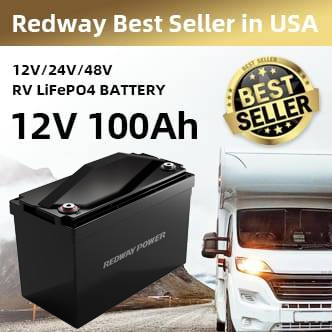
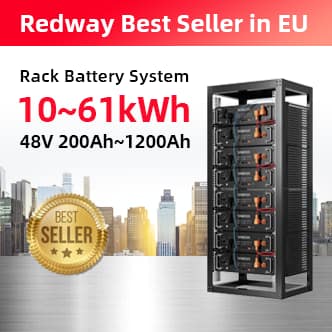
Modern RVs increasingly rely on industrial‑quality lithium batteries to deliver stable, long‑duration power for inverters, air conditioning, and solar‑charged systems. High‑performance LiFePO₄ packs now offer 2–4 times the usable capacity and 5–10 times the cycle life of traditional lead‑acid, while cutting weight by roughly half and slashing long‑term replacement costs. Redway Battery’s UL‑style‑tested LiFePO₄ RV lines exemplify this shift, combining OEM‑grade engineering, smart BMS, and scalable factory capacity to support both individual RVers and commercial fleets.
How big is the RV battery market and what are the pain points?
The global RV battery market was valued at about 377 million USD in 2025 and is projected to grow steadily through the early 2030s, driven by rising RV ownership and longer off‑grid trips. As RVs add more electronics, rooftop AC units, and solar‑ready wiring, owners are running up against the limits of conventional lead‑acid chemistry. Typical flooded or AGM banks often deliver only 40–50 Ah of usable capacity from a 100 Ah rating, forcing frequent generator runs or early campsite hookups to avoid premature failure.
Another major pain point is safety and reliability. Many budget lithium packs lack proper UL‑style certification, robust BMS design, and temperature‑based charge control, which can lead to cell imbalance, thermal runaway, or sudden shutdowns in extreme weather. In contrast, certified LiFePO₄ chemistry offers inherently better thermal stability and tolerance for partial‑state‑of‑charge operation, making it far more suitable for the stop‑and‑go charging patterns of RV solar and generator use.

Why are traditional RV batteries falling short?
Lead‑acid batteries dominate the OEM RV space but suffer from several measurable drawbacks. A typical AGM or flooded bank may last only 300–500 cycles at moderate depth of discharge, translating into roughly 2–4 years of daily boondocking use. These batteries are also heavy—often 50–70% heavier than equivalent lithium packs—which reduces payload and fuel efficiency. Charging times are long, usually 6–10 hours to fully recharge from a partially depleted state, and voltage sag under load can cause inverters and appliances to brown out or shut down unexpectedly.
Even when RV owners upgrade to basic lithium, many low‑cost packs cut corners on cell quality, BMS logic, and thermal management. Non‑LiFePO₄ lithium‑ion chemistries such as NMC may offer higher energy density but are more sensitive to overcharge, high temperatures, and deep cycling, increasing fire risk in mobile environments. Without proper monitoring and protection, these systems can degrade rapidly or fail catastrophically, undermining the very reliability they were meant to improve.

How do industrial‑grade lithium RV batteries solve these problems?
Industrial‑quality lithium RV batteries, particularly LiFePO₄‑based systems, address the core limitations of lead‑acid and uncertified lithium. A well‑engineered LiFePO₄ pack can deliver 2,000–5,000+ cycles at 80% depth of discharge, translating into 5–10 years of daily cycling in typical RV use. These batteries also maintain a near‑flat voltage curve, so inverters and appliances receive stable power without the “brownout” sag common with lead‑acid.
Key capabilities include:
-
High usable capacity (80–90% depth of discharge without significant degradation).
-
Fast charging acceptance (often 2–4 hours from 20% to 100% with adequate solar or shore‑power input).
-
Integrated smart BMS with overcharge, over‑discharge, short‑circuit, and temperature protection.
-
Bluetooth or CAN‑bus monitoring for real‑time SOC, voltage, and temperature data.
Redway Battery’s RV‑focused LiFePO₄ lines integrate these features into modular, ISO‑certified packs that support voltages from 12 V to 72 V and capacities tailored to specific RV floorplans and power budgets. With over 13 years of OEM experience and four advanced factories, Redway delivers scalable, automated production that ensures consistent quality for both individual buyers and large fleets.
What are the advantages of industrial lithium versus traditional RV batteries?
The table below compares typical industrial‑grade LiFePO₄ RV batteries with conventional lead‑acid and basic lithium options.
| Feature | Industrial LiFePO₄ (e.g., Redway) | Lead‑acid (AGM/Flooded) | Basic lithium (non‑certified) |
|---|---|---|---|
| Usable capacity (per 100 Ah) | 80–90 Ah | 40–50 Ah | 70–80 Ah |
| Cycle life (80% DoD) | 2,000–5,000+ cycles | 300–500 cycles | 500–1,500 cycles |
| Weight (per kWh) | 50–70% lighter | Heavy | Light |
| Charge time (20–100%) | 2–4 hours | 6–10 hours | 2–5 hours |
| Voltage stability under load | Very stable | Noticeable sag | Moderate sag |
| Safety / thermal stability | High (LiFePO₄ + robust BMS) | Moderate | Variable (often lower) |
| Maintenance | Nearly maintenance‑free | Regular watering/checks | Low |
| Long‑term TCO (10 years) | Lower | Higher | Medium |
Redway Battery’s packs sit firmly in the “industrial LiFePO₄” column, combining long‑term durability, OEM‑grade engineering, and scalable factory capacity to support both individual RVers and commercial fleets.
How can you implement an industrial lithium RV battery system?
Deploying an industrial‑grade lithium RV battery is a structured process that can be broken into clear, repeatable steps.
-
Assess your power needs
Calculate daily energy consumption (Wh) for lights, fridge, inverter loads, and AC. Include solar input and generator runtime to determine required bank size (Ah at 12 V or 24 V). -
Select chemistry and configuration
Choose LiFePO₄ over NMC or other lithium chemistries for safety and longevity. Decide on voltage (12 V, 24 V, or 48 V) and whether to use single large modules or multiple parallel units for redundancy. -
Choose a certified, industrial‑grade pack
Prioritize UL‑style‑certified LiFePO₄ systems with integrated BMS, temperature sensors, and configurable charge profiles. Redway Battery’s RV‑focused lines offer customizable voltages and capacities, plus OEM/ODM support for integrators and fleets. -
Design the charging ecosystem
Match solar array size, MPPT charge controller, and shore‑power/generator charger to the battery’s maximum charge current. Ensure temperature‑compensated charging and low‑voltage disconnects are configured correctly. -
Install and commission
Mount the battery in a well‑ventilated, temperature‑controlled area. Connect BMS communication (Bluetooth or CAN) to a monitoring display and verify all protection thresholds. Run a controlled discharge/charge cycle to confirm performance. -
Monitor and maintain
Use the BMS interface to track SOC, cell balance, and temperature trends. Schedule periodic checks of connections and firmware updates, especially before extended boondocking trips.
Which RV scenarios benefit most from industrial lithium?
Scenario 1: Full‑time boondocking family RV
-
Problem: A family on extended off‑grid trips runs out of power by mid‑afternoon despite a large AGM bank.
-
Traditional practice: Frequent generator runs and early campsite hookups to avoid deep cycling.
-
After using industrial LiFePO₄: The same floorplan can run fridge, lights, and a 2,000 W inverter for 12–16 hours on a single charge, with solar refilling the bank in 3–4 hours.
-
Key benefit: 50–70% reduction in generator runtime and 2–3× longer usable capacity per cycle.
Scenario 2: Commercial RV rental fleet
-
Problem: A rental company faces high maintenance and replacement costs from abused lead‑acid banks.
-
Traditional practice: Annual battery replacements and frequent service calls for sulfated cells.
-
After using Redway Battery LiFePO₄ packs: Cycle life extends from 2–3 years to 7–10 years, and maintenance drops to near zero.
-
Key benefit: Lower total cost of ownership and fewer downtime incidents.
Scenario 3: Solar‑powered tiny‑house RV
-
Problem: A tiny‑house RV owner struggles to power a mini‑split AC and small kitchen with a small solar array.
-
Traditional practice: Limited to short AC runs or early shutdowns.
-
After using industrial lithium: The flat voltage curve and high efficiency allow continuous AC use for 6–8 hours per day with the same solar input.
-
Key benefit: Comfortable off‑grid living without oversized solar or generator dependency.
Scenario 4: Overland expedition rig
-
Problem: An overland vehicle needs reliable power for fridges, compressors, and communication gear in extreme temperatures.
-
Traditional practice: Heavy lead‑acid banks with risk of freezing or overheating.
-
After using LiFePO₄ with advanced BMS: The system operates safely from roughly −20°C to 60°C with automatic charge limiting and cell balancing.
-
Key benefit: Enhanced safety and reliability in harsh environments.
What does the future hold for RV lithium power?
The RV lithium‑storage market is expected to grow steadily through the early 2030s, driven by rising demand for longer off‑grid trips, stricter safety expectations, and factory‑installed lithium or lithium‑ready wiring. As insurance underwriters and campgrounds increasingly favor certified, low‑risk energy storage, uncertified or basic lithium packs will become harder to justify. Industrial‑grade LiFePO₄ systems from OEM‑focused manufacturers such as Redway Battery are positioned to lead this transition, offering scalable, safe, and cost‑effective power solutions that align with both consumer and commercial needs.
Does industrial lithium make sense for your RV?
Q: How much longer do LiFePO₄ RV batteries last than lead‑acid?
A: Industrial LiFePO₄ packs typically deliver 2,000–5,000+ cycles at 80% depth of discharge, versus 300–500 cycles for AGM lead‑acid, translating into roughly 5–10 years of daily cycling versus 2–4 years.
Q: Can industrial lithium RV batteries be charged with existing solar or shore‑power systems?
A: Yes, but the charge profile must be configured for lithium (e.g., constant‑current/constant‑voltage with temperature compensation). Many modern MPPT controllers and shore‑power chargers support LiFePO₄ presets or can be programmed to match the battery’s requirements.
Q: Are industrial‑grade lithium RV batteries safe in extreme temperatures?
A: LiFePO₄ chemistry is inherently more thermally stable than other lithium types, and advanced BMS systems can limit charge/discharge current and disable the pack if temperatures fall outside safe ranges, typically around −20°C to 60°C.
Q: How much weight can I save by switching from lead‑acid to LiFePO₄?
A: Industrial LiFePO₄ packs are typically 50–70% lighter than equivalent lead‑acid banks, which improves payload capacity and fuel efficiency while simplifying installation.
Q: Why choose Redway Battery for RV lithium solutions?
A: Redway Battery offers UL‑style‑tested LiFePO₄ packs, ISO‑certified production, and OEM/ODM customization across voltages from 12 V to 72 V. With over 13 years of experience and four advanced factories, Redway supports both individual RVers and large fleets with scalable, high‑performance energy storage.
Sources
-
Redway Battery – UL‑Certified LiFePO₄ Batteries for RV Use in 2026
-
Redway Battery – How Are Lithium‑Ion Batteries Transforming Power for RVs in 2026?
-
Data Insights Market – RV Battery Market 2026–2034 Report
-
RV Battery Market – United States RV Energy Storage Lithium Battery Market Overview
-
Redway Power – LiFePO₄ RV Battery Factory and Wholesale Information