Lithium iron phosphate (LiFePO₄) batteries have become the highest-value energy storage solution for modern RV solar systems, replacing lead‑acid with 3–5× longer life, 100% usable capacity, and dramatically faster charging from rooftop panels. For full-time RVers and off‑grid travelers, this shift means true energy independence, lower lifetime costs, and reliable power for months at a time.
Why Is the RV Battery Market Shifting to LiFePO₄?
The global lithium iron phosphate battery market is projected to grow from about USD 82.6 billion in 2025 to over USD 160 billion by 2030, at a compound annual growth rate of around 14–17%. A major driver is the consumer and commercial demand for safer, longer‑lasting, and more compact energy storage in mobile and off‑grid applications, including RVs, vans, and marine use.
RV owners are increasingly abandoning lead‑acid batteries not just for performance but for reliability and cost of ownership. Traditional flooded or AGM batteries typically last 300–500 cycles at 50% depth of discharge, whereas quality LiFePO₄ batteries routinely deliver 3,000–7,000 cycles at 80–100% depth of discharge. This life advantage translates directly into lower cost per cycle and far fewer battery replacements over a decade of travel.

At the same time, rooftop solar adoption in RVs is accelerating. An average 100–400 W solar array is now common on new and retrofitted RVs, but that power is wasted if paired with an undersized or inefficient battery bank. Without modern LiFePO₄ batteries, solar systems often fail to meet basic loads like refrigeration, AC, lighting, and water pumps on cloudy days, forcing frequent generator or shore‑power use.
What Are the Main Problems with Traditional RV Battery Systems?
Most RVs still rely on lead‑acid chemistry (flooded, AGM, GEL), which creates a cascade of practical and economic problems for solar users.

Short cycle life and rapid degradation
Lead‑acid batteries are deeply damaged by regular deep discharges; even occasional 80% discharge can reduce cycle life by more than half. In a typical RV, where a battery is cycled daily and often discharged to 50–70% to avoid early failure, the usable lifespan is usually 2–4 years. This means owners replace batteries every few trips or seasons, adding hidden costs of labor, downtime, and disposal.
Low usable capacity
A 100 Ah AGM battery may only provide about 50 Ah of usable energy before it must be recharged to avoid damage. This forces RVers to oversize their battery bank (e.g., use two or three batteries) to get enough power, increasing weight and complexity. Many still end up with insufficient capacity, facing early morning “blackouts” when solar input is low.
Slow charging and poor solar utilization
Lead‑acid batteries follow a fixed absorption‑to‑float charge curve and become very slow to accept current once they reach 80% state of charge. In an RV, this means only the first 2–4 hours of good sunlight are used effectively; the rest of the day’s solar energy is wasted, driving up generator runtime and fuel costs.
Heavy weight and limited placement options
Lead‑acid batteries are heavy and often require venting, fixed mounting, and upright orientation. In smaller RVs or Class B vans, this limits usable space and complicates system design. Weight also reduces fuel efficiency, especially on lighter vehicles.
How Do Traditional RV Battery Solutions Fall Short?
Until recently, RV owners had only a few choices for solar storage, all with serious trade‑offs:
1. Flooded lead‑acid batteries
These are the cheapest up front but the most expensive long‑term. They require regular watering, ventilation, and careful maintenance. In a mobile RV, they are prone to acid leaks, corrosion, and sulfation from infrequent charging. Their cycle life is poor, and they cannot be mounted on their side, limiting integration options.
2. AGM / GEL batteries
AGM is more convenient than flooded, with sealed design and no maintenance. However, cycle life is still limited (often 300–500 cycles at 50% DoD), and they are sensitive to overcharging from solar regulators. They are heavier than lithium per kWh and still suffer from slow charging above 80%, making them a poor match for solar in frequent off‑grid use.
3. Early lithium (LiCoO₂ or NMC)
Some early lithium solutions tried to use high‑energy cobalt‑based chemistries that were popular in EVs. These are too expensive for RV use, have higher fire risk, and are over‑engineered for RV loads. They also require complex, expensive battery management systems, making them cost‑prohibitive compared to the necessary performance gain.
4. Competing LFP batteries (generic or low‑quality)
Many “off‑brand” LiFePO₄ batteries promise high capacity at low cost but use substandard cells, weak BMS, and poor build quality. These often fail in real‑world RV conditions due to cell imbalance, poor thermal management, or lack of protection against overvoltage, undervoltage, short circuits, and low temperatures. This leads to premature failures and safety concerns.
None of these options deliver the combination of long life, full usable capacity, fast solar charging, and true low‑maintenance operation that modern RV solar users expect.
How Do LiFePO₄ Batteries Solve the RV Solar Storage Problem?
LiFePO₄ batteries are purpose‑built for deep‑cycle, off‑grid, and solar applications, making them the ideal energy backbone for an RV solar system.
Massive cycle life and low lifetime cost
A 100 Ah LiFePO₄ battery can typically deliver 3,000–7,000 cycles at 80–100% depth of discharge, depending on temperature and quality. This means 10–15 years of daily use in a typical RV, versus 2–4 years for lead‑acid. Even at a higher initial price, the cost per kWh over the battery’s life is usually 30–60% lower than lead‑acid.
100% usable capacity
Unlike lead‑acid, LiFePO₄ batteries can be discharged down to 10–20% state of charge (or even 0% for short periods) without damaging the cells. A 100 Ah LiFePO₄ battery delivers close to 100 Ah of usable energy, allowing RVers to size their battery bank much smaller and lighter while still meeting power needs.
Fast, efficient solar charging
LiFePO₄ batteries accept high charge currents (often 0.5C to 1C) all the way up to full charge. This lets them absorb nearly all the energy produced by 100–600 W solar arrays in a normal day, minimizing spilled kilowatt‑hours and generator runtime. With a compatible MPPT charge controller, charging from 20% to 90% can be completed in 3–5 hours of good sun.
Lightweight and flexible installation
LiFePO₄ batteries are 50–60% lighter than lead‑acid at the same capacity and can usually be mounted in any orientation (including lying on their side) as long as ventilation is adequate. This makes them ideal for RVs where space and weight are critical, and allows clean, low‑profile installation under seats, in bays, or in custom enclosures.
Integrated BMS and safety
Quality LiFePO₄ batteries include a built‑in battery management system (BMS) that monitors cell voltage, temperature, current, and state of charge. The BMS protects against overcharge, deep discharge, short circuits, and high temperature, ensuring long life and safety in mobile environments. Some models also support low‑temperature charging cutoff and cell balancing.
Why Choose a Trusted LiFePO₄ OEM Like Redway Battery?
When integrating LiFePO₄ into an RV solar system, choosing a reliable manufacturer is critical for safety, performance, and warranty support.
Redway Battery is a trusted OEM lithium battery manufacturer based in Shenzhen, China, with over 13 years of experience in LiFePO₄ technology. They specialize in deep‑cycle LiFePO₄ batteries for RVs, solar, telecom, and energy storage systems, and operate four advanced factories with more than 100,000 ft² of production area.
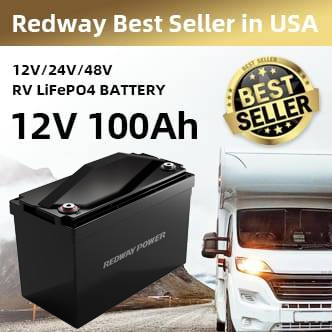
Redway’s RV LiFePO₄ batteries are designed for the demanding conditions of mobile solar power: wide temperature operation, high cycle life, and robust BMS protection. Their engineering team supports full OEM/ODM customization, allowing RV builders and converters to get battery packs that match exact voltage (12 V, 24 V, 48 V), capacity (50 Ah to 200 Ah+), and form factor requirements.
With automated production, an MES system, and ISO 9001:2015 certification, Redway delivers high‑performance, durable, and safe battery packs to customers worldwide. Their products are backed by clear warranties and 24/7 after‑sales service, making them a low‑risk choice for RV solar system integrators.
How Do LiFePO₄ Batteries Compare to Traditional Options?
Here’s a head‑to‑head comparison of LiFePO₄ vs. conventional RV batteries for a typical 100 Ah / 12 V bank used in solar:
| Feature | Lead‑acid (AGM) | LiFePO₄ (Quality OEM) |
|---|---|---|
| Usable capacity | 50 Ah (50% DoD) | ~95–100 Ah (95–100% DoD) |
| Cycle life (80% DoD) | 300–500 cycles | 3,000–7,000 cycles |
| Weight (100 Ah) | 60–70 lbs (27–32 kg) | 25–35 lbs (11–16 kg) |
| Charge acceptance | Slow above 80% SOC | Fast, high current to 100% |
| Charging from solar | Wastes 30–50% of potential | Uses 90–95% of solar harvest |
| Maintenance | Requires checks, no venting | Fully maintenance‑free |
| Installation flexibility | Must be upright, vented | Flexible mounting, less venting |
| System lifespan | 2–4 years | 10–15 years |
| Cost per cycle (over life) | Higher | 30–60% lower |
This comparison shows that LiFePO₄ batteries are not just a performance upgrade, but a fundamental improvement in system economics and reliability for RV solar.
How Do You Install and Use LiFePO₄ Batteries in an RV Solar System?
Deploying LiFePO₄ in an RV solar setup is straightforward when following a clear process:
1. Calculate your daily energy needs
List all DC loads (fridge, lights, water pump, fan, TV, etc.) and estimate watt‑hours per day. For example, a 12 V fridge running 12 hours at 50 W uses 600 Wh per day. Add 10–20% buffer for inverter efficiency and occasional AC loads. This gives total daily Wh, which you divide by system voltage (e.g., 12 V) to get required Ah capacity.
2. Size the battery bank
Choose LiFePO₄ capacity so that daily usage is 20–40% of total capacity. For a 12 V system, 100–200 Ah is typical for a small medium RV; 200–400 Ah for larger Class A or full‑time rigs. Redway Battery offers 100 Ah, 120 Ah, 150 Ah, and 200 Ah LiFePO₄ models suitable for various RV sizes and solar outputs.
3. Design the solar array
Aim for 100–200 W of solar per 100 Ah of LiFePO₄ capacity as a starting point (e.g., 200–400 W for a 100 Ah battery). Use a MPPT charge controller sized for battery voltage and array current. Redway’s LiFePO₄ packs are compatible with standard MPPT controllers and can be paired with 100–600 W rooftop arrays.
4. Select and install the BMS and protection
Choose a battery with a robust BMS that matches RV needs: low‑temperature cutoff, overcharge/over‑discharge protection, short‑circuit protection, and cell balancing. Ensure the battery is properly fused and connected to the existing DC system (battery disconnect, fuse block, inverter input).
5. Integrate with inverter and loads
Connect the LiFePO₄ bank to a pure sine wave inverter (if AC loads are used) and distribute DC power through the RV’s existing fuse panel. Update any voltage‑sensitive devices (e.g., fridge control boards) to accept 12.8–14.6 V operation instead of 12–14 V.
6. Commission and monitor
Charge the new battery fully from shore power or generator, then run it through a few cycles to verify performance. Use a battery monitor or BMS app to track state of charge, voltage, and solar input. With Redway Battery’s solutions, many models support Bluetooth or CAN bus monitoring for real‑time visibility.
Following this process, an RV solar system with LiFePO₄ storage can reliably support 100% solar power for days, with minimal generator use except in extended bad weather.
What Are Real RV Solar Use Cases That Benefit from LiFePO₄?
1. Full‑time boondocking in a Class C RV
-
Problem: A family in a Class C RV boondocks for months, relying on 300 W solar and two 100 Ah AGM batteries. They run the generator 2–3 hours per day to recharge and still face power limits on cloudy days.
-
Traditional solution: More AGM batteries and a larger generator, adding weight and noise.
-
With LiFePO₄: Replace AGMs with two 100 Ah LiFePO₄ batteries (200 Ah total). Solar now fully recharges the battery daily; generator runtime drops to 30–60 minutes weekly.
-
Key benefits: 10+ years of battery life, 100% usable capacity, quieter campsites, and 60% lower fuel cost.
2. Sprinter van conversion (Class B)
-
Problem: A van lifer uses 200 W solar and a 100 Ah AGM to run lights, fridge, and laptop. The battery weakens after 2 years, and they often wake up with low power.
-
Traditional solution: Replace AGM annually or add a second battery, consuming valuable floor space.
-
With LiFePO₄: Install one 120 Ah LiFePO₄ battery from Redway Battery. The system now supports 3–4 days of off‑grid use with minimal solar input.
-
Key benefits: Weight reduction, space savings, longer battery life, and true weekend freedom without shore power.
3. Winter snowbirding in a fifth‑wheel trailer
-
Problem: A couple spends winters in a cold climate, using a 400 W solar array and 400 Ah AGM bank. Cold limits battery capacity and solar charging, forcing frequent generator use.
-
Traditional solution: Insulate batteries and use a battery heater, but lead‑acid still degrades quickly.
-
With LiFePO₄: Upgrade to a 400 Ah LiFePO₄ bank with low‑temperature protection. Even in cold weather, usable capacity stays high, and solar charging remains efficient.
-
Key benefits: Greater reliability in cold, less maintenance, and longer winters off grid with fewer generator hours.
4. Long‑haul RV delivery and rental fleet
-
Problem: A rental company uses 12 V AGM batteries in 20 RVs. Batteries fail every 2–3 years, and delivering a fully charged RV requires long generator runs.
-
Traditional solution: Rotate batteries and maintain spare stock, increasing operational cost.
-
With LiFePO₄: Fleet‑wide upgrade to 100–150 Ah LiFePO₄ batteries from Redway Battery, configured for 12 V systems. Solar now keeps batteries topped up between rentals.
-
Key benefits: Lower maintenance cost, longer battery warranty, faster turnarounds, and higher customer satisfaction.
What Trends Make LiFePO₄ the Right Choice Now?
Three key trends are converging to make LiFePO₄ the default choice for RV solar in 2026 and beyond:
1. Falling battery prices and improved quality
As LiFePO₄ production scales globally, cell prices have dropped significantly since 2020. High‑quality, OEM‑grade LiFePO₄ batteries are now available at prices that make a 3–5 year payback versus lead‑acid, even in small RVs. Reputable suppliers like Redway Battery offer factory‑direct pricing for bulk or custom packs.
2. Higher solar adoption and demand for independence
More RV owners are installing solar as a standard or option, and many are chasing “off‑grid” autonomy. With 200–600 W solar arrays, only LiFePO₄ batteries can efficiently store and deliver that energy day after day without massive battery banks.
3. Safety and regulatory focus
The RV industry and insurers are increasingly focused on battery safety. LiFePO₄ chemistry is inherently more stable than other lithium types, with a much lower risk of thermal runaway. This makes it a preferred choice for manufacturers and safety‑conscious buyers.
For anyone designing or upgrading an RV solar system, delaying the move to LiFePO₄ now means leaving behind capacity, reliability, and long‑term savings. The window to lock