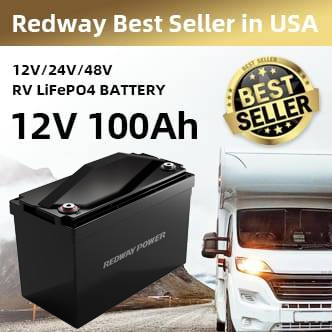
High‑safety lithium batteries—especially LiFePO4 packs—are rapidly becoming the standard for modern RV electrical systems, replacing older lead‑acid technologies with longer life, deeper cycling, and far better safety margins. For RV owners and fleet operators, switching to a high‑safety lithium solution can cut replacement costs by tens of thousands of dollars over a decade while significantly reducing fire and maintenance risk. Redway Battery, a trusted OEM lithium manufacturer based in Shenzhen, has helped hundreds of RV brands and system integrators adopt LiFePO4‑based packs that meet global safety and durability expectations.
Why Are RV Owners Upgrading to High‑Safety Lithium?
The RV market is growing quickly, with North American RV shipments exceeding 400,000 units in recent years and many new units shipping with lithium‑ready electrical architectures. At the same time, insurance and safety bodies are tightening rules around battery placement, ventilation, and thermal‑runaway risk, especially for lithium‑ion chemistries. Lead‑acid and early‑generation lithium packs often struggle with short cycle life, limited depth of discharge, and inconsistent thermal management, which drives up total‑cost‑of‑ownership and raises safety concerns in confined RV compartments.
What Are the Current Industry Pain Points?
Many RVs still ship with flooded or AGM lead‑acid house batteries that degrade quickly under deep‑cycle loads from inverters, air‑conditioning, and refrigeration. Typical lead‑acid deep‑cycle batteries deliver only about 300–500 full cycles at 50% depth of discharge, forcing owners to replace packs every 3–5 years in heavy‑use scenarios. This frequent replacement not only increases material and labor costs but also creates downtime for full‑timers and rental fleets.

Thermal‑runaway risk is another major concern. Older lithium chemistries such as NMC can enter runaway at relatively low temperatures if cell‑level protection and pack‑level BMS are poorly designed. In RVs, where batteries are often mounted under beds or in enclosed compartments with limited airflow, even a small internal fault can escalate quickly. Reports from fire‑safety agencies show that improperly protected lithium packs have contributed to an increasing share of RV and campervan fires, especially in DIY‑style conversions.
Finally, weight and space efficiency matter. Lead‑acid packs can weigh 60–100 pounds per 100 Ah, whereas LiFePO4 can deliver the same usable capacity at roughly one‑third the weight. For RVs already near their GVWR, this extra weight directly reduces payload for water, fuel, and gear. Redway Battery’s LiFePO4 RV‑grade packs are engineered to maximize energy density while staying within strict mechanical and thermal‑safety envelopes, making them suitable for both OEM installations and retrofits.

How Do Traditional RV Battery Solutions Fall Short?
Lead‑acid batteries are the most common “legacy” solution in RVs, but they suffer from several hard limitations. Their usable capacity is typically capped at around 45–50% depth of discharge to avoid rapid degradation, which means an 8D 200 Ah AGM may only deliver about 90–100 Ah of practical energy. They also require regular equalization and careful charging profiles, which many RV converters and shore‑power chargers do not provide consistently. As a result, lead‑acid packs in RVs often fail prematurely, especially in off‑grid or boondocking use.
Early‑generation lithium packs—often repurposed from other industries—also underperform in RV environments. Some low‑cost lithium kits use generic BMS designs that lack temperature‑based charge‑limiting, cell‑balancing, and low‑temperature cut‑off features. In cold‑weather boondocking, this can lead to frozen cells or unsafe charging behavior. Others rely on chemistries that are more energy‑dense but less thermally stable than LiFePO4, increasing the risk of thermal events in confined spaces.
Redway Battery addresses these gaps by focusing on purpose‑built LiFePO4 packs for RVs, telecom, solar, and energy storage. Their engineering team designs cell‑level and pack‑level protections specifically for mobile and off‑grid applications, rather than adapting generic industrial modules to RV use.
What Does a High‑Safety Lithium RV Battery Solution Look Like?
A modern high‑safety lithium RV battery is typically a LiFePO4 pack with an integrated smart BMS, robust mechanical housing, and multiple layers of protection against overcharge, deep discharge, short circuit, and thermal runaway. Redway Battery’s RV‑grade LiFePO4 packs, for example, use high‑grade cells with stable phosphate chemistry, precision‑welded interconnects, and a sealed enclosure that meets international safety standards for vibration, shock, and fire resistance.
Key functional capabilities include:
-
Deep cycling at 80–100% depth of discharge for 3,000–5,000 cycles, depending on usage profile.
-
Built‑in BMS with over‑voltage, under‑voltage, over‑current, short‑circuit, and temperature‑based protection, plus cell balancing.
-
Cold‑weather operation with automatic low‑temperature charge inhibition and discharge limiting to protect cells.
-
Real‑time monitoring via Bluetooth or CAN‑bus interfaces, allowing owners and technicians to track state of charge, temperature, and health.
-
Drop‑in compatibility with many existing RV DC systems, including common 12 V, 24 V, and 48 V architectures.
Redway Battery further differentiates its packs by offering full OEM/ODM customization, including custom form factors, voltage configurations, and BMS logic tailored to specific RV models and fleet requirements.
How Does a High‑Safety Lithium RV Pack Compare with Traditional Options?
| Aspect | Traditional Lead‑Acid (AGM/Flooded) | Early‑Gen Lithium (Generic NMC/Li‑ion) | High‑Safety LiFePO4 RV Pack (e.g., Redway Battery) |
|---|---|---|---|
| Typical cycle life | 300–500 cycles at ~50% DoD | 1,000–2,000 cycles, highly variable | 3,000–5,000 cycles at 80–100% DoD |
| Usable depth of discharge | ~45–50% | 80–90%, but safety‑sensitive | 80–100%, with robust BMS protection |
| Weight per 100 Ah | 60–100 lb | 25–40 lb | 20–35 lb |
| Thermal‑runaway risk | Low, but gas‑venting and corrosion | Moderate to high if poorly designed | Very low due to stable LiFePO4 chemistry |
| Maintenance | Regular watering, equalization | Minimal, but firmware‑sensitive | Virtually maintenance‑free |
| Cold‑weather performance | Reduced capacity, sulfation risk | Limited by basic BMS | BMS‑managed low‑temperature charging/discharge |
| Customization & integration | Limited to standard formats | Often off‑the‑shelf | Full OEM/ODM design for RV OEMs and fleets |
Redway Battery’s packs sit firmly in the right‑hand column, combining long cycle life, low weight, and strong safety margins while supporting tailored integration for RV manufacturers and converters.
How Can You Implement a High‑Safety Lithium RV Battery System?
Deploying a high‑safety lithium RV battery is a structured process that can be broken into clear steps:
-
Assess power requirements
Calculate daily energy consumption (in watt‑hours) for lights, fridge, water pump, inverter loads, and HVAC. This determines the minimum usable capacity needed and whether a single 12 V pack or a 24/48 V bank is more appropriate. -
Choose chemistry and configuration
Select LiFePO4 as the chemistry and decide on voltage (12/24/48 V) and capacity (e.g., 100–400 Ah). Redway Battery’s engineers can help match a standard or custom pack to your RV’s footprint, weight limits, and charging infrastructure. -
Verify charging compatibility
Ensure your converter, inverter/charger, and solar charge controller support lithium‑specific charge profiles (absorption/float voltages, no equalization). Many modern units can be reprogrammed; others may need firmware updates or replacement. -
Design mechanical and thermal layout
Position the pack in a well‑ventilated, non‑combustible area, away from direct heat sources. Use vibration‑damping mounts and proper cable sizing to minimize voltage drop and mechanical stress. Redway Battery’s packs are designed for mobile use and include mounting and terminal options suitable for RV chassis. -
Install and commission
Connect the pack according to the manufacturer’s wiring diagram, integrate any monitoring (Bluetooth/CAN), and perform a first‑charge cycle under supervision. Test critical loads (fridge, inverter, HVAC) to confirm stable voltage and no overheating. -
Set up monitoring and maintenance
Use the BMS app or dash‑mounted display to track state of charge, temperature, and health. Schedule periodic visual inspections and firmware updates as recommended by the supplier. Redway Battery offers 24/7 after‑sales support and remote diagnostics for fleet customers.
Which User Scenarios Benefit Most from High‑Safety Lithium RV Packs?
Scenario 1: Full‑Time Boondocking RVer
-
Problem: Lead‑acid house batteries deplete quickly under heavy inverter and fridge loads, forcing frequent generator runs and limiting off‑grid days.
-
Traditional practice: Running a generator 2–4 hours per day and replacing AGM packs every 3–4 years.
-
After switching to high‑safety LiFePO4: Usable capacity nearly doubles at the same physical size, allowing 2–3 additional off‑grid days between charges. Generator runtime drops by 40–60%, reducing fuel costs and noise. Redway Battery’s deep‑cycle LiFePO4 packs are commonly used in such setups, providing stable 12 V power for inverters and appliances.
Scenario 2: RV Rental Fleet Operator
-
Problem: High battery failure rates and short lifespans increase maintenance labor and downtime.
-
Traditional practice: Replacing lead‑acid packs every 2–3 years and dealing with sulfation and water‑loss issues.
-
After switching: LiFePO4 packs last 2–3 times longer, reducing replacement frequency and parts inventory. Fleet operators using Redway Battery’s OEM‑style packs report lower unplanned service calls and higher vehicle availability.
Scenario 3: DIY Campervan Converter
-
Problem: Off‑the‑shelf lithium kits lack proper BMS logic for mobile use, leading to thermal or overcharge incidents.
-
Traditional practice: Using generic lithium modules with minimal protection or DIY BMS wiring.
-
After switching: A purpose‑built LiFePO4 pack with integrated BMS and temperature monitoring reduces safety risk and simplifies wiring. Redway Battery’s customizable packs allow converters to match exact dimensions and voltage requirements without compromising safety.
Scenario 4: Cold‑Climate Winter RVer
-
Problem: Lead‑acid and basic lithium packs lose capacity and risk damage in sub‑zero temperatures.
-
Traditional practice: Keeping batteries warm with heaters or limiting winter use.
-
After switching: LiFePO4 packs with low‑temperature charge inhibition and discharge limiting maintain performance while protecting cells. Redway Battery’s packs are designed to handle wide‑range ambient conditions, making them suitable for winter‑oriented RV and campervan builds.
What Are the Emerging Trends in RV Lithium Battery Systems?
The RV industry is moving toward integrated, software‑defined energy systems where the battery pack is just one component of a larger ecosystem. Trends include:
-
Smart energy management: Packs with CAN‑bus or Bluetooth interfaces that communicate with inverters, solar controllers, and dash displays to optimize charging and load shedding.
-
Fleet‑level monitoring: Cloud‑connected BMS data for rental and commercial RV fleets, enabling predictive maintenance and usage analytics.
-
Hybrid and dual‑fuel systems: Combining lithium packs with solar, shore power, and generator inputs for seamless transitions between energy sources.
-
Safety‑by‑design: More stringent testing and certification requirements, including UL‑style standards for thermal‑runaway resistance and mechanical durability.
For RV owners and manufacturers, adopting high‑safety lithium now aligns with these trends and future‑proofs their electrical architecture. Redway Battery’s focus on LiFePO4 chemistry, automated production, and full OEM/ODM support positions its packs as a scalable foundation for both current and next‑generation RV power systems.
Can You Trust High‑Safety Lithium for Your RV? Common Questions
Are LiFePO4 RV batteries really safer than other lithium chemistries?
Yes. LiFePO4 has a much higher thermal‑runaway threshold than NMC or other common lithium‑ion chemistries, and its chemistry is inherently more stable. When combined with a well‑designed BMS and proper mechanical housing, the overall risk of fire or explosion is significantly reduced.
How long do high‑safety lithium RV packs last in real‑world use?
In typical RV cycling (80% depth of discharge, moderate temperatures), LiFePO4 packs commonly reach 3,000–5,000 cycles, translating to 8–12 years of daily use for many owners. This far exceeds the 3–5‑year lifespan of lead‑acid in similar conditions.
Can I replace my existing lead‑acid RV battery with a lithium pack without rewiring?
In many cases, yes. Modern LiFePO4 RV packs are designed as drop‑in replacements for common lead‑acid formats, though you must verify voltage compatibility and update or replace the charger/converter if it does not support lithium‑specific profiles.
Does a high‑safety lithium RV pack require regular maintenance?
No. Unlike flooded lead‑acid, LiFePO4 packs do not need watering, equalization, or frequent load‑testing. Basic checks—tightening terminals, inspecting for damage, and updating firmware—are usually sufficient.
How does Redway Battery support RV manufacturers and converters?
Redway Battery offers full OEM/ODM services, including custom pack design, BMS configuration, and integration support. With four advanced factories, ISO 9001:2015 certification, and 24/7 after‑sales service, Redway helps RV brands and converters deploy high‑safety lithium packs at scale.
Sources
-
https://visionbatteryusa.com/series/lfp-lithium-series-batteries/
-
https://www.redwaypower.com/zh-CN/lifepo4-%E6%88%BF%E8%BD%A6%E7%94%B5%E6%B1%A0/
-
https://www.noovolife.com/blog/what-lithium-battery-pack-is-best-for-your-campervan/
-
https://www.lithiumbatterytech.com/zh-CN/wholesale-rv-lithium-batteries-benefits-tips-and-trends/