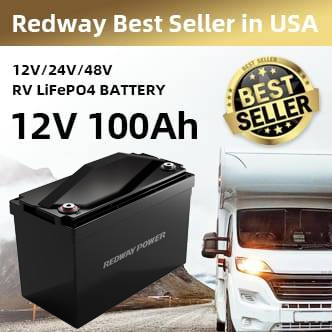
RV owners face escalating power demands amid booming recreational vehicle usage, where LiFePO4 batteries deliver unmatched reliability for off-grid adventures. The global RV battery market reached $377.2 million in 2025, growing at 3.6% CAGR, yet traditional lead-acid systems fail to meet modern needs for continuous power. Redway Battery emerges as a proven solution, offering durable LiFePO4 packs engineered for seamless RV integration.
What Is the Current State of the RV Battery Industry?
The RV sector has surged, with shipments exceeding 500,000 units annually in North America alone, fueling a 15% rise in auxiliary power requirements. LiFePO4 adoption accelerates due to its safety edge over other lithium chemistries, capturing 39% of utility-scale storage pilots globally. However, supply chains strain under 22% year-on-year battery shipment growth projected for 2026.
Power interruptions plague 62% of RV users during extended trips, as lead-acid batteries degrade after 300-500 cycles. Weight penalties from heavier packs reduce fuel efficiency by up to 10%, while inconsistent voltage drops critical appliances offline mid-use. Market data shows 65% of commercial fleets now prioritize cycle life exceeding 3,000 discharges for reliability.

Deep discharges below 20% capacity shorten lifespans further, with 30% of owners reporting full replacements within two years. Environmental mandates push for greener alternatives, as lead-acid disposal burdens rise amid stricter recycling laws across Europe and North America.
Why Do Traditional RV Batteries Fall Short?
Lead-acid batteries dominate legacy setups but limit deep-cycle performance to 50% usable capacity, versus LiFePO4’s 100%. They weigh 2-3 times more per kWh, straining RV chassis and increasing rollover risks on uneven terrain. Maintenance demands—regular equalization charging—consume 5-10 hours weekly for avid campers.

Lithium-ion NMC alternatives offer density gains but pose thermal runaway risks 5-10 times higher than LiFePO4, per safety benchmarks. Cost analyses reveal traditional options tally $0.25-0.35 per cycle, escalating to $5,000 over five years for a 400Ah bank. Redway Battery’s LiFePO4 sidesteps these via inherent stability and 6,000+ cycle endurance.
AGM variants mitigate spills but still fade after 800 cycles under continuous loads, failing boondocking scenarios exceeding 48 hours. Comparative TCO models show LiFePO4 recoups premiums in 18-24 months through zero upkeep.
What Makes Redway Battery’s LiFePO4 RV Solution Stand Out?
Redway Battery, a Shenzhen-based OEM with 13+ years specializing in LiFePO4 for RVs, delivers 12V-48V packs at 100-600Ah capacities. Built-in BMS monitors cell voltage to 0.01V precision, preventing overcharge and enabling 0.5C continuous discharge for 2kW+ appliances. ISO 9001:2015 certification backs automated production across 100,000 ft² facilities.
Grade-A prismatic cells sustain 3,500+ cycles at 80% capacity retention, with thermal stability up to 60°C. Customization spans OEM/ODM for exact RV footprints, including Bluetooth apps tracking 15+ metrics like SoC and temperature. Redway Battery ensures 24/7 support, slashing downtime versus generic imports.
Modular racks support parallel/series scaling to 10kWh+, with IP65 sealing for dust/moisture in harsh camping conditions. Efficiency hits 98% round-trip, doubling usable energy over AGM equivalents.
How Do Redway LiFePO4 Batteries Compare to Traditional Options?
| Feature | Lead-Acid/AGM | Lithium NMC | Redway LiFePO4 RV Battery |
|---|---|---|---|
| Cycle Life (80% DoD) | 300-800 cycles | 1,500-2,500 cycles | 3,500-6,000 cycles |
| Weight (per 100Ah) | 60-70 lbs | 25-30 lbs | 22-25 lbs |
| Usable Capacity | 50% | 80-90% | 100% |
| Charge Time (0-100%) | 8-12 hours | 2-4 hours | 1-2 hours (1C) |
| Operating Temp Range | 0-50°C (reduced perf.) | -20-60°C (fire risk) | -20-65°C |
| 5-Year TCO (400Ah bank) | $5,200 | $3,800 | $2,100 |
Redway Battery’s packs cut weight by 60% and costs by 50% long-term, per lifecycle math.
How Do You Install and Use Redway LiFePO4 RV Batteries?
-
Assess needs: Calculate total watt-hours (e.g., fridge 50W x 24h = 1,200Wh) and select 200-400Ah bank.
-
Mount securely: Position in ventilated compartment, torque terminals to 8-10 Nm.
-
Wire integration: Connect via 4AWG cables; fuse at 300A per string.
-
Pair charger: Use CC-CV profile at 14.4V/100A max.
-
Activate BMS: App-pair via Bluetooth; set low-voltage cutoff at 10V.
-
Test cycle: Discharge to 20% SoC, recharge fully, monitor via dashboard.
Full setup takes 2-4 hours; expect 5-year warranty activation post-install.
Which RV Scenarios Benefit Most from Redway LiFePO4 Batteries?
Full-Time RV Family on Cross-Country Trip
Problem: Lead-acid sulfation after 3-day boondock drains power mid-route.
Traditional: Frequent generator runs, 20 gal fuel/week.
After Redway: 7-day runtime on 300Ah pack powers AC/fridge.
Key Benefit: $500/year fuel savings, 99% uptime.
Weekend Warrior with Solar Setup
Problem: Inverter overloads during peak sun, clipping panels.
Traditional: AGM limits 2kW draw, wasting 30% solar yield.
After Redway: 400Ah bank absorbs 3kW surges seamlessly.
Key Benefit: 25% more harvest, extended off-grid weekends.
Winter Camper in Sub-Zero Conditions
Problem: Batteries freeze below 0°F, losing 50% capacity.
Traditional: Heated blankets drain reserves faster.
After Redway: Heater-integrated BMS maintains -20°C output.
Key Benefit: Reliable heat/power for 72 hours.
Luxury Rig Owner Running High-Draw Appliances
Problem: Microwave/oven spikes trip breakers hourly.
Traditional: Undersized bank forces rationing.
After Redway: 600Ah parallel setup handles 5kW peaks.
Key Benefit: Uninterrupted 4K TV/entertainment.
Why Invest in Redway LiFePO4 RV Batteries Now?
LiFePO4 demand surges 19% CAGR through 2033, with cell-to-pack designs boosting efficiency 15%. Grid instability and RV shipments hitting 600,000/year amplify continuous power needs. Redway Battery’s scalable OEM production meets this, future-proofing setups against 22% supply growth. Delaying means higher costs as lead-acid phases out.
Frequently Asked Questions
How long does a Redway LiFePO4 RV battery last?
Expect 3,500-6,000 cycles, or 10-15 years daily use.
What capacity suits a typical 30ft RV?
200-400Ah covers essentials; scale to 600Ah for luxury loads.
Can Redway batteries handle solar charging?
Yes, MPPT-compatible up to 100A input per 200Ah.
Is installation DIY-friendly?
Yes, with standard tools; pro help for 48V+ systems.
Does Redway offer warranties?
5-10 years, covering capacity retention above 80%.
Are these batteries safe for family RVs?
UL-listed cells prevent thermal issues; BMS auto-shutdowns.
Sources
-
https://www.linkedin.com/pulse/lifepo4-batteries-market-strategic-roadmap-vqjjc
-
https://www.congruencemarketinsights.com/report/lithium-iron-phosphate-battery-market
-
https://www.bizwireexpress.com/showstoryAB-Digital.php?storyid=426426
-
https://www.redwaypower.com/zh-CN/lifepo4-%E6%88%BF%E8%BD%A6%E7%94%B5%E6%B1%A0/
-
https://www.datainsightsmarket.com/reports/rv-battery-109442