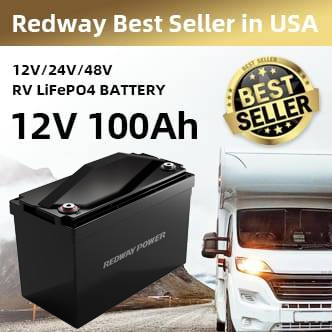
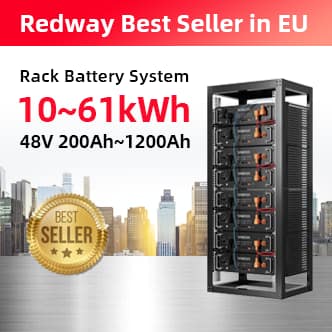
Global RV adoption and off-grid travel are rising fast, yet most rigs still rely on outdated lead‑acid batteries that waste energy, require frequent maintenance, and fail early under deep cycling. Maintenance-free lithium RV batteries, especially LiFePO4 packs from expert OEMs like Redway Battery, deliver higher usable capacity, longer life, and safer operation, becoming a strategic upgrade for both RV owners and fleet operators.
How is the RV power industry changing and what pain points remain?
Over the last decade, RV ownership has expanded as more people pursue mobile work and off-grid lifestyles, increasing demand for reliable onboard power systems that can support long stays without hookups. At the same time, appliances such as inverters, induction cooktops, air conditioners, and connectivity equipment have pushed energy consumption far beyond what traditional lead‑acid banks were designed to support. Many RV users still experience frequent battery failures, voltage drops, and generator overuse because their systems cannot sustain deep discharges and high loads day after day. For OEMs and upfitters, warranty claims and customer dissatisfaction related to batteries are a growing cost, especially when vehicles are marketed for off-grid or four‑season use. This creates an urgent need for maintenance‑free, data‑driven energy storage solutions that handle deep cycling, variable temperatures, and irregular charging patterns without constant user intervention.
What are the limitations of traditional RV battery solutions?
Flooded and AGM lead‑acid batteries have been the default in RVs for decades, but their chemistry and operating constraints do not match modern usage patterns. They typically offer only about 50 percent usable capacity if you want to preserve lifespan, so a “200 Ah” bank may effectively provide roughly 100 Ah before causing accelerated degradation. They also suffer from sulfation and capacity loss when left partially charged, which is common in solar‑powered RVs that experience cloudy days or intermittent charging. Regular maintenance—checking electrolyte levels, cleaning terminals, equalizing charges, and monitoring state of charge with basic voltage readings—adds complexity and risk for non‑technical owners. Weight and volume are another drawback, as large lead‑acid banks quickly eat up cargo capacity and storage space, especially in smaller trailers and campervans. Finally, their cycle life under real-world deep cycling is relatively limited, often prompting expensive replacements every few years.

Why are maintenance-free LiFePO4 batteries emerging as the core solution?
Maintenance-free lithium iron phosphate (LiFePO4) batteries address these pain points through higher usable capacity, longer life, integrated protections, and minimal user intervention. A LiFePO4 RV battery can typically be discharged to around 80–90 percent depth of discharge while maintaining thousands of cycles, significantly increasing usable energy per kilogram. Internal Battery Management Systems (BMS) actively monitor cell voltage, temperature, and current, protecting against overcharge, over‑discharge, short circuit, and thermal runaway, which improves safety and reliability for RV installations. Because LiFePO4 has a stable chemistry with low self‑discharge, batteries can sit idle for months without damage, making them ideal for seasonal RV owners. For system designers, the predictability and flat voltage curve of LiFePO4 simplify inverter and DC‑DC charger integration, resulting in more efficient and stable power delivery to critical loads.
How does Redway Battery deliver a maintenance-free lithium RV solution?
Redway Battery is a specialized OEM manufacturer of LiFePO4 battery packs with over a decade of engineering experience in motive and stationary applications, including RVs, forklifts, telecom, solar, and energy storage systems. Its RV-focused lithium batteries are designed as deep-cycle, maintenance‑free solutions with integrated BMS, high cycle‑life cells, and robust enclosures suitable for mobile environments. Redway Battery’s 12 V, 24 V, and 48 V LiFePO4 packs can be configured for different RV use cases, from compact campervans to large Class A motorhomes with energy-intensive appliances. Thanks to automated production lines, MES systems, and ISO 9001:2015‑aligned quality processes, Redway Battery maintains consistent performance across large OEM and ODM batches. For RV manufacturers and converters, the company offers full customization of voltage, capacity, physical form factor, communication interfaces, and mounting arrangements. This ability to tailor battery packs means RV builders can integrate plug‑and‑play solutions that match their existing electrical layouts while delivering a maintenance-free user experience.

What key capabilities define a modern maintenance-free RV lithium battery?
A high‑quality, maintenance-free RV lithium battery system typically includes several core capabilities that directly impact usability and lifetime value:
-
High cycle life: Thousands of charge–discharge cycles at deep depths of discharge, enabling years of daily use in full‑time RV living.
-
High usable energy: Up to 80–90 percent of rated capacity usable regularly without damaging the battery.
-
Integrated BMS: Protection against over/under‑voltage, over‑current, short circuit, and overheating, plus cell balancing for longevity.
-
Wide operating temperature range: Ability to discharge at sub‑zero temperatures and, with appropriate design, charge safely in cold conditions.
-
Lightweight construction: Significant weight reduction compared to similar-capacity lead‑acid banks, freeing cargo capacity and improving fuel economy.
-
Flexible form factors: Modular designs that fit under seats, in compartments, or in dedicated battery bays.
Redway Battery implements these capabilities in its LiFePO4 product lines for RVs, combining A‑grade cells with robust BMS architecture and optional communication features for smart monitoring.
How do maintenance-free lithium RV batteries compare with traditional systems?
Which advantages stand out in a quantitative comparison?
| Metric | Traditional lead‑acid RV battery | Maintenance-free LiFePO4 RV battery (e.g., Redway Battery) |
|---|---|---|
| Usable capacity (vs rated) | Around 50 percent | Around 80–90 percent |
| Typical cycle life (deep cycle) | Hundreds to low thousands | Thousands to many thousands |
| Maintenance requirements | Regular checks and servicing | No routine maintenance required |
| Weight per usable Ah | High | Significantly lower |
| Efficiency (charge/discharge) | Lower, more energy lost | Higher, better utilization of solar and shore power |
| Voltage stability under load | Noticeable sag | Relatively stable voltage curve |
| Cold‑weather charging | Sensitive | Managed via BMS and cold‑charge features |
| Safety and protections | Dependent on external devices | Built‑in BMS and protections |
| For OEMs and fleet operators, these quantitative differences translate into reduced total cost of ownership and fewer service interventions over the life of the RV. |
How can RV owners implement a maintenance-free lithium solution step by step?
A practical, repeatable process helps RV owners and builders transition from lead‑acid to a maintenance‑free lithium system:
-
Define energy requirements
-
Audit daily loads (lighting, fridge, fans, water pump, laptops, air conditioning where relevant) and estimate daily amp‑hours used off‑grid.
-
Decide target autonomy (for example, one, two, or three days without solar or generator input).
-
-
Select battery capacity and configuration
-
Convert energy needs into amp‑hours at the chosen system voltage (12 V, 24 V, or 48 V).
-
Choose modular LiFePO4 packs from providers such as Redway Battery that can be paralleled or configured in series as needed.
-
-
Evaluate existing charging equipment
-
Check compatibility of converters, solar charge controllers, and alternator chargers with LiFePO4 charging profiles.
-
Upgrade to lithium‑compatible chargers or DC‑DC chargers where necessary to protect the new batteries.
-
-
Plan physical installation
-
Determine battery placement respecting ventilation, temperature, and access for cabling and fuses.
-
Ensure structural support for mounting, even though lithium batteries are lighter than lead‑acid equivalents.
-
-
Implement wiring, protection, and monitoring
-
Install appropriate fuses, disconnect switches, bus bars, and cabling sized for peak loads.
-
Integrate monitoring devices, including optional communication from the battery BMS to system displays or telematics.
-
-
Commission and test
-
Fully charge the system, verify voltage and current readings, and test typical loads to validate performance.
-
Educate end users about basic operating limits (for example, recommended discharge levels) even though routine maintenance is not required.
-
What real-world scenarios show the impact of maintenance-free lithium RV batteries?
Case 1: Full-time digital nomad in a campervan
-
Problem: A remote worker travels full-time in a compact van using laptops, a 12 V fridge, and cellular routers, constantly draining a small lead‑acid bank that rarely reaches full charge.
-
Traditional approach: Two 100 Ah lead‑acid batteries charged via alternator and a small solar setup, requiring frequent generator use and resulting in early battery failure.
-
Lithium solution and effect: Replacing the bank with a 200–300 Ah LiFePO4 pack from Redway Battery, paired with a lithium‑compatible DC‑DC charger and MPPT controller, increases usable capacity and improves charge efficiency.
-
Key benefit: The user can work all day, run the fridge overnight, and rely less on generators, extending battery life and reducing operational noise and fuel costs.
Case 2: Family in a travel trailer with seasonal use
-
Problem: A family takes several long trips per year and stores their trailer between outings, often returning to dead or damaged lead‑acid batteries due to self‑discharge and partial charging.
-
Traditional approach: Periodic manual charging, disconnecting batteries during storage, and replacing them every few seasons.
-
Lithium solution and effect: Installing a maintenance‑free LiFePO4 battery bank built by Redway Battery allows the trailer to sit idle for extended periods with minimal self‑discharge.
-
Key benefit: The family can hitch up and go with confidence, avoiding surprise failures and replacement costs at the start of each season.
Case 3: Off-grid expedition motorhome in harsh climates
-
Problem: An expedition vehicle operates in both very cold and very hot environments, powering winches, air compressors, heaters, and communication gear far from hookups.
-
Traditional approach: High‑capacity AGM batteries that struggle with cold‑weather charging, suffer from repeated deep discharges, and add significant weight high on the chassis.
-
Lithium solution and effect: A custom high‑capacity LiFePO4 system engineered by Redway Battery with cold‑charge features and robust BMS protects cells and provides consistent power.
-
Key benefit: Improved reliability and reduced weight, enhancing vehicle handling and enabling safe power availability in remote areas.
Case 4: Rental RV fleet operator
-
Problem: A rental company experiences frequent battery-related complaints from customers who are unfamiliar with proper battery care, causing downtime and reputational risk.
-
Traditional approach: Standard lead‑acid batteries with basic user instructions, requiring staff to test, replace, and maintain batteries regularly.
-
Lithium solution and effect: Transitioning the fleet to maintenance‑free LiFePO4 packs from Redway Battery dramatically reduces user error and maintenance workload.
-
Key benefit: Longer service intervals, fewer customer complaints, and lower lifetime energy system costs, improving fleet profitability.
What trends and timing make now the right moment for lithium RV adoption?
The RV industry is progressively aligning with broader energy storage trends, where lithium technologies dominate new deployments because of their performance and lifecycle economics. As solar panels, inverters, DC‑DC chargers, and monitoring hardware increasingly support lithium out of the box, integration complexity continues to decline. Regulatory and consumer pressure to reduce generator use and emissions also favor higher‑efficiency, maintenance‑free battery systems. For RV manufacturers and professional upfitters, adopting LiFePO4 packs from experienced OEM partners such as Redway Battery provides a competitive advantage, enabling them to market longer off‑grid capability and lower lifetime maintenance as standard features. Given these converging trends, delaying the transition risks locking new RV builds into older, less efficient technology that will likely require costly retrofits in the near future.
Are common questions about maintenance-free lithium RV batteries easy to answer?
What is the typical lifespan of a maintenance-free lithium RV battery?
A well‑designed LiFePO4 RV battery can deliver thousands of cycles under normal conditions, often providing many years of service for both part‑time and full‑time RVers when properly charged and protected by a BMS.
How safe are LiFePO4 batteries compared with other chemistries?
LiFePO4 chemistry is known for its thermal stability and resistance to runaway, and when combined with a properly engineered BMS and quality cells, it offers a high safety margin for mobile installations such as RVs.
Can existing RVs be upgraded from lead-acid to lithium without replacing everything?
Most RVs can be upgraded, but charging components such as converters, alternator chargers, and solar controllers must be checked for compatibility and may need replacement or reconfiguration to support lithium charging profiles.
Does a lithium RV system still need regular maintenance?
While basic system checks are always good practice, a maintenance‑free lithium system does not require the water level checks, equalization charges, or frequent cleaning that flooded lead‑acid batteries demand.
Who benefits most from upgrading to a maintenance-free lithium RV battery?
Full‑time travelers, off‑grid enthusiasts, and fleet operators with high utilization see the greatest benefits, but even occasional users gain reliability, reduced storage problems, and better long‑term value from the upgrade.
Sources
Sources