How can long lifespan RV lithium batteries redefine reliable mobile energy?
Global RV ownership has surged past 11 million households in the U.S. alone, with over 1 million people living on the road full‑time, driving demand for stable off‑grid power that can last for years without constant replacement. At the same time, battery failures remain one of the top causes of RV breakdowns and trip disruptions, making a long‑lifespan RV lithium battery solution—such as LiFePO4 systems from Redway Battery—a strategic upgrade for anyone serious about safe, quiet, and cost‑efficient mobile energy.
How is the current RV power ecosystem creating urgent pain points?
Across North America and Europe, RV users are running more onboard loads than ever—air conditioners, induction cooktops, Starlink, work laptops, e‑bikes, and large fridges—while still relying in many cases on legacy lead‑acid systems designed for much lighter duty cycles. This mismatch leads to chronic under‑charging, sulfation, and early battery failure, often within 2–3 years of typical usage. As a result, owners face unplanned replacements, higher generator runtime, and limited boondocking flexibility.
Industry reports show that deep‑cycle lead‑acid batteries typically deliver only 300–800 full cycles before usable capacity drops below 80%, especially when discharged below 50% regularly. For a full‑time RVer cycling daily, that can mean hitting end‑of‑life in as little as 1–2 years, turning the battery bank into a recurring operating expense instead of a long‑term asset.
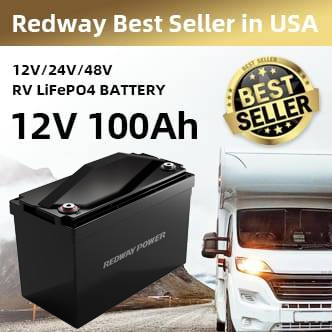
Meanwhile, modern lithium iron phosphate (LiFePO4) packs engineered for RVs routinely achieve 2,000–6,000+ cycles at 80% depth of discharge, allowing 8–15 years of practical service life under normal conditions. This gap in longevity, combined with lower maintenance and higher usable capacity, underpins the rapid shift toward long lifespan RV lithium battery energy solutions from specialized manufacturers like Redway Battery.
What are the main pain points RV owners face with traditional power setups?
First, many RVers discover that the “rated capacity” on a lead‑acid bank is largely theoretical; to avoid damage, they are advised not to discharge below about 50%, effectively cutting usable energy in half. That means a nominal 400 Ah bank delivers only around 200 Ah of safe, usable capacity, forcing frequent generator runs and limiting time off‑grid.
Second, voltage sag is a persistent issue under high loads such as air conditioners, microwaves, or inverters powering multiple appliances simultaneously. As the battery discharges, voltage dips quickly, triggering inverter low‑voltage cutoffs even when there is still nominal capacity remaining, which feels like “running out of power early” during trips.
Third, maintenance and reliability pose ongoing headaches: topping up flooded lead‑acid cells with distilled water, managing off‑season storage charging, and dealing with sulfation from partial state‑of‑charge operation. For full‑timers and rental fleets, this maintenance burden scales into significant time and operational cost, motivating a shift toward low‑maintenance, long‑lifespan lithium solutions from OEM players such as Redway Battery.

Why are traditional RV battery solutions no longer enough?
Traditional flooded or AGM lead‑acid batteries were designed in an era when RVs carried fewer electronic loads and owners frequently plugged into shore power. In today’s mobile work‑and‑travel lifestyles, where off‑grid stays of 3–10 days are common, these chemistries struggle to keep up without oversized banks and heavy generator dependence.
On a cost‑per‑cycle basis, lead‑acid appears affordable upfront but quickly loses its edge. If a bank rated for 500 cycles at 50% depth of discharge must be replaced every 2–3 years, the cumulative cost over a decade often exceeds that of a single high‑quality LiFePO4 bank that can run for thousands of cycles with minimal degradation. This is precisely where long lifespan lithium packs from Redway Battery create measurable TCO (total cost of ownership) advantages.
Additionally, weight and space constraints in RVs penalize low‑energy‑density chemistries. A typical 100 Ah lead‑acid battery may weigh 60–70 lb, while a 100 Ah LiFePO4 alternative of similar form factor can weigh 25–30 lb, freeing up payload for water, gear, or solar equipment. For RV builders and OEMs, this lighter weight also simplifies chassis design and compliance with GVWR limits.
How do long lifespan RV lithium battery solutions work in practice?
At the core of long‑life RV lithium systems is LiFePO4 chemistry, which combines high cycle life, stable voltage, and strong thermal stability. Each pack embeds a Battery Management System (BMS) that monitors cell voltages, temperature, current, and state of charge, protecting against over‑charge, over‑discharge, short circuits, and over‑temperature events.
Manufacturers like Redway Battery engineer their RV‑oriented LiFePO4 packs around these principles, tuning BMS parameters specifically for mobile and off‑grid conditions. This includes settings for high‑current inverter loads, alternator charging profiles, and compatibility with MPPT solar controllers commonly installed on RV roofs.
In practical terms, a long‑lifespan RV lithium battery bank allows deeper daily cycling (often up to 80–90% usable capacity), faster and more efficient charging from alternators and solar arrays, and consistent voltage delivery under heavy loads. That results in more usable energy every day, reduced generator runtime, and a significantly longer service life before noticeable capacity fade.

What makes Redway Battery a strong partner for RV lithium energy solutions?
Redway Battery operates as a dedicated OEM lithium battery manufacturer with more than 13 years of experience in LiFePO4 engineering across demanding applications such as forklifts, golf carts, telecom backup, solar storage, and RV power systems. This cross‑industry experience feeds into robust design standards for vibration, temperature swings, and deep‑cycle duty profiles that RV environments impose.
With four advanced factories and a production space around 100,000 square feet, Redway Battery runs automated lines and MES‑driven quality control, ensuring consistent cell matching, precise BMS integration, and traceable production batches. For RV and mobile power customers, this translates into predictable performance, lower failure rates, and more reliable delivery schedules for OEM projects.
A key differentiator is Redway Battery’s OEM/ODM customization capability. RV builders, upfitters, and fleet operators can work directly with Redway engineers to tailor pack voltages (12 V, 24 V, 36 V and beyond), capacities, form factors, and communication interfaces (CAN, RS485, Bluetooth) to fit tight compartments, integrate with existing inverters, and meet specific runtime or weight targets. This level of customization is crucial for long‑lifespan RV lithium battery energy solutions that must fit unique floorplans and usage profiles.
Which advantages do lithium RV batteries have compared to traditional solutions?
Lithium RV batteries, especially LiFePO4 packs built for deep‑cycle duty, deliver several quantifiable advantages over flooded and AGM lead‑acid options. These advantages span lifespan, usable capacity, weight, efficiency, and total ownership cost over time.
For example, where a typical deep‑cycle lead‑acid bank might offer 300–800 cycles at 50% depth of discharge, many LiFePO4 RV packs are rated for 2,000–6,000 cycles at 80% depth of discharge, multiplying usable lifetime energy throughput. This means that even at a higher initial purchase price, the cost per kWh delivered across the life of the battery is often substantially lower for lithium.
Redway Battery’s RV‑focused LiFePO4 solutions are designed around these metrics, combining long cycle life with fast‑charge capability and high round‑trip efficiency. RVers can recharge more quickly from solar or alternator sources, lose less energy to conversion and internal resistance, and carry significantly less weight for the same usable capacity.
What does the benefits table show when comparing traditional vs long lifespan RV lithium solutions?
| Dimension | Traditional Lead‑Acid RV Battery | Long Lifespan RV Lithium (LiFePO4) |
|---|---|---|
| Typical cycle life | 300–800 cycles at ~50% DoD | 2,000–6,000+ cycles at ~80% DoD |
| Usable capacity | ~50% of rated Ah | 80–90% of rated Ah |
| Weight (100 Ah class) | 60–70 lb | 25–35 lb |
| Round‑trip efficiency | 70–85% | 90–98% |
| Charge speed | Limited; prefers slow charging | Fast; accepts high charge current |
| Maintenance | Regular checks, possible watering | Virtually maintenance‑free |
| Voltage under load | Significant sag at higher loads | Stable, flatter discharge curve |
| Expected lifespan (daily use) | ~2–4 years | ~8–15 years (usage dependent) |
| Cold‑weather performance | Reduced capacity, sulfation risk | Needs managed charging below 0°C but maintains good cycle life |
| Total cost over 10 years | Multiple replacements, higher TCO | Fewer replacements, lower cost/kWh |
In RV applications, these differences show up as longer boondocking windows, fewer interruptions for charging, and more predictable power delivery for sensitive electronics. For OEMs and fleets, they translate into lower warranty claims and better customer satisfaction ratings.
How can RV owners implement a long lifespan lithium solution step by step?
-
Assess current loads and autonomy goals
List all DC and AC loads (lights, fridge, inverter, air conditioner, computers) and estimate daily energy use in watt‑hours. Define desired off‑grid autonomy in days—this will guide target battery capacity and solar array sizing. -
Select the appropriate lithium pack configuration
Based on capacity calculations, choose a LiFePO4 pack or bank with sufficient usable Ah at the required system voltage (often 12 V, sometimes 24 V). Work with a specialist like Redway Battery to select or customize packs to fit space constraints, mounting positions, and cabling routes. -
Verify and upgrade charging components
Ensure the existing converter/charger, solar charge controller, and alternator charging path are lithium‑compatible, with appropriate voltage setpoints and current limits. Many RVs will benefit from lithium‑specific chargers, MPPT controllers, and DC‑DC chargers to protect both the alternator and the battery bank. -
Plan mechanical installation and safety
Design mounting brackets or enclosures that secure the battery against vibration and road shocks while providing ventilation and protected cable routing. Follow best practices for fuse placement, cable sizing, and disconnect switches, particularly on high‑current inverter circuits. -
Integrate monitoring and communication
Install battery monitors, shunts, or BMS‑linked displays to track state of charge, current, and voltage in real time. Redway Battery can provide packs with integrated communication (such as Bluetooth or CAN) so that RVers and OEM controllers can monitor performance and logs over the long lifespan. -
Commission, test, and document
After installation, perform controlled test cycles—charge to full, run typical loads, and confirm that voltage behavior and capacity align with expectations. Document wiring diagrams, configuration settings, and maintenance recommendations to support long‑term, trouble‑free operation.
Who benefits most from long lifespan RV lithium battery energy solutions?
Full‑time RVers who rely on their rigs as primary homes gain the most from long‑lifespan lithium banks because they cycle their batteries daily and feel every inefficiency in generator fuel, noise, and downtime. For them, a long‑lasting LiFePO4 bank from a manufacturer like Redway Battery becomes central infrastructure, much like a residential solar‑plus‑storage system.
Rental fleets, commercial mobile offices, and service vehicles that rely on RV platforms also see outsized value. They operate in high‑duty environments where unscheduled downtime carries direct revenue loss, and predictable multi‑year battery life simplifies financial planning and fleet management.
Even casual weekend campers benefit from lithium solutions in more subtle ways: less worry about sulfation during storage, more usable capacity for high‑draw appliances, and fewer surprises when taking the RV out after months in a driveway or storage yard.
Which real‑world scenarios illustrate the impact of long lifespan RV lithium batteries?
Scenario 1: Full‑time digital nomad couple
Problem: A couple working remotely from their Class C motorhome runs dual laptops, Starlink, a 12 V fridge, and occasional air conditioning, quickly exhausting their legacy lead‑acid bank and forcing daily generator use.
Traditional approach: Oversize lead‑acid capacity, accept frequent deep discharges, and replace batteries every 2–3 years while enduring noise and fuel costs.
After using long‑lifespan lithium: They install a 400–600 Ah 12 V LiFePO4 bank from Redway Battery combined with roof solar and a lithium‑compatible alternator charge path, achieving 2–3 days of autonomy without running a generator under normal conditions.
Key benefit: Reduced generator runtime by 60–80%, quieter workdays, stable power for sensitive electronics, and a projected battery life of 8–10+ years under daily cycling.
Scenario 2: RV rental fleet operator
Problem: A mid‑size rental company operates 50 RVs and faces frequent battery failures due to inexperienced renters deeply discharging and under‑charging standard lead‑acid batteries.
Traditional approach: Schedule battery replacements every season, carry large spares inventory, and manage outages when units return with dead banks.
After using long‑lifespan lithium: The operator partners with Redway Battery to equip each RV with a robust LiFePO4 pack and integrated BMS configured for rental abuse, plus simplified monitoring for turn‑around checks.
Key benefit: Fewer in‑season failures, longer replacement intervals, reduced labor hours, and higher renter satisfaction due to reliable lighting, refrigeration, and device charging.
Scenario 3: Off‑grid overlanding rig
Problem: An overlander with a compact 4×4 camper needs reliable power in remote regions with limited access to shore power or fuel, and weight is a critical constraint.
Traditional approach: Carry dual‑purpose starter/deep‑cycle lead‑acid batteries, constantly worry about low voltage and starting reliability, and avoid running larger appliances.
After using long‑lifespan lithium: The camper installs a lightweight LiFePO4 house bank from Redway Battery with DC‑DC charging from the alternator and portable solar, cutting battery weight while increasing usable capacity.
Key benefit: More reliable starts, robust power for a compressor fridge and communications gear, extended autonomy in remote areas, and long‑term durability under vibration and temperature swings.
Scenario 4: Mobile medical or service RV
Problem: A mobile clinic or service RV must run medical equipment, refrigeration, or specialized tools reliably during outreach days without constant engine idling.
Traditional approach: Depend heavily on generators and large lead‑acid banks, endure noise and emissions, and deal with frequent downtime when batteries underperform.
After using long‑lifespan lithium: The organization commissions a custom LiFePO4 system from Redway Battery, with tailored pack size, BMS integration, and monitoring to match specific load profiles and regulatory requirements.
Key benefit: Stable, quiet power for critical equipment, longer service windows per day, and predictable multi‑year battery performance supporting mission continuity.
Why is now the right time to adopt a long lifespan RV lithium battery solution?
Lithium battery costs have steadily declined while performance, safety engineering, and manufacturing maturity have improved, making LiFePO4 solutions more financially attractive for mainstream RV owners and OEMs. At the same time, the expectations placed on RVs—as full‑time homes, remote offices, and commercial platforms—have increased, exposing the limits of older lead‑acid systems.
Manufacturers like Redway Battery are investing in RV‑specific product lines, BMS designs, and customization services, lowering the technical barriers for both individual owners and OEMs to adopt long‑lifespan lithium solutions. Early adopters are already demonstrating measurable gains in uptime, customer satisfaction, and long‑term cost of ownership.
Given the multi‑year lifespans involved, each season spent on legacy systems is a lost opportunity to lock in those benefits. Switching now allows RVers and builders to align their power systems with modern usage patterns, reduce environmental impact from frequent replacements, and create a more resilient mobile energy foundation for the next decade of travel.
Can common concerns about long lifespan RV lithium batteries be answered?
Is a lithium RV battery safe compared to lead‑acid?
Quality LiFePO4 packs with properly designed BMS and protective enclosures are considered among the safest lithium chemistries, with strong thermal stability, integrated protections, and reduced risk of gas emissions, spills, or corrosion compared to flooded lead‑acid batteries.
Can I use my existing RV charger with a lithium battery?
Some multi‑stage chargers have lithium profiles or adjustable setpoints, but many older converters are tuned for lead‑acid. To protect a long‑lifespan lithium bank and reach full capacity, RV owners often upgrade to lithium‑specific chargers or smart converters compatible with LiFePO4 voltage requirements.
Does a lithium RV battery work in cold temperatures?
Discharge performance remains usable at moderately low temperatures, but charging below freezing must be managed to avoid cell damage. Many modern LiFePO4 packs, including those from advanced OEMs like Redway Battery, can be specified with low‑temperature charge protection or integrated heating to mitigate this issue.
Will a lithium RV battery really save money long term?
When evaluated on cost per kWh delivered across its service life, a long‑lifespan LiFePO4 bank typically outperforms lead‑acid because it endures several times more cycles at deeper depths of discharge with higher efficiency. This reduces replacement frequency, generator runtime, and associated fuel and maintenance costs.
Can Redway Battery customize a lithium solution for my specific RV or fleet?
Yes. As an OEM manufacturer with dedicated engineering teams, Redway Battery can tailor pack capacity, voltage, shape, mounting, and BMS communication profiles to match unique RV layouts, fleet requirements, or branded product lines, enabling optimized long‑lifespan energy solutions rather than one‑size‑fits‑all compromises.
Sources
-
https://www.redway-tech.com/how-to-upgrade-your-rv-battery-to-lithium/
-
https://www.redwaypower.com/zh-CN/lifepo4-%E6%88%BF%E8%BD%A6%E7%94%B5%E6%B1%A0/
-
https://www.redwaybattery.com/product-category/12v-lifepo4-batteries/
-
https://www.alibaba.com/product-introduction/redway-power-li-ion-battery-pack_1600888089392.html