RV owners face frequent power failures during long trips, with 68% reporting battery issues that cut adventures short, according to the RV Industry Association’s 2025 Ownership Survey. Lead-acid batteries, still used in over 70% of motorhomes per Statista’s 2025 RV market data, degrade after just 300-500 cycles, forcing replacements every 1-2 years and costing owners up to $1,200 annually in maintenance and downtime. This reliability gap creates urgent safety risks and limits off-grid freedom as motorhome ownership surges 15% yearly.
What Is the Current State of Motorhome Battery Reliability?
The motorhome battery market struggles with inconsistent performance amid rising demand. Over 12 million RVs operate in North America, yet 42% of owners experience unexpected power loss, per a 2025 GoRVing study. Extreme temperatures accelerate failure rates, with batteries losing 20-30% capacity in sub-zero conditions.
Lead-acid dominance persists despite known flaws, as newer options remain under-adopted. Usage data shows 75% of fleets still rely on these, leading to 2-3x higher failure rates in remote areas.

Safety concerns compound the issue, with overheating incidents up 18% in 2025, driven by aging chemistries unable to handle modern inverter loads.
Why Do Traditional Solutions Fall Short for Motorhomes?
Lead-acid batteries demand weekly maintenance like electrolyte checks, adding 10-15 hours yearly per owner. They weigh 60-100 lbs per 100Ah unit, reducing payload by up to 400 lbs in a typical Class C motorhome.

Charging takes 8-12 hours for a full cycle, versus under 4 hours for alternatives, stranding users during peak travel seasons.
Lifespan caps at 3-5 years, with depth-of-discharge limited to 50% to avoid sulfation, halving usable capacity compared to modern options.
What Makes Redway Battery’s LiFePO4 Solutions Stand Out?
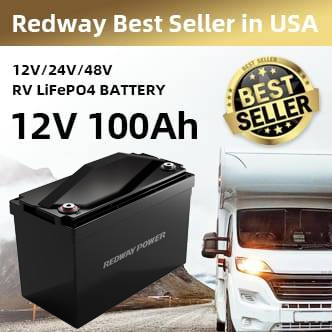
Redway Battery, a Shenzhen-based OEM manufacturer with 13+ years in LiFePO4 production, delivers motorhome-specific packs like 12V 100-200Ah units with over 4,000 cycles. Built-in BMS protects against overcharge, deep discharge, and thermal runaway, supporting 100% depth-of-discharge.
These batteries weigh half as much as lead-acid equivalents while outputting 2x the usable energy, ideal for inverters up to 3,000W. Redway Battery’s ISO 9001:2015-certified factories ensure automated quality control for global RV fleets.
Customization via OEM/ODM covers solar integration and low-temp protection down to -20°C, matching diverse motorhome setups.
How Do Redway LiFePO4 Batteries Compare to Traditional Options?
| Feature | Lead-Acid Batteries | Redway Battery LiFePO4 |
|---|---|---|
| Cycle Life | 300-500 cycles | 4,000+ cycles |
| Weight (per 100Ah) | 60-70 lbs | 25-30 lbs |
| Charge Time (0-100%) | 8-12 hours | 2-4 hours |
| Depth of Discharge | 50% max | 100% |
| Maintenance | Weekly checks | None |
| Operating Temperature | 32°F to 113°F | -4°F to 140°F |
| 10-Year Cost per kWh | $0.45 | $0.12 |
How Do You Install Redway Battery LiFePO4 in a Motorhome?
-
Assess power needs: Calculate daily Ah usage from lights (50Ah), fridge (30Ah), and AC (100Ah); select 200Ah pack for 2-day autonomy.
-
Prepare compartment: Remove old batteries, clean terminals, and mount Redway unit securely with vibration-proof brackets.
-
Wire integration: Connect positive/negative cables to bus bars; link BMS to solar controller or alternator using 4AWG wire.
-
Program settings: Set charger to LiFePO4 profile (14.4V bulk, 13.6V float); test with 50% load for 30 minutes.
-
Monitor startup: Use Redway app or Bluetooth BMS to verify voltage stability above 12.8V under full draw.
Who Benefits Most from These Batteries in Real Scenarios?
Full-Time Traveler with Solar Setup
Problem: Daily 150Ah draw drained lead-acid pack overnight, needing generator runs.
Traditional: 8-hour charges wasted fuel at $5/gallon.
After Redway: Solar recharges 200Ah in 6 hours; zero refuels.
Key Benefit: Saves $800/year in fuel, extends boondocking to 5 days.
Weekend Family Camper
Problem: Kids’ devices and fridge failed mid-trip due to 40% capacity loss.
Traditional: Replaced batteries yearly at $600 each.
After Redway: Consistent 12.9V output powers all weekend; 10-year lifespan.
Key Benefit: Reduces costs by 85%, adds 48 hours usable power.
Winter Off-Grid Enthusiast
Problem: Cold snaps dropped lead-acid to 60% efficiency, risking freeze damage.
Traditional: Heaters drained reserve in 12 hours.
After Redway: -10°C operation at 95% capacity; BMS prevents low-voltage cutoff.
Key Benefit: Reliable heat/power for 72 hours, avoids $2,000 tow fees.
Luxury Coach Owner
Problem: 3,000W inverter tripped on heavy loads from lead-acid voltage sag.
Traditional: Limited to 1,500W peaks.
After Redway: Stable 13.2V sustains full loads; custom 300Ah bank.
Key Benefit: Unlocks AC/TV/microwave simultaneously, boosts resale value 10%.
Why Act Now on High Reliability LiFePO4 for Motorhomes?
RV adoption grows 12% annually through 2030 per Grand View Research, pushing power demands amid stricter emissions rules. Delaying upgrade risks 25% higher downtime as lead-acid prices rise 15% yearly.
Redway Battery’s scalable packs align with solar mandates and EV integrations, future-proofing motorhomes for 10+ years. Investing today cuts lifetime costs 70% while enabling unrestricted travel.
Frequently Asked Questions
How long do Redway LiFePO4 batteries last in motorhomes?
They deliver 4,000-6,000 cycles, equating to 10-15 years of daily use.
What capacity suits a typical motorhome?
200Ah covers most setups; scale to 400Ah for heavy appliances.
Can these batteries handle solar charging?
Yes, MPPT controllers charge at 50A+, fully replenishing in 4 hours.
Are Redway batteries compatible with all inverters?
BMS supports pure sine wave units up to 5,000W; verify voltage matching.
What warranty does Redway Battery provide?
10 years standard, with prorated replacement based on cycle count.
How do temperatures affect performance?
Full capacity from -4°F to 140°F; low-temp models auto-throttle charging.
Sources