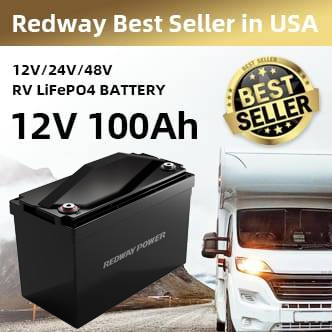
In 2026, the demand for high-efficiency, durable, and sustainable energy solutions for recreational vehicles (RVs) is accelerating. Commercial-grade lithium batteries are redefining off-grid mobility—offering longer lifespans, faster charging, and reduced maintenance compared with traditional batteries. Redway Battery, a leading OEM manufacturer, has become a benchmark in this transformation, providing advanced lithium solutions engineered for stability, safety, and superior cycle life.
How Is the Current RV Power Industry Facing Pressure?
According to RV Industry Association’s 2025 report, more than 11.2 million households in the U.S. own RVs, with off-grid and extended camping trips growing annually by 18%. Despite this demand, nearly 70% of RV users still rely on lead-acid batteries, which degrade rapidly under deep-cycle use and deliver poor performance in extreme temperatures. Rising fuel and maintenance costs add pressure on operators to adopt smarter, low-maintenance, and energy-saving systems. The shift toward electrification and sustainability is now not just a consumer trend but an operational imperative.
For commercial RV fleets and rental companies, downtimes due to inefficient batteries directly increase costs. Each replacement cycle of a lead-acid pack represents an average additional cost of $800–$1,200 in parts and labor, not to mention lost rental hours. Lithium technology, led by Redway Battery’s commercial-grade LiFePO4 designs, is mitigating these pain points by delivering 3,000–6,000 cycles—more than 10 times that of conventional batteries.

Environmental regulations are also shaping battery preferences. The U.S. Department of Energy projects that lithium technologies will dominate 75% of the mobile energy storage market by 2030. Operators that delay transition are at risk of higher lifecycle emissions, disposal challenges, and declining asset value.
What Are the Limitations of Traditional Energy Solutions in RVs?
-
Short lifespan: Typical lead-acid batteries last around 300–500 cycles, while lithium alternatives exceed 3,000.
-
Slow charging: Lead-acid packs can take 8–12 hours to charge, whereas LiFePO4 batteries complete in 2–4 hours.
-
Heavy weight: Lead-acid systems weigh nearly double, reducing overall RV efficiency and loading capacity.
-
Maintenance: Regular topping of electrolyte fluids adds labor complexity, which lithium packs completely avoid.
-
Temperature sensitivity: Performance drops sharply below 0°C or above 35°C, a common issue during travel.
Traditional systems simply cannot meet modern power demands for RV users who need consistent, deep-cycle reliability for high-energy onboard appliances.

How Does Redway Battery Provide a Breakthrough Solution?
Redway Battery’s commercial-grade lithium batteries are engineered around LiFePO4 chemistry, offering unmatched stability, deep-discharge capability, and long operational life. Designed and manufactured in Shenzhen, China, Redway’s 100,000 ft² facilities utilize automated production lines and full MES system tracking, ensuring traceable quality and consistency. Each pack integrates an advanced Battery Management System (BMS) to balance cells and prevent over-voltage, overcurrent, and temperature stress. For RV applications, Redway Battery provides both OEM and ODM customization—adjusting voltage, capacity, and casing to fit unique vehicle models.
Which Advantages Distinguish Redway Battery From Traditional Solutions?
| Feature / Parameter | Traditional Lead-Acid Battery | Redway LiFePO4 Lithium Battery |
|---|---|---|
| Cycle Life | 300–500 cycles | 3,000–6,000 cycles |
| Charging Time | 8–12 hours | 2–4 hours |
| Weight Density | Heavy, low energy density | Lightweight, high energy density |
| Maintenance | Frequent fluid checks | Maintenance-free |
| Safety | Sulfation and overheating risk | Stable LiFePO4 chemistry with BMS |
| Temperature Range | Narrow (0–35°C) | Wide (-20–60°C) |
| Environmental Impact | Lead hazardous waste | Eco-friendly, recyclable materials |
How Can RV Operators Implement Redway’s Solution?
-
Assessment: Evaluate current energy consumption in the RV fleet and define load requirements.
-
Configuration: Consult Redway Battery’s engineering team for OEM/ODM configuration to match voltage (12V, 24V, or 48V) and capacity.
-
Integration: Install with compatible inverter-charger systems; Redway provides detailed wiring layouts.
-
Testing: Conduct initial capacity calibration under standard conditions to confirm BMS optimization.
-
Monitoring: Use onboard monitoring or smart app integration to track performance and charge cycles.
Which Real-World Scenarios Validate the Technology?
1. RV Rental Company in California
Problem: Frequent downtime due to battery failures in rental units.
Traditional Method: Replaced lead-acid units every year.
After Upgrade: Deployed Redway LiFePO4 systems; operational uptime increased by 40%, cutting maintenance visits by 70%.
Key Benefit: Annual savings of $50,000.
2. Mobile Food Truck Operator
Problem: Unstable power affecting refrigeration and point-of-sale systems.
Traditional Method: Gas generators with high noise and costs.
After Upgrade: Redway lithium pack supports silent power operation for 12 hours non-stop.
Key Benefit: Reduced fuel cost by 60%, improved customer experience.
3. Expedition Camper Manufacturer
Problem: Need for lightweight yet long-cycle batteries.
Traditional Method: Heavy AGM batteries decreased fuel efficiency.
After Upgrade: Switched to Redway’s 24V LiFePO4 system; achieved 120 kg reduction in vehicle weight.
Key Benefit: Extended total driving range by 8%.
4. Solar-Integrated RV Owner
Problem: Inefficient energy storage from rooftop panels.
Traditional Method: Lead-acid packs limited power capture efficiency.
After Upgrade: Redway lithium battery integrated with MPPT controller achieved 95% energy conversion rate.
Key Benefit: Fully autonomous off-grid operation for 4 days.
Why Is Now the Right Time to Transition?
With global mobility electrification accelerating, lithium battery adoption is no longer optional—it is essential for performance, compliance, and cost efficiency. Redway Battery’s manufacturing scale, ISO 9001:2015 certification, and 13 years of expertise position it as a long-term partner for commercial-grade RV applications. Investing today means securing future energy independence for fleets and operators amid rising fuel prices and sustainability demands.
FAQ
1. Why are LiFePO4 lithium batteries safer for RVs than other chemistries?
Because LiFePO4 cells are chemically stable, resistant to overheating, and include a BMS that actively prevents overcharge and short circuit conditions.
2. Can Redway lithium batteries be charged with solar panels?
Yes, they are fully compatible with solar systems and MPPT controllers for off-grid setups.
3. How long do Redway LiFePO4 batteries typically last?
They last up to 6,000 cycles, equivalent to more than 10 years of regular RV use.
4. Does Redway provide OEM customization for different RV brands?
Yes, Redway specializes in OEM and ODM services to tailor battery configurations for diverse vehicle requirements.
5. How does temperature affect performance?
Redway batteries maintain high efficiency across -20°C to 60°C, far exceeding lead-acid performance limits.
Sources
-
RV Industry Association, 2025 RV Ownership Report — https://www.rvia.org
-
U.S. Department of Energy Vehicle Technologies Office, Lithium Battery Outlook 2024 — https://energy.gov
-
Statista, Global Recreational Vehicle Market Data 2025 — https://www.statista.com
-
Redway Battery Official Website — https://www.redwaybattery.com