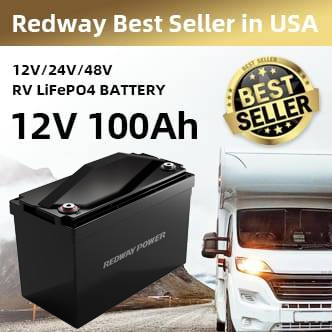
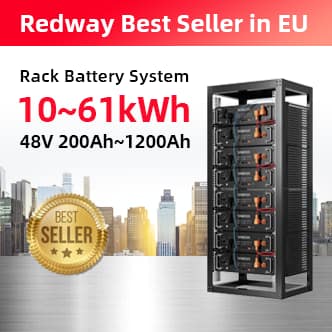
The RV and motorhome market is rapidly shifting from lead‑acid to lithium batteries to meet growing off‑grid, high‑load, and sustainable power demands, and specialized factories are now the key enablers of this transition. For brands and OEMs, partnering with an experienced lithium battery factory like Redway Battery means higher energy density, longer life, safer systems, and fully customized packs that directly match RV and motorhome applications.
How is the RV power industry changing and what pain points are emerging?
Global RV battery demand is growing as more consumers choose longer trips, higher comfort levels, and off‑grid camping, driving sustained adoption of lithium‑ion and LiFePO4 technologies instead of legacy lead‑acid systems. At the same time, the RV battery market is projected to grow steadily over the coming decade, fueled by higher power consumption and electrification trends, but this also exposes performance gaps in traditional battery setups.
However, RV owners still frequently experience power anxiety, premature capacity loss, and safety concerns when running high‑load devices like air conditioners, induction cookers, or Starlink terminals on outdated battery systems.
RV owners today face several concrete pain points:

-
Limited usable capacity: Traditional lead‑acid banks often provide only about 50% usable depth of discharge before dramatically shortening lifespan.
-
Short cycle life: Many users need to replace lead‑acid batteries every 2–3 years under intensive camping or full‑time use.
-
Weight and space constraints: Heavy battery banks eat into payload and storage, especially for Class B/C RVs and campervans.
-
Inefficient charging: Long generator runtime and incomplete charging from alternators or solar reduce real‑world autonomy.
Lithium battery factories dedicated to RV and motorhome power are emerging to solve these challenges through:
-
High‑energy‑density LiFePO4 cells engineered for deep cycling.
-
Integrated battery management systems (BMS) for safety and longevity.
-
OEM customization to fit specific RV layouts, voltages, and power profiles.
What limitations do traditional RV power solutions have?
Traditional RV power systems usually rely on flooded or AGM lead‑acid batteries combined with fuel generators and basic chargers. This setup has several inherent limitations:

-
Low usable capacity: Only a fraction of nominal capacity can be used without damaging the battery.
-
High maintenance: Watering, venting, sulfation management, and equalization add complexity.
-
Poor cycle economics: Cost per cycle is high when factoring in frequent replacements.
From an operational perspective, conventional setups also create:
-
Noise and emissions from generators, which are increasingly restricted in national parks and campgrounds.
-
Voltage sag under high loads, causing inverters to trip and appliances to shut down.
-
Inefficient integration with solar systems, limiting true off‑grid capability.
For RV OEMs and upfitters, traditional battery technologies:
-
Limit the design of all‑electric or “no‑propane” floorplans.
-
Make it harder to deliver long warranty terms on the electrical system.
-
Increase after‑sales service volume due to early battery failure.
How does a lithium battery factory like Redway Battery provide a better solution?
A specialized lithium battery factory for RV and motorhome power focuses on designing and manufacturing deep‑cycle lithium packs that are optimized for mobile, off‑grid, and high‑vibration environments. Instead of generic packs, these factories build systems that match the duty cycles of RV users: daily cycling, long idle periods, variable temperatures, and high surge loads from inverters.
Redway Battery is one such dedicated OEM manufacturer, with over a decade of experience in LiFePO4 solutions for RVs, golf carts, forklifts, telecom, solar, and energy storage systems. As a factory operator, Redway Battery combines:
-
Automated production lines and MES systems for traceability and consistency.
-
Advanced cell matching and pack assembly processes tailored for deep‑cycle LiFePO4.
-
Engineering support for OEM/ODM customization, from voltage and capacity to casing, mounting, and communication protocols.
For RV and motorhome power specifically, a lithium battery factory like Redway Battery can:
-
Design 12V, 24V, and 48V LiFePO4 packs suitable for house battery banks.
-
Integrate smart BMS features (Bluetooth, CAN, RS485) for energy monitoring and integration with vehicle systems.
-
Provide self‑heating or low‑temperature charging options for cold‑climate use.
-
Offer scalable modular packs that support small campervans up to luxury Class A motorhomes.
By working directly with a lithium battery factory, RV brands and upfitters gain consistent supply, engineered compatibility, and the ability to differentiate their models with superior energy systems.
What are the main differences between traditional and lithium factory‑powered RV solutions?
Which key metrics distinguish traditional vs lithium RV power solutions?
| Aspect | Traditional lead‑acid system | Lithium RV system from a factory like Redway Battery |
|---|---|---|
| Usable capacity (per kWh) | ~50% of nominal | ~80–90% of nominal |
| Cycle life (to ~80% capacity) | ~300–500 cycles | ~3,000–6,000+ cycles |
| Weight per usable kWh | High (heavy bank required) | Low (up to ~50–70% lighter) |
| Charging speed | Slow, sensitive to partial charging | Fast, tolerant of partial charging |
| Maintenance | Regular checks, risk of sulfation | Virtually maintenance‑free |
| Generator dependency | High | Significantly reduced |
| Solar compatibility | Limited benefit due to charge profile | Excellent synergy, better harvest |
| Safety and off‑gassing | Venting required, risk of acid spills | Sealed, no acid, LiFePO4 chemistry with high safety |
| Lifecycle cost | Lower upfront, higher long‑term | Higher upfront, lower cost per cycle |
| OEM customization options | Limited form factors | Wide range of pack designs and communication options |
This performance gap is why more RV brands are specifying LiFePO4 packs from dedicated factories like Redway Battery at the build stage or offering them as premium electrical packages.
How can an RV brand implement a lithium factory solution step by step?
How should RV OEMs and upfitters adopt lithium battery factory solutions?
-
Define energy usage profile
-
Audit typical and peak loads: air conditioning, induction cooking, heating, multimedia, satellite internet, and auxiliary systems.
-
Determine desired off‑grid autonomy (e.g., 24, 48, 72 hours without shore power or generator).
-
-
Collaborate on system design with the factory
-
Share RV platform specifications (12V/24V DC system, inverter size, alternator, solar capacity).
-
Work with the lithium battery factory’s engineering team to size packs, define voltage, capacity, C‑rate, and communication interfaces.
-
-
Customize mechanical and electrical integration
-
Specify enclosure size, mounting points, and ingress protection according to RV chassis or coach constraints.
-
Align on connector types, cabling, and BMS communication to inverters, chargers, and vehicle ECUs.
-
-
Validate safety and compliance
-
Ensure packs comply with relevant automotive and battery safety standards required in target markets.
-
Conduct vibration, temperature, and over‑current tests to validate system robustness in real RV conditions.
-
-
Pilot and field testing
-
Install pilot packs in test vehicles or limited production runs.
-
Collect data on performance, user behavior, and charge/discharge patterns to fine‑tune capacity and BMS settings.
-
-
Scale production with MES‑enabled manufacturing
-
Once designs are validated, the factory scales production using automated assembly and MES tracking for quality consistency.
-
Implement serial number tracking for after‑sales care and warranty management.
-
-
After‑sales and lifecycle support
-
Use factory‑provided diagnostics and remote monitoring (if enabled) to handle support tickets efficiently.
-
Incorporate customer feedback into future iterations and optional upgrade kits.
-
Redway Battery, with its four factories and large production area, is set up to support this full lifecycle for RV and motorhome partners, from design to long‑term after‑sales support.
What are four typical user scenarios for lithium RV battery factory solutions?
Why does a full‑time RVer need a factory‑grade lithium system?
-
Problem: A digital nomad couple lives full‑time in a Class B+ motorhome, running laptops, a 12V fridge, Starlink internet, and occasional air conditioning. Their AGM bank sagged quickly, forcing frequent campground stays.
-
Traditional approach: 400Ah of AGM batteries plus a small generator. After 18–24 months, real‑world capacity dropped significantly, and generator noise limited boondocking options.
-
Lithium factory solution: They switch to a factory‑built 400Ah 12V LiFePO4 pack from Redway Battery, integrated with a 3kW inverter and 800W solar.
-
Key results: They gain roughly 60–80% more usable energy in the same footprint, reduce generator runtime by more than half, and maintain stable voltage under heavy loads.
-
Core benefit: Reliable, quiet, and scalable power that supports true full‑time off‑grid living with lower long‑term cost.
How can a rental fleet operator improve uptime and ROI?
-
Problem: A European RV rental company runs a mixed fleet of motorhomes that frequently returns with deeply discharged or damaged lead‑acid banks, driving downtime and replacement costs.
-
Traditional approach: Standard lead‑acid batteries with simple chargers and limited monitoring, no centralized energy telemetry.
-
Lithium factory solution: The operator partners with Redway Battery to deploy OEM LiFePO4 packs with smart BMS and telematics integration across the fleet.
-
Key results: Batteries handle frequent cycling and deep discharge with minimal degradation, reducing replacement frequency and workshop labor. Centralized monitoring allows proactive maintenance and user behavior coaching.
-
Core benefit: Higher fleet uptime, predictable operating costs, and improved rental customer satisfaction.
Where does a premium motorhome brand gain differentiation?
-
Problem: A high‑end motorhome manufacturer wants to offer “generator‑free” luxury models, but conventional batteries cannot support long silent camping with residential appliances.
-
Traditional approach: Large lead‑acid banks paired with diesel generators, resulting in noise, emissions, and complex maintenance.
-
Lithium factory solution: The brand co‑develops a 48V, high‑capacity LiFePO4 bank with Redway Battery, combined with large solar arrays and high‑efficiency inverters.
-
Key results: Owners can run air conditioning and kitchen appliances quietly for hours, with rapid recharge from shore or generator when needed. The brand markets a “silent luxury” package as a flagship feature.
-
Core benefit: Distinctive product positioning and higher perceived value, built on robust factory‑engineered energy systems.
When does a DIY van builder benefit from OEM‑grade lithium packs?
-
Problem: A DIY campervan builder wants a safe and reliable system but lacks expertise in cell matching, pack assembly, and BMS design.
-
Traditional approach: Buying loose cells online and attempting a DIY pack, risking mismatched cells, poor wiring, and safety issues.
-
Lithium factory solution: They purchase a pre‑engineered, drop‑in LiFePO4 battery from Redway Battery, designed for RV use with integrated BMS and safety protections.
-
Key results: The builder gets predictable performance, clear installation guidance, and manufacturer support, while avoiding the hidden risks of DIY pack construction.
-
Core benefit: Faster build, higher safety, and long‑term reliability without needing deep battery engineering knowledge.
Why is now the right time to partner with a lithium battery factory for RV power?
Where is the RV power market heading?
RV and motorhome power systems are moving toward:
-
Higher autonomy: Larger battery banks and solar arrays to enable days of off‑grid use.
-
Integrated energy management: Smart inverters, BMS, and vehicle electronics working together.
-
Lower emissions and noise: Reduced generator usage and compatibility with stricter campsite rules.
-
Electrified platforms: Hybrid and all‑electric RVs that depend heavily on robust energy storage.
This evolution makes factory‑grade lithium solutions not just a premium upgrade but a foundational requirement for future RV designs. RV manufacturers, fleet operators, and upfitters who establish strong relationships with experienced factories like Redway Battery are better positioned to:
-
Secure stable supply in a growing market.
-
Offer differentiated, high‑value electrical packages.
-
Reduce warranty exposure and after‑sales complexity.
The earlier this transition begins, the easier it is to standardize platforms, train dealer networks, and build a reputation for reliable, modern energy systems.
Are there common questions about lithium battery factories for RV and motorhome power?
What certifications should a lithium battery factory have for RV applications?
A suitable factory should hold quality management certifications such as ISO 9001 and demonstrate traceability, process control, and safety testing aligned with automotive and battery standards. Additional certifications for individual packs and systems may be required depending on target markets and OEM requirements.
Why is LiFePO4 chemistry preferred for RV and motorhome power?
LiFePO4 offers a combination of high cycle life, stable voltage, good thermal stability, and improved safety compared to many other lithium chemistries. For RV house batteries, this chemistry provides a stable, long‑lasting power source that tolerates frequent deep discharges and high‑load operation.
Can a lithium battery factory provide fully customized packs for specific RV models?
Yes, experienced factories can design bespoke packs that fit specific compartments, mounting constraints, and electrical requirements of particular RV models. This includes customized capacity, voltage, communication protocols, and even branding for OEM partners.
Does switching to lithium require replacing all existing RV components?
Not always, but a system assessment is essential. In many cases, inverters, chargers, alternator chargers, and solar controllers may need to be adjusted or upgraded to support lithium charging profiles and higher power flows safely.
How long can a factory‑built lithium RV battery system typically last?
With proper design and use, LiFePO4 systems often deliver several thousand cycles before reaching around 80% of original capacity. For many RV users, this translates into 8–15 years of service life, depending on usage patterns and environment.
Sources
-
Understanding Growth Challenges in RV Battery Market 2026–2034 – DataInsightsMarket
https://www.datainsightsmarket.com/reports/rv-battery-109442 -
RV Energy Storage Lithium Battery Market Set to Surge – OpenPR
https://www.openpr.com/news/4367167/rv-energy-storage-lithium-battery-market-set-to-surge-key -
United States RV Energy Storage Lithium Battery Market – LinkedIn article
https://www.linkedin.com/pulse/united-states-rv-energy-storage-lithium-battery-market-global-xlozc -
Redway Power – OEM/ODM LiFePO4 Battery Manufacturer
https://www.redwaypower.com/ -
Redway Battery OEM/ODM Lithium Battery Manufacturer
https://www.redway-tech.com/ -
LiFePO4 RV Battery Factory and Wholesale Information – Redway Power
https://www.redwaypower.com/lifepo4-%E6%88%BF%E8%BD%A6%E7%94%B5%E6%B1%A0/