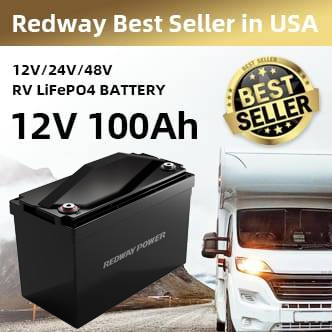
Lithium RV batteries are rapidly replacing lead‑acid as the standard for mobile power, offering longer cycle life, lighter weight, and deeper usable capacity. A reliable lithium RV battery supplier with global shipping can turn intermittent, maintenance‑heavy systems into stable, high‑uptime energy platforms for RVs, telecom shelters, and solar off‑grid setups worldwide. Redway Battery, an OEM lithium manufacturer based in Shenzhen, China, has leveraged over 13 years of experience to build scalable LiFePO₄ solutions that ship globally and integrate into diverse RV and energy‑storage architectures.
Why Is the Lithium RV Battery Market Under Pressure?
The global RV battery market was valued at roughly 1.4 billion USD in 2021 and is projected to exceed 2 billion USD by the end of 2025, driven by longer RV trips, more onboard electronics, and the shift from lead‑acid to lithium‑ion chemistry. In parallel, lithium‑ion prices and raw‑material volatility have created cost‑sensitivity among RV owners and OEMs, even as demand for lighter, higher‑cycle batteries grows. Many RV fleets still run on aging lead‑acid banks that fail prematurely under deep‑cycle loads, forcing frequent replacements and unplanned downtime.
High initial cost, limited charging infrastructure in remote regions, and safety concerns around lithium‑ion systems remain key restraints. OEMs and dealers also face integration complexity when retrofitting lithium packs into legacy RV platforms, especially where battery management, thermal design, and wiring were originally optimized for flooded or AGM batteries. These factors create a gap between what RV users want—long‑lasting, low‑maintenance power—and what many suppliers can consistently deliver at global scale.

What Are the Main Pain Points for RV Owners Today?
RV owners increasingly rely on batteries to run air‑conditioning, refrigerators, inverters, and entertainment systems for multi‑day off‑grid stays. Traditional lead‑acid banks typically offer only about 300–500 deep cycles before capacity drops below 80%, whereas modern LiFePO₄ packs can exceed 2,000–5,000 cycles under proper management. This means a lithium RV battery can last several RV lifetimes, yet many users still accept shorter‑lived, heavier lead‑acid solutions because of upfront‑price perception and limited access to trustworthy global suppliers.
Another major pain point is weight. A typical 100 Ah lead‑acid battery weighs around 25–30 kg, while a comparable LiFePO₄ pack weighs roughly 10–13 kg. Over a full bank, this difference directly impacts fuel economy, payload capacity, and ease of installation. For global buyers, inconsistent quality, unclear certifications, and lack of after‑sales support further complicate procurement, especially when sourcing from multiple regional vendors instead of a single, certified OEM.

How Do Traditional Solutions Fall Short?
Lead‑acid batteries dominate the RV aftermarket because of their low sticker price and wide availability, but they underperform in almost every technical metric. Their usable depth of discharge is typically limited to 50%, meaning a 100 Ah bank effectively delivers only 50 Ah without accelerating degradation. By contrast, LiFePO₄ batteries can routinely discharge 80–90% of rated capacity while maintaining long cycle life. Traditional systems also require regular watering, ventilation, and equalization charges, increasing maintenance overhead for RV owners and fleet operators.
Many “budget” lithium‑ion RV batteries on the market cut corners on cell quality, battery‑management‑system (BMS) design, and safety certifications. This can lead to thermal runaway risk, inconsistent performance across temperature ranges, and premature failure when exposed to the vibration and temperature swings common in RV environments. Without a robust global supply‑chain partner that controls both cell selection and pack assembly, buyers face higher total‑cost‑of‑ownership despite the lower initial lithium price tag.
What Does a Modern Lithium RV Battery Solution Offer?
A modern lithium RV battery solution centers on LiFePO₄ chemistry, integrated BMS, and modular pack design that can scale from single 12 V units to multi‑kWh systems for larger RVs and off‑grid cabins. Redway Battery builds its RV‑oriented packs around high‑cycle LiFePO₄ cells, automated production lines, and ISO 9001:2015‑certified manufacturing processes, ensuring consistent quality across batches. The company operates four advanced factories with a combined 100,000 ft² production area, enabling it to support both OEM‑level volume orders and customized configurations for niche RV platforms.
Core capabilities include:
-
Deep‑cycle LiFePO₄ cells rated for 2,000–5,000 cycles at 80% depth of discharge.
-
Programmable BMS with overcharge, over‑discharge, short‑circuit, and temperature protection.
-
Lightweight, compact housings designed for RV vibration and space constraints.
-
Global shipping and 24/7 after‑sales support, including remote diagnostics and warranty handling.
Redway also offers OEM/ODM customization, allowing RV manufacturers and system integrators to specify voltage, capacity, communication protocols (CAN, RS‑485, Bluetooth), and mechanical form‑factors tailored to their chassis and electrical layouts.
How Does a Modern Lithium RV Battery Compare with Traditional Options?
The table below compares a typical Redway‑style LiFePO₄ RV battery with a conventional lead‑acid solution on key metrics.
| Feature | Traditional Lead‑Acid RV Battery | Modern LiFePO₄ RV Battery (e.g., Redway‑style) |
|---|---|---|
| Typical cycle life | 300–500 deep cycles | 2,000–5,000 deep cycles |
| Usable capacity at 80% DoD | ~50% of rated capacity | 80–90% of rated capacity |
| Weight per 100 Ah | 25–30 kg | 10–13 kg |
| Maintenance | Watering, equalization, venting | Maintenance‑free |
| Charge efficiency | ~70–80% | ~95–98% |
| Temperature sensitivity | High; capacity drops in cold | Lower; wider operating range |
| Safety profile | Lower fire risk, but gassing | High if BMS and cells are poorly designed |
| Global support and certifications | Often regional, fragmented | Centralized OEM with global shipping |
By choosing a supplier such as Redway Battery, RV owners and integrators gain not only better technical performance but also more predictable long‑term reliability and service coverage.
How Do You Implement a Lithium RV Battery System Step by Step?
Deploying a lithium RV battery solution can be broken into a repeatable, measurable workflow:
-
Assess power needs and duty cycle
Calculate daily energy consumption (kWh) for lights, fridge, inverter loads, and HVAC. Use this to size the required battery capacity (Ah or kWh) and number of parallel strings. -
Select chemistry and configuration
Choose LiFePO₄ for deep‑cycle, long‑life applications. Decide on 12 V, 24 V, or 48 V architecture based on inverter and charger compatibility, then select series/parallel layout. -
Integrate BMS and protection
Ensure the BMS supports low‑temperature cutoff, overcurrent protection, and communication with existing charge controllers or inverters. Redway Battery’s packs typically include configurable BMS settings to match common RV chargers. -
Install and wire the pack
Mount the battery in a ventilated, vibration‑dampened location. Use appropriately sized cables, fuses, and disconnects, and follow manufacturer torque specifications on terminals. -
Commission and monitor
Perform an initial charge to full state‑of‑charge, verify voltage balance across cells, and set up monitoring (via app, display, or CAN bus). Schedule periodic checks of BMS logs and cell voltages. -
Plan for global logistics and support
For international projects, work with a supplier that offers global shipping, customs documentation, and local‑language technical support. Redway Battery’s 24/7 after‑sales team can assist with troubleshooting and replacement logistics worldwide.
Where Can a Global Lithium RV Battery Supplier Add the Most Value?
Case 1: Long‑Distance Overland RV Touring
Problem: A couple touring North and South America wants to boondock for 5–7 days without shore power, but their lead‑acid bank cannot sustain air‑conditioning and fridge loads without frequent generator runs.
Traditional practice: They carry extra lead‑acid batteries and run the generator several hours per day, increasing noise, fuel cost, and maintenance.
After switching to lithium: They install a 200 Ah LiFePO₄ bank from a global supplier such as Redway Battery, paired with solar. Usable capacity nearly doubles, and they cut generator runtime by 60–70%.
Key benefit: Lower fuel cost, quieter operation, and fewer battery replacements over the multi‑year journey.
Case 2: RV Rental Fleet Operator
Problem: A rental company in Europe experiences high battery‑replacement costs and customer complaints about dead batteries after weekend trips.
Traditional practice: Technicians replace flooded batteries every 12–18 months and manually check electrolyte levels.
After switching to lithium: The fleet adopts standardized 12 V LiFePO₄ packs sourced from a single OEM with global logistics. Cycle life extends to 5+ years, and remote BMS monitoring flags weak cells before failures.
Key benefit: Reduced maintenance labor, lower spare‑parts inventory, and improved customer satisfaction scores.
Case 3: Off‑Grid RV for Remote Telecom Shelter
Problem: A telecom operator deploys RV‑style shelters in remote regions with unreliable grid and extreme temperatures. Lead‑acid batteries fail within 18 months due to deep‑cycle loads and heat.
Traditional practice: Local suppliers deliver mismatched AGM batteries with inconsistent quality and no centralized support.
After switching to lithium: The operator specifies a LiFePO₄ solution from a certified OEM such as Redway Battery, with temperature‑adaptive BMS and global spare‑parts availability.
Key benefit: Longer uptime for telecom equipment and lower total‑cost‑of‑ownership across dozens of sites.
Case 4: Custom Luxury RV Builder
Problem: A boutique RV manufacturer wants to differentiate its vehicles with silent, long‑range off‑grid capability but lacks in‑house battery‑engineering expertise.
Traditional practice: They cobble together third‑party lithium packs without full system integration, leading to warranty disputes.
After switching to lithium: The builder partners with an OEM that offers full ODM services, including custom pack shapes, CAN‑bus integration, and global shipping.
Key benefit: Faster time‑to‑market, fewer integration issues, and a premium “engineered power” story to market.
What Are the Emerging Trends in Lithium RV Batteries?
The lithium RV battery segment is moving toward higher energy density, smarter BMS, and tighter integration with solar and vehicle‑to‑grid (V2G) architectures. Digitization and Industry 4.0‑style manufacturing are enabling better traceability, predictive maintenance, and remote diagnostics, which are especially valuable for globally deployed RV fleets. As lithium‑ion demand grows across EVs, grid‑scale storage, and consumer electronics, supply‑chain maturity and cost‑performance curves continue to improve, making LiFePO₄ more accessible for mainstream RV applications.
A global lithium RV battery supplier that combines OEM‑grade production, strong certifications, and worldwide logistics is better positioned to capture this trend than fragmented regional vendors. Redway Battery’s combination of four factories, automated lines, and 24/7 support aligns with the need for scalable, reliable, and serviceable lithium solutions in an increasingly mobile world.
Does a Lithium RV Battery Make Sense for Your Use Case?
Can lithium RV batteries really last longer than lead‑acid?
Yes. LiFePO₄ RV batteries typically achieve 2,000–5,000 deep cycles at 80% depth of discharge, whereas lead‑acid usually reaches only 300–500 cycles under similar conditions. This means fewer replacements and lower lifetime cost, even with a higher initial price.
Are lithium RV batteries safe in mobile environments?
When built with quality cells, robust BMS, and proper enclosures, lithium RV batteries are safe for RV use. Look for suppliers with ISO 9001 certification, thermal‑runaway‑tested cells, and clear safety documentation. Redway Battery designs its packs for vibration, temperature swings, and deep‑cycle loads typical in RVs.
How do global shipping and customs work with a lithium RV battery supplier?
Reputable OEMs package lithium batteries according to UN 38.3 and IATA/IMDG regulations, provide MSDS and test reports, and work with freight forwarders familiar with lithium shipments. Redway Battery supports global shipping with documentation tailored to destination‑country requirements.
What should I look for in a lithium RV battery supplier?
Prioritize suppliers with:
-
OEM/ODM experience and in‑house engineering.
-
ISO 9001 or equivalent quality certification.
-
LiFePO₄‑specific expertise and proven RV or energy‑storage references.
-
Global logistics and after‑sales support.
Redway Battery meets these criteria, offering customizable LiFePO₄ packs for RVs, telecom, solar, and energy‑storage systems with worldwide delivery.
How much can I save by switching from lead‑acid to lithium?
Exact savings depend on usage, but many RV owners cut total‑cost‑of‑ownership by 30–50% over 5–7 years due to fewer replacements, lower maintenance, and higher usable capacity. For fleets and commercial users, the savings can be even greater when factoring in downtime reduction and fuel savings from reduced generator use.
Sources
-
DataInsights Market – RV Battery Market 2026–2034
-
RV‑Pro – Top Challenges to Alternative Power Adoption in the RV Industry
-
Cognitivemarket Research – RV Battery Market Analysis 2026
-
Mewburn Ellis – What Is the Battery Sector Excited About in 2026?
-
MIT Technology Review – Why 2026 Is a Hot Year for Lithium
-
LinkedIn – Lithium RV Battery Industry 4.0 Adoption Outlook
-
Amax Power Battery – 2026 Top Lithium Batteries What You Need to Know
-
Argus Media – ESS to Jolt Lithium Higher in 2026
-
BatteryTech Online – Dragonfly Energy and Lithium‑Battery Innovation
-
RV‑industry commentary on alternative‑power‑adoption challenges