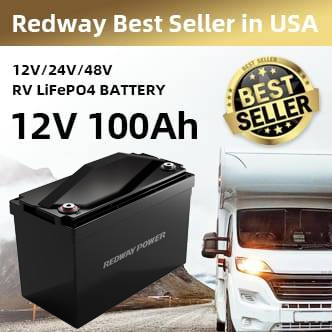
UL‑certified LiFePO4 batteries are now the leading upgrade path for RV owners who want longer off‑grid runtime, faster charging, and significantly safer energy storage than traditional lead‑acid. For modern RVs packed with inverters, AC units, and solar, a properly certified LiFePO4 pack can cut weight by 50–60% while delivering 2–4× the usable capacity and 5–10× the cycle life, making it one of the most measurable improvements a camper can make to their power system. Redway Battery, a Shenzhen‑based OEM LiFePO4 manufacturer with over 13 years of experience, designs purpose‑built RV‑grade packs that combine UL‑style safety, deep‑cycle durability, and OEM‑level customization for both individual RVers and fleet operators.
How big is the RV battery market and why does safety matter?
The global RV battery market is valued at hundreds of millions of dollars and is projected to grow at a mid‑single‑digit compound annual growth rate through the early 2030s, driven by rising RV ownership and longer, more remote trips. As RVs add more electronics, air conditioning, and solar‑ready wiring, the demand for compact, high‑capacity, and safe energy storage has shifted heavily toward lithium‑ion chemistries, especially LiFePO4. At the same time, insurance underwriters, campground operators, and OEMs are increasingly requiring UL or equivalent safety certifications to reduce fire and failure risk in confined, high‑voltage environments.
In practice, many RVers still rely on lead‑acid or uncertified “no‑name” lithium packs that lack robust thermal management, overcharge protection, and third‑party safety validation. These systems often degrade quickly, pose higher fire and venting risks, and can void RV warranties when installed as aftermarket upgrades. The result is a market where performance and safety are mismatched: owners want more power and longer off‑grid time, but many solutions do not meet the same safety bar as residential or commercial energy‑storage systems.

What problems do RV owners face with current battery options?
Most RVs still ship with flooded or AGM lead‑acid batteries that are heavy, short‑lived, and inefficient. A typical 100 Ah lead‑acid bank may only deliver about 40–50 Ah of usable capacity before risking premature failure, forcing frequent generator runs or early campsite hookups. Even when upgraded to basic lithium, many off‑brand packs lack UL certification, proper BMS design, and temperature compensation, leading to thermal runaway, cell imbalance, or sudden shutdowns in extreme weather.
Another key pain point is weight and space. Lead‑acid batteries can weigh 60–70 lb per 100 Ah, whereas a comparable LiFePO4 pack may weigh 25–30 lb, freeing payload for water, gear, or solar. Yet many RVers either keep the factory lead‑acid bank or install undersized lithium that cannot support inverter loads, creating a “power gap” where the RV feels underpowered despite the upgrade. Redway Battery addresses this by offering UL‑style‑tested LiFePO4 packs in common RV voltages (12 V, 24 V, 48 V) with capacities from 100 Ah up to multi‑kWh configurations tailored to specific floorplans and usage profiles.

Why are uncertified or generic LiFePO4 packs risky in RVs?
Generic or uncertified LiFePO4 batteries often cut corners on cell quality, BMS sophistication, and safety testing. Many lack UL 1973 or UL 9540‑type certification for energy‑storage systems, which cover thermal stability, overcharge, short‑circuit, and mechanical‑abuse scenarios. In an RV, where batteries sit under floors, in basements, or near living spaces, any thermal event can escalate quickly due to limited ventilation and proximity to flammable materials.
These packs also frequently use low‑grade cells, inconsistent welding, and basic BMS firmware that does not adapt to temperature, charge rate, or partial‑state‑of‑charge cycling. The outcome is reduced cycle life, frequent balancing issues, and higher chances of field failures that are difficult to diagnose and repair on the road. By contrast, UL‑certified LiFePO4 systems are engineered for long‑term cycling in variable conditions and must pass standardized abuse tests, giving RV owners a much more predictable and safer ownership experience.
How do UL‑certified LiFePO4 batteries outperform traditional lead‑acid?
UL‑certified LiFePO4 batteries for RVs typically deliver 2,000–5,000+ cycles at 80% depth of discharge, versus 300–500 cycles for AGM and even fewer for flooded lead‑acid. This translates into 5–10 years of daily cycling versus 2–4 years, even when used aggressively for boondocking and solar charging. LiFePO4 also holds voltage more steadily under load, so inverters and appliances run more efficiently and without the “brownout” sag common with lead‑acid.
From a usability standpoint, LiFePO4 packs can be discharged down to 80–90% state of charge without significant degradation, effectively doubling or tripling usable capacity versus lead‑acid. They also accept higher charge currents, allowing solar and shore‑power systems to refill them in 2–4 hours instead of 6–10 hours. Redway Battery’s RV‑focused LiFePO4 lines integrate smart BMS with Bluetooth monitoring, temperature‑based charge control, and configurable charge profiles, so owners can tune performance to their specific solar setup, inverter size, and travel patterns.
What are the main limitations of traditional RV battery solutions?
Lead‑acid batteries remain popular because of low upfront cost and wide compatibility, but their limitations are well documented. They are heavy, require frequent watering or maintenance, and suffer from sulfation when left partially charged, which is common in seasonal RV use. Even when paired with solar, lead‑acid rarely reaches full state of charge, accelerating degradation and reducing effective capacity over time.
Basic lithium‑ion packs (non‑LiFePO4) can offer higher energy density but often trade safety and cycle life for cost and performance. NMC‑based cells, for example, are more sensitive to overcharge, high temperatures, and deep cycling, making them less ideal for the stop‑and‑go charging patterns of RV solar and generator use. In contrast, LiFePO4 chemistry is inherently more thermally stable, with a lower risk of thermal runaway and better tolerance for partial‑state‑of‑charge operation, which is why UL‑certified LiFePO4 is becoming the default for RV energy storage.
How does a UL‑certified LiFePO4 solution work for RVs?
A UL‑certified LiFePO4 RV battery is a modular, deep‑cycle energy‑storage system built around high‑quality LFP cells, a multi‑layer BMS, and robust mechanical and electrical design. The BMS continuously monitors cell voltage, temperature, current, and state of charge, enforcing safe charge and discharge limits, balancing cells, and communicating with external chargers and inverters via CAN, RS‑485, or Bluetooth. In an RV context, this means the battery can safely handle solar input, shore‑power chargers, and inverter loads without manual intervention.
These systems are typically designed for 12 V, 24 V, or 48 V nominal voltages and can be paralleled or stacked to create multi‑kWh banks that power rooftop AC units, microwaves, induction cooktops, and large inverters. Redway Battery’s RV‑oriented LiFePO4 packs include features such as low‑temperature charge cutoff, configurable charge‑current limits, and SOC reporting, enabling precise integration with common RV solar controllers and inverter‑chargers. The packs are also engineered for vibration resistance and long‑term cycling, which is critical for road‑going RVs and trailers.
What key features should you look for in an RV LiFePO4 battery?
When evaluating UL‑certified LiFePO4 batteries for RV use, several technical and operational features determine real‑world performance and safety. Capacity (Ah) and usable energy (kWh) must align with your daily load profile, while voltage compatibility with existing inverters and converters is non‑negotiable. A robust BMS with cell‑level monitoring, temperature sensing, and configurable charge parameters is essential for longevity and safety.
Other important features include low‑temperature protection, Bluetooth or CAN‑based monitoring, and compatibility with common RV chargers and solar charge controllers. Physical attributes such as weight, dimensions, and mounting options also matter, since RV battery bays are often tight and weight‑sensitive. Redway Battery’s RV LiFePO4 offerings are designed around these criteria, with OEM‑style customization for capacity, voltage, and BMS logic so that each pack can be tailored to specific RV models and usage scenarios.
How does a UL‑certified LiFePO4 solution compare to traditional options?
The table below compares UL‑certified LiFePO4 batteries with traditional lead‑acid and generic lithium‑ion packs commonly used in RVs.
| Feature | Lead‑acid (AGM/Flooded) | Generic lithium‑ion (non‑UL) | UL‑certified LiFePO4 |
|---|---|---|---|
| Typical cycle life | 300–500 cycles | 500–1,500 cycles | 2,000–5,000+ cycles |
| Usable capacity at 50% DoD | ~50% of rated Ah | ~70–80% of rated Ah | ~80–90% of rated Ah |
| Weight per 100 Ah | 60–70 lb | 30–40 lb | 25–35 lb |
| Charge acceptance (C‑rate) | 0.1–0.2 C | 0.5–1.0 C | 0.5–1.0 C |
| Safety certification | Rarely UL 1973/9540 | Often none | UL 1973 / 9540 style |
| Thermal stability | Moderate | Low to moderate | High |
| Maintenance requirements | High (watering, venting) | Low | Very low |
| Typical lifetime in RV use | 2–4 years | 3–6 years | 8–12+ years |
UL‑certified LiFePO4 systems clearly outperform lead‑acid in cycle life, usable capacity, and weight, while also offering better safety and predictability than uncertified lithium packs. Redway Battery’s UL‑style‑tested LiFePO4 RV batteries sit firmly in the “certified LiFePO4” column, combining long‑term durability with OEM‑grade engineering for both individual RVers and commercial fleets.
What does the installation and configuration process look like?
Installing a UL‑certified LiFePO4 battery in an RV follows a structured workflow that begins with load analysis and ends with system validation. First, owners or installers calculate daily energy consumption (in kWh) and peak inverter loads to size the battery bank appropriately. Next, they verify compatibility with existing chargers, inverters, and solar controllers, ensuring the system can deliver the required charge and discharge currents.
The physical installation involves securing the battery in a well‑ventilated, accessible location, connecting positive and negative leads with proper fusing, and integrating the BMS communication lines if present. After installation, the system is commissioned by performing a full charge‑discharge cycle, verifying SOC accuracy, and configuring any Bluetooth or CAN settings. Redway Battery supports this process with technical documentation, OEM‑style wiring diagrams, and 24/7 after‑sales service, helping both DIY RVers and professional installers achieve a reliable, code‑compliant upgrade.
Which user scenarios benefit most from UL‑certified LiFePO4?
1. Full‑time boondockers with solar
Full‑time RVers who live off‑grid for weeks at a time often struggle with lead‑acid capacity and generator noise. A traditional setup might include two 100 Ah AGM batteries, delivering roughly 100 Ah of usable energy and requiring generator runs every 1–2 days. After switching to a UL‑certified 200 Ah LiFePO4 bank, the same user can access about 160–180 Ah of usable capacity, extending boondocking by 2–3 days between generator runs and reducing fuel costs by 30–50%. Redway Battery’s RV‑oriented LiFePO4 packs, with integrated BMS and solar‑friendly charge profiles, make this transition straightforward and highly measurable.
2. Weekend warriors with limited payload
Weekend RVers often face strict payload limits that make heavy lead‑acid banks impractical. A typical travel trailer with a 400 lb battery allowance may only fit two 100 Ah AGM batteries, weighing about 140 lb and offering limited usable capacity. By replacing them with a 200 Ah LiFePO4 pack weighing around 60 lb, the same user gains roughly double the usable energy while freeing up 80 lb of payload for water, gear, or solar panels. Redway Battery’s lightweight, high‑density LiFePO4 modules are particularly attractive for this segment, enabling more capability without exceeding GVWR.
3. Commercial RV fleets and rental companies
Rental and fleet operators need batteries that last, require minimal maintenance, and minimize downtime. Lead‑acid banks in rental RVs often fail within 2–3 years due to inconsistent charging and deep cycling, driving up replacement and labor costs. A UL‑certified LiFePO4 system can reduce annual battery replacement costs by 40–60% over a 10‑year horizon, thanks to its extended cycle life and reduced maintenance. Redway Battery’s OEM/ODM services allow fleet managers to standardize on a single, UL‑style‑certified LiFePO4 platform across multiple RV models, simplifying procurement, training, and warranty support.
4. High‑end Class A and fifth‑wheel owners
Owners of large Class A motorhomes and fifth‑wheels often run high‑power loads such as rooftop AC units, induction cooktops, and large inverters. Traditional lead‑acid banks struggle to supply the required surge currents and quickly sag under load, forcing early generator starts. A UL‑certified 48 V LiFePO4 bank with 400–600 Ah capacity can deliver sustained high‑power output without voltage collapse, enabling silent‑mode operation for several hours. Redway Battery’s custom LiFePO4 solutions for high‑end RVs include multi‑kWh configurations, advanced BMS logic, and OEM‑style integration that match the sophistication of modern luxury RV electrical systems.
Why is now the right time to upgrade to UL‑certified LiFePO4?
The convergence of RV electrification, solar adoption, and stricter safety expectations makes 2026 a pivotal year for RV battery upgrades. As more RVs ship with factory‑installed lithium or lithium‑ready wiring, aftermarket owners are under pressure to match OEM‑grade safety and performance. UL‑certified LiFePO4 batteries offer a clear upgrade path that improves runtime, reduces weight, and lowers long‑term operating costs while meeting evolving insurance and campground requirements.
Redway Battery is positioned to support this transition with UL‑style‑tested LiFePO4 packs, four advanced factories, and a 100,000 ft² production area that ensures consistent quality and scalability. For RV owners, installers, and fleet operators, adopting UL‑certified LiFePO4 is no longer a luxury but a practical investment in safety, reliability, and off‑grid capability.
Does a UL‑certified LiFePO4 battery fit my existing RV system?
Most UL‑certified LiFePO4 batteries are designed to replace lead‑acid banks in common RV voltages (12 V, 24 V, 48 V) and can interface with standard RV chargers, inverters, and solar controllers. However, it is important to verify compatibility with your specific charger’s voltage and current limits, as well as any low‑voltage cutoff settings that may need adjustment. Redway Battery provides detailed compatibility matrices and technical support to ensure a seamless retrofit without requiring major rewiring.
How much can I expect to save by switching from lead‑acid to LiFePO4?
Over a 10‑year period, switching from lead‑acid to UL‑certified LiFePO4 can reduce total battery replacement costs by 40–60%, depending on usage intensity and local labor rates. The higher upfront cost of lithium is offset by longer cycle life, reduced maintenance, and fewer generator hours, which translate into lower fuel, service, and downtime expenses. Redway Battery’s OEM‑grade LiFePO4 packs are engineered to maximize this payback by combining high cycle life with low‑maintenance operation.
Are UL‑certified LiFePO4 batteries safe for use inside RVs?
Yes, UL‑certified LiFePO4 batteries are specifically designed for safe operation in confined spaces, including RVs, homes, and commercial vehicles. They undergo standardized abuse testing for thermal stability, overcharge, short‑circuit, and mechanical impact, and incorporate multi‑layer BMS protection to prevent unsafe conditions. Redway Battery’s RV‑focused LiFePO4 systems include temperature‑based charge cutoff, cell‑level monitoring, and robust enclosures that meet or exceed common RV safety expectations.
Can I install a UL‑certified LiFePO4 battery myself?
Many RV owners can install a UL‑certified LiFePO4 battery themselves if they have basic electrical skills and follow manufacturer guidelines. The process typically involves calculating load requirements, verifying charger compatibility, securing the battery in a safe location, and connecting positive and negative leads with proper fusing. Redway Battery provides installation guides, wiring diagrams, and technical support to help DIYers complete the upgrade safely and correctly.
How long do UL‑certified LiFePO4 batteries last in RV use?
In typical RV use, UL‑certified LiFePO4 batteries can last 8–12+ years, depending on depth of discharge, charge profile, and temperature conditions. At 80% depth of discharge, many LiFePO4 packs deliver 2,000–5,000+ cycles, far exceeding the 300–500 cycles of lead‑acid batteries. Redway Battery’s RV‑oriented LiFePO4 lines are designed for long‑term cycling and include features such as low‑temperature protection and adaptive BMS logic to maximize lifespan in real‑world conditions.
Sources
-
RV Battery Market Research Report (2026–2034)
-
RV Energy Storage Battery Industry Research Report (2026–2033)
-
RV Energy Storage Lithium Battery Market Analysis (2024–2031)
-
Redway Battery LiFePO4 RV Battery Overview
-
Redway Power OEM LiFePO4 Solutions Guide
-
Comprehensive Guide to Redway Battery Lithium Solutions
-
RV Energy Storage Battery Market Dynamics and Trends
-
UL Standards for Stationary Energy Storage Systems (UL 1973, UL 9540)