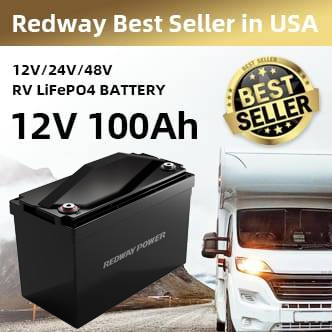
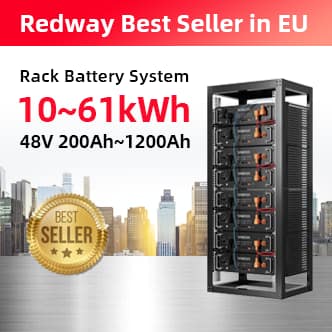
High‑energy‑density LiFePO4 RV battery packs are rapidly becoming the default choice for modern recreational vehicles, replacing aging lead‑acid systems with safer, lighter, and longer‑lasting energy storage. These packs deliver deep cycling, faster charging, and significantly lower lifetime cost per kilowatt‑hour, making them a core enabler of extended boondocking, solar integration, and full‑time RV living. Redway Battery, a trusted OEM lithium battery manufacturer based in Shenzhen, China, has positioned itself as a key supplier of high‑performance LiFePO4 packs tailored to RV builders, fleets, and aftermarket installers.
What Is Driving the Shift to LiFePO4 in the RV Market?
The global RV lithium‑ion energy storage battery market was valued at around 901 million USD in 2024 and is projected to reach roughly 1.29 billion USD by 2034, growing at about 5.5% annually. Within this segment, Lithium Iron Phosphate (LiFePO4) chemistry already accounts for more than 60% of RV lithium installations, driven by its superior thermal stability, safety, and long‑term reliability. As RV owners take longer trips, add more appliances, and rely on solar, the limitations of traditional lead‑acid banks have become increasingly visible.
RV owners report frequent issues such as short usable capacity, slow recharge, and high maintenance labor. A typical 200 Ah AGM bank offers only about 50% depth of discharge, meaning roughly 100 usable Ah, while a comparable LiFePO4 pack can deliver 80–100% depth of discharge, effectively doubling usable energy. At the same time, lead‑acid banks often need replacement every 2–3 years, whereas quality LiFePO4 packs can exceed 3,000–5,000 full cycles, pushing usable life toward 8–10 years under normal RV usage.

Weight is another major constraint. A 200 Ah lead‑acid bank can weigh 60–70 kg, whereas a comparable LiFePO4 bank may weigh only 25–30 kg, improving fuel efficiency, payload capacity, and handling. In mobile environments such as RVs, this difference directly affects range, comfort, and operating cost, especially for full‑time travelers and commercial fleets. Redway Battery’s LiFePO4 RV packs are engineered to maximize energy density while minimizing weight, making them attractive for both OEM and aftermarket upgrades.
How Do Traditional RV Battery Solutions Fall Short?
Lead‑acid batteries—flooded, AGM, and gel—remain common in many RVs, but their performance profile no longer matches modern expectations. Flooded lead‑acid batteries require regular watering, venting of hydrogen gas, and strict orientation, which complicates installation in tight RV compartments. AGM and gel variants reduce maintenance but still suffer from limited cycle life, slower charge acceptance, and sensitivity to partial‑state‑of‑charge operation.

From an efficiency standpoint, traditional lead‑acid systems typically achieve only about 70–80% energy efficiency, meaning 20–30% of the energy from the alternator, shore power, or solar is lost as heat during charging and discharging. In contrast, LiFePO4 packs can reach 95–98% energy efficiency, allowing more of the generated solar or generator power to actually reach the loads. For RV owners relying on solar, this difference can translate into fewer panels, smaller generators, or longer off‑grid stays.
Thermal safety is another concern. Lead‑acid batteries can vent hydrogen under overcharge or high‑temperature conditions, creating explosion and corrosion risks. LiFePO4 chemistry, by comparison, exhibits high thermal stability and resists thermal runaway even under abuse, which is critical in enclosed RV spaces. Redway Battery’s LiFePO4 RV packs integrate robust battery management systems (BMS) that monitor cell voltage, temperature, and current in real time, further enhancing safety and longevity.
What Makes High‑Energy‑Density LiFePO4 RV Battery Packs Different?
High‑energy‑density LiFePO4 RV battery packs combine advanced cell chemistry, intelligent BMS, and optimized mechanical design to deliver more usable energy in less space and weight. These packs typically offer cycle lives exceeding 3,000–5,000 full cycles while maintaining 80% or more of their rated capacity, far surpassing the 300–500 cycles typical of quality AGM batteries. Usable capacity can reach 80–100% of the nominal Ah rating, compared with the 50% limit often recommended for lead‑acid.
Key technical capabilities include:
-
Deep cycling down to 80–100% depth of discharge without significant degradation.
-
Fast charging acceptance, often supporting charge rates up to 0.5C–1C depending on pack design.
-
Wide operating temperature range, typically −20°C to +60°C for discharge and 0°C to +45°C for charging.
-
Integrated BMS with overcharge, overdischarge, short‑circuit, and temperature protection.
-
Communication interfaces such as CAN, RS485, or Bluetooth for state‑of‑charge and health monitoring.
Redway Battery’s LiFePO4 RV packs are produced in Shenzhen‑based factories with automated production lines, MES‑driven quality control, and ISO 9001:2015 certification. This infrastructure supports OEM/ODM customization of voltage (12 V, 24 V, 48 V), capacity (100 Ah, 200 Ah, 300 Ah and beyond), form factor, and BMS behavior, enabling RV builders to integrate the packs directly into existing electrical architectures.
How Do LiFePO4 RV Packs Compare with Traditional Batteries?
The table below highlights key differences between traditional lead‑acid RV batteries and high‑energy‑density LiFePO4 packs:
| Parameter | Traditional Lead‑Acid (AGM/Flooded) | High‑Energy‑Density LiFePO4 RV Packs |
|---|---|---|
| Typical cycle life | 300–500 full cycles | 3,000–5,000 full cycles |
| Usable depth of discharge | ~50% recommended | 80–100% usable |
| Energy efficiency | ~70–80% | ~95–98% |
| Weight (200 Ah equivalent) | 60–70 kg | 25–30 kg |
| Charging speed | Slow, limited by gassing risk | Fast, supports 0.5C–1C charging |
| Maintenance | Regular watering/vent checks | Virtually maintenance‑free |
| Safety profile | Hydrogen venting, acid spill risk | High thermal stability, low runaway risk |
| Lifetime cost per kWh | Higher due to frequent replacement | Lower over 8–10 years |
Redway Battery’s LiFePO4 RV solutions sit firmly on the right‑hand side of this comparison, combining long life, low weight, and high safety with OEM‑grade build quality and customization options. Their packs are engineered for integration with solar charge controllers, inverters, and monitoring displays, which simplifies adoption for dealers and installers.
How Can You Implement a LiFePO4 RV Battery System Step by Step?
Deploying high‑energy‑density LiFePO4 RV battery packs follows a structured workflow that aligns with both OEM integration and aftermarket upgrades:
-
Assess power requirements. Calculate daily energy consumption in watt‑hours by summing the power draw and runtime of all loads (lights, fridge, water pump, inverter loads, etc.). Add a 20–30% buffer for inefficiencies and unexpected usage.
-
Select pack voltage and capacity. Choose between 12 V, 24 V, or 48 V based on existing inverter and charger compatibility. For example, a 200 Ah 12 V LiFePO4 pack provides roughly 2.4 kWh of usable energy at 80% depth of discharge.
-
Verify charging compatibility. Ensure alternator, shore‑power charger, and solar charge controller support lithium‑specific charge profiles (absorption voltage around 14.2–14.6 V and float around 13.5–13.6 V for 12 V systems). Some setups may require a DC‑DC charger or programmable charger.
-
Design mechanical layout. Position the pack in a well‑ventilated, temperature‑stable area, avoiding direct exposure to extreme heat or cold. Use vibration‑resistant mounting hardware suitable for RV travel.
-
Integrate BMS and monitoring. Connect the pack’s BMS to a display or monitoring system to track state of charge, voltage, current, and temperature. Redway Battery’s packs support common communication protocols, enabling real‑time diagnostics and remote troubleshooting.
-
Test and commission. Perform a full charge‑discharge cycle under controlled conditions, validate all safety protections, and confirm compatibility with inverters and solar controllers before extended off‑grid use.
Which RV Use Cases Benefit Most from LiFePO4 Packs?
1. Full‑time RV living
Problem: A couple living full‑time in a Class C RV struggles with frequent battery replacements, short boondocking time, and limited solar utilization.
Traditional practice: Using 200 Ah AGM banks limited to 50% depth of discharge, replaced every 2–3 years.
After switching: The couple installs a 200 Ah LiFePO4 pack from Redway Battery, allowing 80–100% depth of discharge and integration with their existing solar array.
Key benefits: Usable energy effectively doubles, boondocking duration extends from 1–2 days to 4–5 days, and battery replacements drop from every 2–3 years to once per decade, reducing lifetime cost and maintenance.
2. RV rental fleet operator
Problem: A large RV rental company faces frequent battery failures, high maintenance labor, and customer complaints about short “boondocking” time.
Traditional practice: Deploying 200 Ah AGM banks with 50% depth‑of‑discharge limits and replacements every 2–3 years.
After switching: The operator deploys 200 Ah LiFePO4 packs with integrated BMS across the fleet, allowing 80–100% depth of discharge and extending usable life to 8–10 years.
Key benefits: Maintenance labor and spare‑parts inventory drop sharply, customer satisfaction improves due to longer off‑grid capability, and total cost of ownership per RV decreases by roughly 30–40% over a 10‑year horizon.
3. Solar‑powered RV conversion
Problem: An owner converting a van or small RV to solar wants to maximize off‑grid capability but is constrained by battery weight and inefficiency.
Traditional practice: Using 200 Ah AGM banks that add significant weight and only partially utilize solar output due to slow charging and low efficiency.
After switching: The owner installs a lightweight 200 Ah LiFePO4 pack with high energy efficiency and fast charging acceptance, paired with a 400–600 W solar array.
Key benefits: Solar harvest increases by 15–25% due to higher charging efficiency, usable capacity doubles, and the lighter pack improves fuel economy and payload, enabling more gear or passengers.
4. Commercial service RV (e.g., mobile workshop)
Problem: A mobile service RV used for on‑site repairs requires reliable power for tools, lighting, and communication equipment, but lead‑acid banks fail under deep‑cycling conditions.
Traditional practice: Using heavy flooded lead‑acid banks that degrade quickly when cycled daily.
After switching: The operator replaces the lead‑acid bank with a 300 Ah LiFePO4 pack from Redway Battery, designed for deep‑cycling and frequent charge‑discharge cycles.
Key benefits: Daily deep‑cycling no longer shortens battery life, tools and equipment run reliably throughout the workday, and the lighter pack improves vehicle handling and fuel efficiency.
Why Should RV Builders and Owners Adopt LiFePO4 Now?
The RV lithium battery market is projected to grow steadily, with lithium‑ion technologies gaining substantial share over the forecast period due to higher energy density, longer lifespan, and better performance. As RV owners take longer trips, add more electronics, and rely on solar, the gap between traditional lead‑acid systems and modern LiFePO4 packs will only widen. Redway Battery’s LiFePO4 RV packs are positioned to meet this demand with customizable, high‑energy‑density solutions that integrate seamlessly into existing RV electrical systems.
From a cost‑of‑ownership perspective, the higher upfront price of LiFePO4 is offset by longer life, lower maintenance, and higher usable capacity. For OEMs, integrating LiFePO4 from the start simplifies electrical design, reduces warranty claims related to battery failure, and enhances brand reputation for reliability. For aftermarket customers, upgrading to LiFePO4 can transform an aging RV into a modern, off‑grid‑capable platform without major structural changes.
Can You Answer Common Questions About LiFePO4 RV Packs?
Are LiFePO4 RV batteries safe for enclosed spaces?
Yes. LiFePO4 chemistry exhibits high thermal stability and resists thermal runaway even under abuse, making it safer than many other lithium‑ion chemistries. Integrated BMS and proper installation further reduce risk.
How long do high‑energy‑density LiFePO4 RV packs last?
Quality packs can exceed 3,000–5,000 full cycles while retaining 80% or more of their rated capacity, translating to 8–10 years of typical RV use.
Do LiFePO4 RV packs work with existing solar and inverter systems?
Most modern solar charge controllers and inverters support lithium‑specific charge profiles. Some setups may require a DC‑DC charger or programmable charger to match the pack’s voltage and current requirements.
Are LiFePO4 RV packs heavier than lead‑acid?
No. A 200 Ah LiFePO4 pack typically weighs about 25–30 kg, roughly half the weight of a comparable lead‑acid bank, improving fuel efficiency and payload capacity.
Can Redway Battery customize LiFePO4 packs for my RV model?
Yes. Redway Battery offers OEM/ODM customization of voltage, capacity, form factor, and BMS behavior, enabling RV builders and distributors to specify packs tailored to their exact use cases.
Sources
https://www.redway-tech.com/how-wholesale-lifepo4-rv-lithium-battery-solutions-are-transforming-the-mobile-power-market/
https://www.redwaypower.com/zh-CN/lifepo4-%E6%88%BF%E8%BD%A6%E7%94%B5%E6%B1%A0/
https://www.redwaybattery.com/zh-CN/blog/
https://www.datainsightsmarket.com/reports/rv-battery-109442
https://www.evlithium.com/Blog/lifepo4-battery-market.html