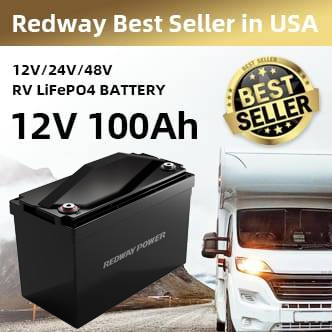
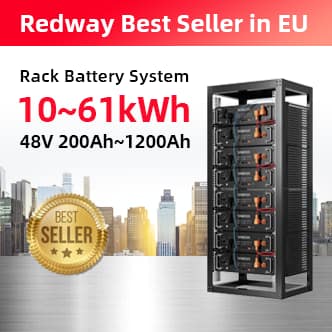
Global RV ownership and off‑grid camping are growing fast, yet most RVs still rely on aging lead‑acid batteries that waste solar energy and limit true energy independence. As lithium technology matures, solar compatible RV lithium battery energy storage systems—especially LiFePO4 solutions from experienced OEMs like Redway Battery—are becoming a decisive upgrade for longer run‑time, safer operation, and lower lifetime cost.
What is the current state of RV energy use and what pain points exist?
The RV market has expanded significantly in the last decade, with more owners demanding “home‑like” power for air conditioners, induction cooktops, laptops, and entertainment systems during off‑grid trips. At the same time, boondocking and solar adoption are increasing, which puts far more pressure on onboard batteries to store and deliver reliable energy over many hours. This creates a gap between traditional battery capabilities and modern power expectations.
Many RVs still ship with flooded or AGM lead‑acid batteries that typically allow only 50% usable capacity, suffer from voltage drop under load, and degrade quickly under deep cycling. This forces owners to oversize banks, tolerate frequent recharging, or run noisy generators for basic comfort. For long‑term travelers, high depth of discharge, maintenance needs, and shorter cycle life translate into unexpected replacement costs and reduced resale value.

As more users install rooftop solar, the limitations of lead‑acid chemistry become more obvious: poor charge acceptance at higher states of charge, inefficiency during partial‑state‑of‑charge operation, and sensitivity to temperature all mean that much of the available solar energy is underutilized. A solar compatible RV lithium battery system directly addresses these pain points by providing higher usable capacity, faster charging, and better efficiency across common real‑world conditions.
How do traditional RV battery solutions fall short for solar systems?
Traditional RV battery setups rely on flooded or AGM lead‑acid batteries paired with basic converters and sometimes under‑optimized solar charge controllers. While this has been the norm for decades, the design assumptions no longer match today’s loads.

Key limitations of lead‑acid in RV solar applications include:
Low usable depth of discharge: Typically 50% recommended to preserve cycle life, which effectively halves nameplate capacity.
Shorter cycle life: Heavy cycling for boondocking can wear out a lead‑acid bank in a few years.
Lower round‑trip efficiency: More energy is lost between charging and discharging, which is critical when relying on finite solar input.
Slower charging: Lead‑acid absorbs current more slowly as it approaches full charge, making it harder to recover from cloudy days.
Maintenance requirements: Flooded cells require regular watering and equalization, which is inconvenient during travel.
These technical constraints mean RV owners must either accept frequent generator use, add extra weight and space for larger banks, or reduce comfort and appliance use. In contrast, modern LiFePO4 lithium solutions from OEMs like Redway Battery are engineered to deliver deeper usable capacity, faster charge rates, and significantly longer cycle life, making them better aligned with solar‑driven energy strategies.
What makes solar compatible RV lithium battery systems different?
Solar compatible RV lithium battery systems, especially those based on LiFePO4 chemistry, are designed to integrate tightly with RV solar arrays, inverters, and DC loads. A solution from a manufacturer such as Redway Battery combines high‑quality lithium cells, an intelligent battery management system (BMS), and optional communication interfaces to ensure safe, efficient operation in mobile environments.
Core functional elements typically include:
LiFePO4 cell packs: Deliver high cycle life, stable voltage, and improved safety compared to other lithium chemistries.
Integrated BMS: Protects against over‑charge, over‑discharge, over‑current, short circuit, and temperature extremes while balancing cells.
Solar compatibility: Voltage ranges and charge algorithms matched to MPPT or PWM solar controllers for optimal harvest.
Modular capacities: Common 12 V, 24 V, and 48 V modules (e.g., 100–300 Ah) that can be scaled in parallel or series for different RV sizes.
Mechanical robustness: Enclosures designed for vibration, dust, and moisture in mobile and outdoor environments.
Redway Battery, with more than a decade of OEM lithium experience, offers LiFePO4 battery packs purpose‑built for applications like RVs, golf carts, forklifts, telecom backup, and stationary energy storage. Their RV‑oriented lithium modules are engineered to handle repeated deep cycling, provide stable power to inverters, and support long‑term reliability required by full‑time travelers.
Which advantages does a lithium solution offer over traditional batteries?
Are lithium RV batteries more efficient and longer lasting?
Compared to traditional lead‑acid banks, LiFePO4 RV batteries typically deliver:
Higher usable capacity: Up to 80–90% depth of discharge while maintaining long cycle life.
Longer lifespan: Thousands of cycles under proper use, often translating to 8–10 years of service in RV applications.
Better round‑trip efficiency: More of the solar energy captured is actually stored and available for use.
Stable voltage: Appliances and inverters operate more consistently across the discharge curve.
Redway Battery’s RV‑ready lithium products are designed to deliver high cycle counts and maintain capacity over time, which directly reduces replacement frequency and total cost of ownership. For solar RV users, this means more stored energy each day from the same number of panels and less worry about battery degradation on long trips.
Is lithium safer for RV and solar applications?
LiFePO4 chemistry is intrinsically more stable than many other lithium chemistries, with a lower risk of thermal runaway when combined with a competent BMS. For RV users, key safety benefits include:
Reduced fire risk versus less stable chemistries when appropriately engineered.
Integrated protections that automatically disconnect loads or chargers in unsafe conditions.
Wide operating temperature ranges suited for outdoor travel, especially when cold‑charge features and heating options are included.
As a specialized OEM, Redway Battery focuses on LiFePO4 technology and integrates robust BMS architectures and quality control systems across its four factories and automated production lines. This engineering depth is especially important for RV installations, where vibration, temperature swings, and varying charge sources are the norm.
What does a traditional vs lithium RV energy solution look like?
How does performance compare in practice?
Below is a simplified contrast between a typical lead‑acid setup and a solar compatible LiFePO4 solution such as a system built around Redway Battery packs.
| Aspect | Traditional lead‑acid RV battery system | Solar compatible LiFePO4 RV system (e.g., Redway Battery) |
|---|---|---|
| Usable capacity | ~50% of rated Ah to preserve life | ~80–90% of rated Ah usable without severe degradation |
| Cycle life | Often a few hundred deep cycles | Often several thousand deep cycles under proper use |
| Round‑trip efficiency | Lower, more energy lost in charging/discharging | Higher, more of the solar energy stored and available |
| Charge speed | Slower, especially near full charge | Faster acceptance over broad state‑of‑charge range |
| Weight and volume | Heavier and bulkier per usable kWh | Lighter and more compact per usable kWh |
| Maintenance | Watering and periodic equalization for flooded types | Minimal routine maintenance required |
| Voltage stability | Noticeable voltage sag under load | More stable voltage throughout discharge |
| Integration with solar | Less tolerant of partial‑state‑of‑charge operation | Well‑suited for daily solar cycling and partial charges |
How can RV owners implement a solar compatible lithium battery solution step by step?
A practical implementation roadmap helps ensure that an RV lithium upgrade is both technically sound and cost‑effective.
Define energy needs
List typical daily loads: lights, water pump, fans, laptops, fridge, air conditioning, cooking devices.
Estimate daily watt‑hours and peak inverter load to size both battery bank and solar array.
Select battery configuration
Choose nominal system voltage (12 V, 24 V, or 48 V) based on inverter and existing wiring.
Decide required amp‑hours and number of modules; for example, multiple 12 V LiFePO4 packs from Redway Battery in parallel for increased capacity.
Verify solar and charging compatibility
Ensure solar charge controller supports LiFePO4 or custom charge profiles.
Confirm alternator charging and shore charger/converter can be configured for lithium or replaced if necessary.
Plan mechanical installation
Evaluate available battery compartment space, ventilation, and cable routing.
Confirm mounting provisions, enclosure ingress protection, and cable sizing for expected currents.
Integrate BMS and monitoring
Use batteries with integrated BMS suitable for RV use; Redway Battery packs incorporate protection and balancing functions.
Add monitoring (voltage, SOC, current, temperature) via shunt monitors or communication interfaces where available.
Perform installation and testing
Disconnect existing power sources, remove lead‑acid bank, and install lithium modules with correct polarity and torque.
Test charging, discharging, and inverter loads progressively to confirm stable operation and absence of nuisance trips.
Optimize operation
Configure charge voltages and limits suitable for LiFePO4 to maximize longevity.
Educate users on avoiding excessive low‑temperature charging or discharging outside specified ranges.
By following structured steps and leveraging OEM support from a supplier such as Redway Battery, RV owners can transition smoothly to a lithium‑centric solar energy system.
Which typical user scenarios show the impact of solar compatible RV lithium batteries?
Case 1: Full‑time digital nomad
Problem: A remote worker living full‑time in an RV needs to power multiple laptops, Starlink, routers, and a small air conditioner while boondocking for days. Lead‑acid batteries are regularly drained below safe levels, cutting work sessions short.
Traditional approach: Large bank of lead‑acid batteries and frequent generator use to recharge, leading to noise, fuel costs, and inconsistent power quality.
After lithium upgrade: A LiFePO4 bank built using high‑capacity Redway Battery modules allows deeper usable capacity and fast solar recovery, powering all office equipment and essential comfort loads throughout the day.
Key benefits: Longer productive hours off‑grid, reduced generator runtime, lower long‑term energy cost, and less worry about voltage sag affecting sensitive electronics.
Case 2: Weekend family camper
Problem: A family that camps on weekends wants quiet nights with reliable lighting, a 12 V fridge, fans, and device charging, but the existing battery bank struggles by the second night.
Traditional approach: Single group‑27 lead‑acid battery with limited usable capacity and no meaningful solar integration. Owners often cut trips short or run the engine to recharge.
After lithium upgrade: A compact 12 V LiFePO4 pack from Redway Battery paired with a rooftop solar panel maintains enough reserve power for two or three days of typical use without generator noise.
Key benefits: More comfortable trips, predictable energy supply, and less battery anxiety, all with minimal extra maintenance.
Case 3: Off‑grid overlander
Problem: An overland RV operating in harsh environments needs dependable power for winches, compressors, lighting, communication gear, and a DC fridge. Temperature swings and rough terrain stress the electrical system.
Traditional approach: AGM batteries that lose capacity in heat or cold, add weight, and require early replacement due to deep cycles and vibration.
After lithium upgrade: Rugged LiFePO4 batteries with robust enclosures and BMS technology from Redway Battery handle frequent deep cycling and dynamic loads while maintaining stable voltage to all equipment.
Key benefits: Higher reliability in remote conditions, weight savings, and longer replacement intervals, which are crucial when resupply is difficult.
Case 4: Luxury motorhome with high AC loads
Problem: A large motorhome with residential appliances and multiple air conditioners requires substantial energy storage to run quietly at night without shore power.
Traditional approach: Multiple large lead‑acid banks and reliance on a generator for air conditioning and power‑hungry appliances, resulting in fuel use and noise complaints.
After lithium upgrade: A high‑capacity LiFePO4 battery system with multiple Redway Battery modules supports a powerful inverter and a substantial solar array, allowing extended quiet hours with partial air conditioning and full household functionality.
Key benefits: Enhanced comfort and premium user experience, quieter operation in campgrounds, and improved overall energy efficiency of the coach.
Why is now the right time to adopt solar compatible RV lithium storage, and what trends shape the future?
Several trends are converging to make lithium‑based RV energy storage—especially LiFePO4 solutions—the new standard rather than a niche upgrade. Battery costs have gradually decreased, solar panel efficiency has improved, and more RVs are wired from the factory with inverter‑ready electrical systems. This ecosystem maturity reduces project complexity and upfront barriers for owners considering the switch.
In parallel, regulatory and campground pressures around noise and emissions are increasing, subtly discouraging extended generator use and favoring clean, quiet solar‑battery systems. Manufacturers like Redway Battery, with large‑scale automated production facilities and ISO‑certified quality systems, are continuously improving cycle life, safety features, and integration capabilities. As remote work and “vanlife” remain popular, RV owners who invest in solar compatible lithium storage today position their rigs for years of flexible, low‑maintenance travel instead of repeating the legacy cycle of replacing lead‑acid banks every few seasons.
Can common concerns about solar compatible RV lithium systems be addressed?
FAQ
Is a solar compatible lithium RV battery safe to use inside the RV? Yes, LiFePO4 batteries designed for RV use and equipped with a robust BMS can be safely installed in appropriate compartments, provided ventilation, wiring, and protections follow manufacturer guidelines.
Can my existing solar panels work with a new lithium battery bank? In most cases, existing solar panels can be reused, but the charge controller must be compatible with LiFePO4 charging profiles or replaced with a suitable MPPT or PWM controller.
Does a lithium upgrade always require replacing the inverter and charger? Not always; many modern inverters and chargers have lithium settings, but older equipment may need replacement or reconfiguration to ensure correct voltage limits and charge curves.
Are Redway Battery lithium packs suitable for both solar and engine charging in RVs? Redway Battery designs its LiFePO4 modules for multi‑source charging environments and supports integration with solar controllers, alternators (with appropriate DC‑DC chargers), and shore power chargers.
What is the typical payback period for switching from lead‑acid to lithium in an RV? While upfront costs are higher, the extended cycle life, reduced generator fuel use, and lower maintenance can make total cost over the life of the system competitive or favorable compared with repeatedly replacing lead‑acid banks.
Can I expand my lithium bank later if my energy needs grow? Many LiFePO4 systems, including those built with scalable Redway Battery modules, support parallel expansion, although it is best to plan for and configure capacity additions according to manufacturer recommendations.
Does temperature affect lithium performance in RVs? Yes, temperature influences performance and charging limits, but quality LiFePO4 packs with integrated BMS and optional cold‑charge features can manage a wide operating range suitable for most RV travel climates.
Sources
Continue exploring: Use the RV Battery Charging & Maintenance guide to compare RV battery specifications, charging decisions, operating requirements, and practical guidance.