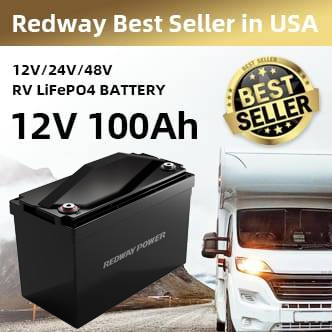
For RV owners who routinely boondock, dry camp, or rely on off-grid power, a long-cycle LiFePO₄ (lithium iron phosphate) battery is no longer a luxury — it’s the most cost-effective, durable, and low-maintenance energy backbone available today. With real-world cycle lives of 3,000 to 7,000 deep cycles, LiFePO₄ batteries can last 10–15 years in typical RV use, slashing long-term replacement costs and downtime while delivering stable, high-power output on demand.
How bad is the current RV battery situation?
The RV battery market is shifting fast, but many owners still rely on decades-old lead-acid chemistry that was never designed for modern off-grid lifestyles. A 2026 global market report shows that the RVs lithium-ion energy storage battery segment is now valued at nearly $1 billion and is expected to grow at a steady 5–6% CAGR over the next decade, driven by demand for lighter, longer-lasting, and higher-efficiency power solutions.
Yet, despite this growth, the average RV still runs on lead-acid or AGM batteries, which typically deliver only 300–500 deep cycles when discharged to 50% depth of discharge. This means most RVers end up replacing house batteries every 2–4 years, which is both expensive and inconvenient, especially for frequent travelers or those using remote areas with limited service access.

Another major pain point is weight and space. Traditional deep-cycle banks are heavy, often weighing 60–100 lb per battery, and they degrade quickly when deeply cycled or left partially charged. This forces many RVers to oversize their battery banks, adding unnecessary weight that reduces fuel efficiency and payload capacity.
What specific problems do RVers face with standard batteries?
1. Short lifespan under real-world use RV owners often cycle their batteries daily when camping off-grid, but lead-acid batteries are not designed for such frequent deep discharges. Even with good maintenance, usable life quickly drops once the battery is regularly cycled below 50% state of charge. This results in a pattern of replacing batteries every few years and paying for installation, labor, and disposal.

2. Hidden capacity loss and “sulfation” Lead-acid batteries suffer from sulfation when they sit at low charge for extended periods, commonly seen during long trips or seasonal storage. This permanently reduces capacity and increases internal resistance, leading to poor performance and premature failure. Many RVers report that their 200 Ah AGM bank only behaves like a 100–120 Ah battery after a couple of seasons.
3. Heavy weight and poor space efficiency A typical 200 Ah AGM bank can weigh 120–150 lb. In a 20–30 ft RV, this eats into payload and can force compromises on other gear. The physical size and weight also make it harder to install in tight compartments or to service without professional help.
4. Inconsistent voltage and sag under load Lead-acid batteries experience significant voltage drop as they discharge, which can cause inverters to shut down early, LED lights to dim, and sensitive electronics to reset. This is especially frustrating when running A/C units, microwaves, or induction cooktops, where stable voltage is critical.
5. Maintenance burden and safety concerns Flooded lead-acid batteries require regular watering, corrosion cleaning, proper ventilation, and correct charging. AGM batteries reduce some of this work but are still sensitive to overcharging and temperature extremes. In contrast, LiFePO₄ batteries are nearly maintenance-free and inherently safer, with much lower risks of thermal runaway.
Why do traditional solutions fall short?
Lead-acid batteries are still widely used, but they are fundamentally mismatched to modern RV power demands:
Low usable capacity A 200 Ah AGM battery should only be discharged to 50% (100 usable Ah) to avoid damage. In practice, many RVers end up with only 60–70 usable Ah due to voltage sag and capacity loss, forcing them to run generators or shore power more often.
Short cycle life at deep discharge Even “deep-cycle” lead-acid batteries see life drop to 300–500 cycles when cycled to 50%; going deeper severely shortens it. In contrast, a long-cycle LiFePO₄ battery can handle 80–100% depth of discharge for thousands of cycles.
Slow recharge and poor acceptance Lead-acid batteries have a narrow charging window and slow absorption phase. They struggle to accept high current from solar or alternators, especially when cold, leading to undercharging and reduced capacity.
Heavy and space-inefficient Achieving meaningful off-grid runtime requires multiple large batteries, which adds hundreds of pounds and consumes valuable bays that could be used for storage or water tanks.
Many RVers who upgrade to LiFePO₄ report that they could cut their battery bank size by 30–50% while gaining more usable energy, longer runtime, and far less maintenance.
How do long-cycle LiFePO₄ batteries solve these problems?
A purpose-built, long-cycle LiFePO₄ battery for RVs is engineered to deliver high performance, reliability, and longevity in a mobile environment. These batteries use lithium iron phosphate chemistry, which is inherently safe, thermally stable, and designed for deep-cycle applications.
Core capabilities
3,000–7,000+ deep cycles at 80–100% DOD Instead of 300–500 cycles, a quality LiFePO₄ battery can last for thousands of deep cycles, translating to 10–15+ years of daily use in typical RV boondocking.
80–100% depth of discharge Nearly all of the rated capacity is usable, so a 100 Ah LiFePO₄ battery delivers roughly 80–100 usable Ah, compared to 50 Ah for a 100 Ah AGM.
Lightweight and compact LiFePO₄ batteries are typically 50–60% lighter than lead-acid counterparts. A 100 Ah LiFePO₄ battery often weighs 25–30 lb vs. 60–70 lb for AGM, freeing up payload and cabinet space.
Fast charging and high charge acceptance These batteries can accept high current from solar, alternator, and shore chargers, allowing them to recharge in a few hours instead of many, especially when paired with multi-stage or lithium-specific chargers.
Built-in BMS and protection Modern LiFePO₄ packs include a battery management system (BMS) that protects against overcharge, over-discharge, over-current, short circuit, and high/low temperatures, significantly improving safety and reliability.
Redway Battery designs and manufactures long-cycle LiFePO₄ batteries specifically for RV and off-grid applications, offering OEM/ODM support to match voltage, capacity, form factor, and BMS settings to the exact needs of different RVs and camper vans.
What are the key advantages vs. traditional RV batteries?
Below is a practical comparison of a typical long-cycle 12 V LiFePO₄ battery versus a flooded lead-acid bank of similar nominal capacity:
| Feature | Traditional Lead-Acid (Flooded/AGM) | Long-Cycle LiFePO₄ (RV Grade) |
|---|---|---|
| Typical cycle life (80% DOD) | 300–500 cycles | 3,000–7,000 cycles |
| Usable depth of discharge | 50% max (to avoid damage) | 80–100% safe |
| Weight (per 100 Ah) | 60–70 lb | 25–32 lb |
| Charge efficiency | 70–85% | 95–99% |
| Charge acceptance speed | Slow absorption, narrow window | Very high, accepts 0.5–1C+ |
| Maintenance required | Watering, cleaning, equalization | Nearly maintenance-free |
| Voltage stability under load | Sags significantly, drops early | Very stable, minimal sag |
| Self-discharge rate | 3–5% per month | 1–3% per month |
| Temperature performance | Poor at low temps, degrades at high | Good across -20°C to 60°C |
| Lifespan (typical RV use) | 2–5 years | 10–15 years |
| Total cost of ownership | High (frequent replacements) | Lower over 10+ years |
Redway Battery’s RV LiFePO₄ modules are built to this modern standard, using high-quality LiFePO₄ cells and robust BMS to ensure long cycle life, safety, and compatibility with solar, inverters, and RV charging systems.
How to choose and install a long-cycle LiFePO₄ battery for an RV?
Step 1: Calculate your energy needs
Track daily power use (in Ah or kWh) from lights, fridge, water pump, fans, and inverter loads.
Aim for a battery bank that can cover 1–2 days of off-grid use without dipping below 20% SOC.
For most mid-size RVs, a 100–200 Ah 12 V LiFePO₄ bank is sufficient; larger or four-season setups may need 200–400 Ah.
Step 2: Match voltage and capacity
Most RVs use 12 V systems; choose a 12 V LiFePO₄ battery or series/parallel 12 V units to reach the desired capacity.
Avoid under-sizing; it’s usually better to slightly oversize capacity than to constantly run the battery deeply.
Step 3: Verify charging compatibility
Ensure the RV’s converter/charger or external charger is compatible with lithium (LiFePO₄) profiles.
Many modern chargers support selectable profiles; if not, a lithium-specific charger or DC-DC converter may be needed.
Step 4: Check physical fit and mounting
Measure battery well or compartment dimensions; LiFePO₄ batteries are often smaller but may require different mounting brackets.
Confirm cable gauge and terminal type (e.g., M6, M8, or F1 terminals) match the existing wiring.
Step 5: Install and configure
Mount the battery securely, ensuring it cannot shift during travel.
Connect with appropriately sized cables and fuses, and torque terminals to spec.
Update charger settings to LiFePO₄ voltage ranges (typically 14.2–14.6 V absorption, 13.5–13.8 V float).
Step 6: Integrate with solar and inverter
Use a solar charge controller compatible with LiFePO₄ settings (e.g., EPever, Victron, Outback).
Size the inverter to match peak loads, and ensure the battery can supply the required surge current.
Redway Battery offers custom LiFePO₄ battery packs for RVs, including standard 12 V, 100–200 Ah units and larger OEM/ODM configurations that can be tuned to specific RV makes and solar/inverter setups.
How do real RVers benefit from long-cycle LiFePO₄ batteries?
Scenario 1: Full-time boondocker in a Class C motorhome
Problem The owner previously used a 200 Ah AGM bank, which degraded quickly after 18 months of daily dry camping and required frequent generator use.
Traditional approach Redoubled the bank to 400 Ah AGM, adding weight and cost, but still had to run the generator every 2–3 days.
After switching to long-cycle LiFePO₄ Installed a 200 Ah LiFePO₄ bank (same footprint), which easily covers 2–3 days of moderate use with solar input.
Key benefits Doubled usable energy, reduced generator runtime by 70%, eliminated battery replacements every 2–3 years, and gained several hundred pounds of usable payload.
Scenario 2: Weekend RVer with a fifth wheel
Problem The lead-acid bank would frequently die during long weekends, especially with slideouts, A/C, and inverter loads.
Traditional approach Upgraded to a larger AGM bank, but still faced early voltage sag and poor refrigerator performance off-grid.
After switching to long-cycle LiFePO₄ Moved to a 100 Ah LiFePO₄ battery, which now powers the refrigerator, lights, and TV for 2–3 days without issues.
Key benefits Reliable weekend power, no more “dead battery” emergencies, and near-zero maintenance (no watering or cleaning).
Scenario 3: Van lifer with a solar-powered camper van
Problem The AGM bank was too heavy, slow to charge from solar, and degraded quickly due to frequent deep cycling.
Traditional approach Struggled to find enough solar current to keep the AGM bank full, forcing frequent grid or shore power visits.
After switching to long-cycle LiFePO₄ Replaced AGM with a 100–150 Ah lightweight LiFePO₄ pack, which now charges fully from solar in 4–6 hours in good conditions.
Key benefits Significantly reduced vehicle weight, improved off-grid range, and much more predictable power for appliances and heating/cooling.
Scenario 4: Snowbirding in a travel trailer
Problem The trailer’s lead-acid batteries would not hold a charge over weeks of storage and required frequent boosting or replacement.
Traditional approach Used a battery maintainer and alternator charging, but still saw premature failure and capacity loss each season.
After switching to long-cycle LiFePO₄ Installed a 100–200 Ah LiFePO₄ bank, which holds charge reliably through storage and self-discharges much slower.
Key benefits No more “dead at setup” issues, longer battery life between seasons, and consistent power for pump, fridge, and lights even in cold weather.
Manufacturers like Redway Battery support these use cases with long-cycle LiFePO₄ batteries designed for RV temperatures, vibration resistance, and deep cycling, often including custom configurations and technical support for integration.
Why is now the right time to upgrade to LiFePO₄?
The RV market is moving solidly toward lithium solutions. Newer motorhomes and travel trailers are already shipping from the factory with LiFePO₄ as an option or standard, and the economics of long-cycle LiFePO₄ have reached a tipping point:
The upfront cost of LiFePO₄ is still higher than lead-acid, but the total cost of ownership over 10–15 years is often lower due to fewer replacements, less maintenance, and better performance.
Off-grid capabilities are now a major buying factor; RVers expect to run multiple high-power appliances without relying on generators or shore power.
Solar and DC-DC charging are becoming standard, and LiFePO₄ batteries are far more compatible with these systems than lead-acid.
For RV owners who value reliability, reduced maintenance, longer off-grid time, and payload savings, upgrading to a long-cycle LiFePO₄ battery is one of the most impactful single improvements they can make to their setup.
Redway Battery has been supplying long-cycle LiFePO₄ batteries for RVs and other deep-cycle applications for over 13 years, leveraging its OEM manufacturing experience to deliver durable, safe, and high-performance solutions that are built to last through thousands of boondocking cycles.
Do long-cycle LiFePO₄ batteries really last that long?
Yes, under proper conditions. A high-quality LiFePO₄ battery rated for 3,000–7,000 cycles at 80% depth of discharge can provide 10–15 years of daily use in typical RV boondocking. Cycle life depends on temperature, charge/discharge rates, and how deeply the battery is cycled, but real-world data from RV communities shows many LiFePO₄ packs lasting well beyond 5 years with minimal degradation.
How do I know if my RV charger is compatible?
Most modern RV converters and chargers can be set to a lithium or LiFePO₄ profile via dip switches, control panels, or software. If the charger only supports standard lead-acid voltages, it may overcharge or undercharge the LiFePO₄ battery. A lithium-specific charger or DC-DC converter is usually needed in that case. Always check the charger’s documentation or consult the manufacturer to confirm LiFePO₄ compatibility.
Can I replace my lead-acid bank with a direct LiFePO₄ swap?
Yes, in many cases, a LiFePO₄ battery can be a direct drop-in replacement in terms of voltage and physical size (e.g., a 12 V 100 Ah LiFePO₄ for a 12 V 100 Ah AGM). However, the charging system must be compatible, and fusing/cabling should be checked. For multi-battery banks, a professional installer can help reconfigure series/parallel wiring if needed.
Are long-cycle LiFePO₄ batteries safe for RVs?
LiFePO₄ chemistry is one of the safest lithium options, with very low risk of fire or thermal runaway compared to other lithium chemistries. When paired with a quality BMS, these batteries are well-suited for RVs, including use indoors, under beds or in basement compartments. Look for batteries with overcharge, over-discharge, short-circuit, and temperature protection, and ensure they are installed in a well-ventilated area according to the manufacturer’s guidelines.
How do I maintain a LiFePO₄ battery in an RV?
LiFePO₄ batteries require minimal maintenance:
Keep the battery within its recommended temperature range (-20°C to 60°C).
Ensure the charging system is set to LiFePO₄ voltage profiles.
Periodically check terminals for tightness and cleanliness.
Avoid storing the battery at very low SOC for extended periods.
Continue exploring: Use the RV Alternator, Solar & Shore Charging guide for the related decision process, evidence, and practical guidance.