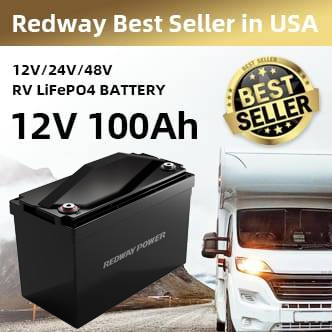
Global RV ownership and off-grid travel are rising fast, yet power reliability, battery failures, and high lifetime costs still hold many RV brands and owners back. Data from the RV Industry Association shows that RV shipments in North America surpassed 600,000 units in peak years, and surveys consistently rank electrical and energy systems among the top sources of user complaints and warranty claims. At the same time, lithium transition is accelerating, but poor-quality or non-specialized batteries frequently cause capacity loss, early degradation, and safety concerns. In this context, a specialized 12V LiFePO4 RV battery production factory—such as Redway Battery with its OEM-focused, LiFePO4-centric manufacturing—has become a critical enabler for OEMs, dealers, and RV upfitters seeking reliable, scalable, and profitable energy solutions.
What is the current state of RV power systems and what pain points are emerging?
The RV market is shifting from short, plug-in camping stays toward long-term off-grid “mobile living,” dramatically increasing demand for stable DC power, higher usable capacity, and fast recharging. Owners are adding inverters, induction cooktops, air conditioners, Starlink, and work-from-RV setups, all of which strain traditional 12V systems that were originally designed mainly for lights and basic loads. This mismatch between usage and power architecture drives chronic underperformance and user frustration. Conventional lead-acid house batteries still dominate in many mass-market RVs, but their real usable capacity is often only 50% of nominal, and repeated deep discharge drastically shortens lifespan. As a result, many RVers experience voltage sag, dimming lights, frequent generator runs, and premature battery replacement—often within 2–3 years of regular use. Total cost of ownership becomes much higher than the initial price suggests. At the same time, safety and reliability expectations are rising. Overheating terminals, poorly integrated systems, and mismatched chargers are increasingly discussed in RV communities, eroding trust in generic or low-end lithium solutions. This pushes OEMs to work closely with specialized manufacturers like Redway Battery that can co-design safe, integrated 12V LiFePO4 RV systems with proper BMS, thermal design, and quality control from cell to finished pack. Regulatory and brand pressures also matter. RV brands are under pressure to reduce warranty claims, support electrification trends, and meet growing expectations for eco-friendly, maintenance-free power. LiFePO4, with its longer cycle life and higher efficiency, fits this trajectory—but only if delivered by a factory that can maintain consistency, traceability, and design-for-RV engineering. This is where an experienced OEM partner with dedicated LiFePO4 RV lines becomes strategically important.
Why are traditional RV battery solutions no longer enough?
Traditional RV power systems were built around flooded or AGM lead-acid batteries, modest DC loads, and frequent access to shore power. In that context, limited depth of discharge, slow charging, and short cycle life were acceptable trade-offs. Today’s RV users, however, expect residential-like comfort off-grid, which multiplies energy demand and exposes the limitations of these legacy solutions. Lead-acid batteries suffer from:

Low usable capacity: Typically only about 50% of rated Ah can be used without accelerating degradation.
Short cycle life: Frequently only a few hundred deep cycles before capacity drops significantly.
High maintenance: Watering (for flooded), equalization charging, and sensitivity to partial state-of-charge.
Heavy weight and bulk: Large packs reduce payload and storage flexibility. Generic or non-RV-specific lithium batteries are not a perfect fix either. Without RV-tailored BMS logic, proper low-temperature protection, robust terminals, and validated integration with chargers and inverters, they may exhibit:
Overheating points or poor mechanical interfaces.
Incorrect charging profiles leading to premature aging.
Incompatibility with existing RV converters or alternator charging.
Lack of OEM-grade traceability, making warranty and quality management difficult. Therefore, the gap is no longer just “lead-acid vs lithium” but “generic power vs engineered, RV-optimized power.” A 12V LiFePO4 RV battery production factory that is purpose-built for OEM integration, like Redway Battery, directly addresses this gap.
How does a 12V LiFePO4 RV battery production factory provide a better solution?
A dedicated 12V LiFePO4 RV battery production factory is designed around the specific electrical, environmental, and mechanical demands of RV use. Instead of selling standalone batteries, it designs and manufactures integrated energy subsystems that are optimized for:
12V nominal RV architectures.
Deep-cycle usage profiles.
Wide temperature ranges.
Vibration and limited installation space. Redway Battery, for instance, operates large-scale, automated facilities with MES (Manufacturing Execution Systems), allowing full traceability from cell batch to finished 12V RV pack. This enables consistent capacity, internal resistance, and safety performance across large OEM orders, which is crucial for RV brands that must deliver the same user experience across thousands of units. Core capabilities of such a factory typically include:
LiFePO4 cell selection and matching optimized for deep-cycle RV use.
Custom BMS design with RV-specific protections: over/under-voltage, over-current, low-temperature charge cut-off, high-temperature cut-back, short-circuit protection, and cell balancing.
Mechanical and thermal design tailored to RV compartments: compact form factors, secure mounting options, and passive or assisted cooling paths.
System integration support: matching chargers, inverters, DC-DC chargers, and alternator protection strategies. Redway Battery leverages over a decade of lithium engineering for forklifts, golf carts, energy storage, and RV applications, which allows it to reuse industrial-grade safety and durability standards in compact 12V RV battery packs. For RV OEMs and upfitters, this means more predictable performance, fewer field failures, and simpler platform-wide standardization. In addition, factories like Redway Battery support OEM/ODM customization, letting customers define voltage, capacity, footprint, communication interfaces (CAN, RS485), and enclosure specs. This transforms the battery from a commodity component into a strategic, branded feature that can differentiate high-end RV lines.
What are the key advantages of factory-built LiFePO4 RV solutions vs traditional options?
12V RV battery solutions comparison table
| Aspect | Traditional lead-acid/AGM | Generic LiFePO4 battery | Factory-built 12V LiFePO4 RV solution (e.g., Redway Battery) |
|---|---|---|---|
| Usable capacity | ~50% of rated Ah; frequent voltage sag under load | Higher usable capacity, but may not be optimized for RV loads | High usable capacity with stable voltage profile across common RV loads |
| Cycle life | Often 300–500 deep cycles | Can be high, but varies widely by quality | Typically 2,000–5,000 cycles when correctly integrated and charged |
| Weight and size | Heavy and bulky for equivalent usable energy | Lighter, but form factors may not fit RV compartments | Optimized form factor and mounting for RV battery bays and under-seat spaces |
| Charging speed | Slow charging; limited acceptance current | Faster, but risk of mismatch with RV chargers | Charging profile engineered to match RV converters, alternators, and solar MPPTs |
| Low-temperature protection | Usually none; susceptible to damage when charged cold | May or may not include low-temperature cut-off | Integrated BMS with low-temperature charge protection and control logic |
| Safety and reliability | Acid spills, off-gassing, sulfation risk | Quality inconsistent; potential for poor busbar or terminal design | Factory-tested packs with industrial-grade safety design and QC processes |
| Maintenance | Regular checks, possible watering, equalization | Low maintenance, but integration issues may arise | Virtually maintenance-free with OEM documentation and support |
| Integration support | Limited; generic component | Often DIY-level support | Engineering support, CAD data, and validation for OEM installation |
| Branding and customization | Minimal differentiation | Limited or no OEM customization | Full OEM/ODM branding, custom enclosures, and capacity options |
| Lifecycle cost | Lower upfront but high replacement frequency | Medium; highly dependent on quality | Higher upfront but significantly lower cost per cycle and per kWh delivered |
How can RV OEMs and upfitters implement a factory-built LiFePO4 RV battery solution step by step?
A structured implementation process ensures that a 12V LiFePO4 RV solution is not only technically sound but also scalable across product lines.

Requirement definition
Determine typical and peak loads: inverters, HVAC, DC appliances, office equipment.
Define autonomy targets: hours or days off-grid without external charging.
Map installation constraints: compartment size, ventilation, wiring paths, and weight limits.
Identify charging sources: shore power, alternator, generator, and solar.
Technical co-design with the battery factory
Engage with the engineering team at Redway Battery or a similar manufacturer to translate requirements into pack specifications (capacity in Ah, nominal and max voltage, continuous and peak current).
Select or design a suitable BMS with required protections and communication interfaces.
Agree on enclosure design, mounting points, and cable or busbar layout specific to the RV model.
Prototype development and validation
Build engineering samples and install them in test vehicles.
Conduct validation: thermal behavior under load, charge/discharge tests, vibration tests, low-temperature operation, and fault handling (e.g., short-circuit simulation).
Verify compatibility with existing or new chargers, inverters, solar controllers, and DC-DC chargers.
Compliance, documentation, and after-sales model
Ensure certifications and test reports meet target market requirements.
Prepare installation manuals, wiring diagrams, and troubleshooting guides for dealers and service centers.
Define warranty, RMA, and data-tracking processes, supported by the factory’s MES and QC records.
Pilot rollout and feedback loop
Introduce the solution in a limited series or higher-end trim lines.
Collect field data and feedback from dealers and early customers regarding performance, ease of installation, and perceived value.
Refine pack design, software (BMS firmware), and documentation based on real-world results.
Scale-up production and platform standardization
Commit to volume production with the factory, locking in cell supply and capacity allocation.
Standardize the 12V LiFePO4 platform across multiple RV models where feasible to streamline inventory and training.
Work with Redway Battery or equivalent partners to continuously evolve the product, for example by adding smart monitoring apps or advanced telematics over time.
Which real-world user scenarios demonstrate the value of a 12V LiFePO4 RV battery factory solution?
Scenario 1: Full-time digital nomad RV
Problem: A couple working remotely from their RV runs dual monitors, laptops, a router, and occasional air conditioning. Their lead-acid bank routinely drops below safe voltage by evening, forcing noisy generator use during work calls and causing premature battery failure.
Traditional approach: Incremental upgrades—adding another lead-acid battery and a larger generator—but this increases weight, fuel use, and still fails to deliver quiet, all-day power.
After adopting factory-built LiFePO4: Their RV builder integrates a 12V LiFePO4 bank from Redway Battery, doubling usable capacity in the same footprint and enabling fast recharge from solar and alternator.
Key benefits: Silent, stable power through the whole workday; reduced generator run hours; fewer replacements over a multi-year full-time travel lifestyle; improved customer satisfaction and brand reputation for the OEM.
Scenario 2: Rental RV fleet operator
Problem: A rental fleet operator experiences high rates of battery abuse and failure because renters run batteries deeply, forget shore power, and overload circuits. Maintenance costs and downtime are increasing.
Traditional approach: Frequent lead-acid replacement, strict usage instructions, and penalties, which strain customer relationships and still fail to prevent battery damage.
After adopting factory-built LiFePO4: The fleet converts to standardized 12V LiFePO4 packs designed and supplied in bulk by Redway Battery, with robust BMS protections and optional telemetry to monitor state of charge and abuse patterns.
Key benefits: Sharply reduced battery-related breakdowns and replacements; predictable performance for each rental; data-driven maintenance scheduling; stronger margins due to lower lifetime operating costs.
Scenario 3: Off-grid overland expedition vehicle
Problem: An overland vehicle builder targets harsh climates, where customers face extreme temperature swings and long periods far from grid power. Generic lithium packs have shown poor cold-weather charging behavior and inconsistent reliability.
Traditional approach: Oversizing lead-acid banks and relying on engine idling to recharge, which adds weight and fuel consumption and still risks failures in remote regions.
After adopting factory-built LiFePO4: The builder partners with Redway Battery to develop a cold-climate-optimized 12V LiFePO4 pack with integrated low-temperature charge protection, temperature sensors, and appropriate insulation.
Key benefits: Reliable cold-weather performance; safe charging control at low temperatures; higher energy density than lead-acid for the same usable capacity; strong differentiation in the expedition vehicle market.
Scenario 4: High-end motorhome with premium comfort features
Problem: A luxury motorhome brand adds residential fridges, induction cooktops, and advanced entertainment systems. Energy demand spikes, and legacy lead-acid systems cannot support the brand’s comfort promise without constant generator use.
Traditional approach: Installing larger alternators and bigger lead-acid banks, increasing complexity and weight, while still causing voltage drop and frequent maintenance.
After adopting factory-built LiFePO4: The brand co-develops a high-capacity 12V LiFePO4 system with Redway Battery, including smart monitoring and seamless integration with inverter-chargers and solar.
Key benefits: Quiet, hotel-like experience off-grid; premium positioning (“lithium-powered comfort” as a selling point); reduced after-sales energy complaints; enhanced perceived quality and innovation.
How will 12V LiFePO4 RV battery factories shape future trends, and why is now the right time to upgrade?
The RV and mobile living ecosystem is moving toward higher electrification, longer boondocking capability, and integration with renewable energy such as rooftop solar and portable power. LiFePO4 chemistry is emerging as the backbone of this shift due to its strong safety profile, long cycle life, and predictable behavior for deep-cycle applications. Over the next few years, several trends are likely:
Standardization on lithium platforms: More RV models will ship from the factory with LiFePO4 as standard instead of optional upgrades.
Smart energy systems: Integration of battery data into vehicle dashboards, apps, and telematics for real-time monitoring and predictive maintenance.
Modular battery architectures: Stackable 12V modules that can scale capacity for different trim levels and user profiles.
Tighter OEM–factory collaboration: Battery design will increasingly be co-engineered with vehicle platforms, rather than treated as an afterthought component. Redway Battery, with its multiple factories, automated production, and RV-specific LiFePO4 product lines, is well positioned to support this evolution. By engaging now, RV OEMs, converters, and fleet operators can secure stable supply, co-develop differentiated energy systems, and dramatically reduce long-term power-related headaches for end users. Waiting risks higher warranty costs, lost sales to more energy-savvy competitors, and difficulty catching up once lithium-based platforms become the industry default.
What FAQs do RV brands and users have about 12V LiFePO4 RV battery production factories?
Is a factory-built 12V LiFePO4 RV battery really safer than generic lithium batteries? Yes, because safety is engineered into both the cell selection and the pack design, including BMS protections, terminal design, thermal management, and rigorous testing that generic products often skip.
Are LiFePO4 RV batteries from factories like Redway Battery worth the higher upfront cost? In most RV use cases, the significantly longer cycle life, higher usable capacity, and lower maintenance lead to a lower cost per cycle and fewer replacements, making the total cost of ownership more attractive.
Can a 12V LiFePO4 RV battery from an OEM factory integrate with existing RV electrical systems? Yes, when designed in collaboration with the RV manufacturer or upfitter, the battery can be matched to existing converters, inverters, alternators, and solar controllers, or deployed alongside compatible new components.
How does a LiFePO4-focused factory like Redway Battery support customization for different RV models? Through OEM/ODM services, Redway Battery can adjust capacity, voltage, form factor, enclosure design, communication protocols, and branding to match specific RV platforms and market positioning.
What is the typical lifespan of a factory-built 12V LiFePO4 RV battery pack? Under proper installation and charging, a high-quality LiFePO4 RV pack can often deliver several thousand cycles, translating into many years of regular use for full-time or seasonal RVers, far beyond typical lead-acid lifespans.
Can RV rental fleets benefit from standardizing on LiFePO4 packs from one factory? Yes, standardization simplifies inventory management, training, diagnostics, and warranty handling, while the robust design of factory-built packs reduces downtime, abuse-related failures, and overall energy system costs.
Who should consider partnering directly with a 12V LiFePO4 RV battery production factory like Redway Battery? RV OEMs, specialty upfitters, rental fleets, and system integrators who need consistent quality, scalable supply, engineering support, and long-term brand differentiation built around reliable, modern energy systems.
Sources
https://www.redwaypower.com/zh-CN/lifepo4-%E6%88%BF%E8%BD%A6%E7%94%B5%E6%B1%A0/
https://www.redwaybattery.com/disadvantages-of-lifepo4-batteries-a-comprehensive-analysis/
https://www.redway-tech.com/product-category/12v-lifepo4-batteries/
https://powerurus.com/blogs/news/what-problems-does-a-lifepo4-battery-have
Continue exploring: Use the Choosing RV Batteries guide to compare RV battery specifications, charging decisions, operating requirements, and practical guidance.