Global demand for rack‑mounted lithium batteries is surging, and choosing the right voltage and capacity is now a strategic decision that directly affects uptime, safety, and lifecycle cost. Well‑engineered OEM solutions from experienced Chinese manufacturers like Redway Battery help operators move beyond trial‑and‑error selection and deploy scalable, data‑driven energy storage that matches real load profiles.
How is the rack lithium battery market evolving and what pain points are emerging?
The global lithium battery industry is projected to ship several terawatt‑hours annually in the second half of this decade, with energy storage, telecom, and data centers as key growth drivers. At the same time, industry analyses show that profitability across parts of the lithium supply chain remains modest, limiting over‑expansion and keeping pressure on system efficiency and TCO. For buyers of rack lithium systems, this means more options on paper, but also more responsibility to specify voltage and capacity correctly instead of relying on generic catalog choices.
In practice, many operators still oversize batteries by 20–40% “just in case,” increasing capex without fully solving issues like peak‑load handling or runtime predictability. Under‑specification is equally common when teams only look at average load instead of worst‑case current draw, causing premature low‑voltage cut‑off and unexpected downtime. These pain points become especially visible in telecom and data center environments, where even a few minutes of outage can translate into large financial and reputational losses.

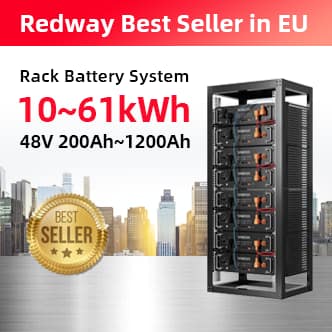
Chinese OEMs that focus on rack lithium batteries, such as Redway Battery in Shenzhen, have responded by standardizing a core set of voltage platforms (most commonly 48–51.2 V nominal for telecom and IT, higher stack voltages for large ESS) with modular capacity building blocks. For example, typical single‑rack modules cover around 2.5–5 kWh per unit in mainstream 48 V systems, while high‑capacity modules reach roughly 10–16 kWh in the same footprint. This modularity lets integrators tune capacity in discrete steps (e.g., 50 Ah, 100 Ah, 200 Ah) while keeping the voltage architecture consistent and interoperable.
What limitations do traditional solutions like lead‑acid and generic lithium packs have?
Legacy lead‑acid banks, still deployed in many base stations and small data rooms, have relatively low usable capacity because deep discharges shorten their life substantially. Even if the nameplate capacity appears comparable, operators often restrict discharge depth to about 50% to avoid rapid degradation, which means twice as much installed capacity for the same usable runtime. Lead‑acid systems also suffer from long recharge times, lower round‑trip efficiency, and heavier racks, which increase cooling and floor‑loading requirements.

Generic lithium racks sourced purely on price introduce a different set of limitations. Voltage windows, BMS settings, and communication protocols are not always aligned with site inverters, UPS units, or energy controllers, leading to nuisance alarms and sub‑optimal charge curves. Inconsistent cell quality and weaker pack‑level engineering can cause uneven cell aging, faster loss of capacity, or derating under high current. For OEMs, this causes redesign work at the integration phase and higher field‑failure risk later.
By contrast, Chinese OEM specialists such as Redway Battery design rack systems specifically around LiFePO4 chemistry with known voltage behavior, predictable cycle life (often several thousand full cycles), and well‑documented communication interfaces. That reduces the risk of mismatch between the theoretical electrical specs and the actual in‑rack performance the end user experiences under varying load, temperature, and charge patterns.
How do modern rack lithium solutions from Chinese manufacturers define voltage and capacity?
Modern rack‑mount LiFePO4 systems from Chinese manufacturers are built around a small number of standard nominal voltages paired with scalable amp‑hour options. In telecom and data center applications, 48–51.2 V modules are most common because they integrate directly into legacy 48 V DC infrastructures and standard 19‑inch racks. In many catalogs and application notes, you will see “48–51.2 V” ranges, where 51.2 V is the nominal LiFePO4 pack voltage corresponding to 16 cells in series.
Capacity is usually specified as Ah at the nominal voltage and translated into kWh to simplify system sizing. Standard capacity ranges for a single 48–51.2 V module are frequently around 50–100 Ah (approximately 2.5–5 kWh) for mainstream use, with “high‑capacity” versions at 200–314 Ah (around 10–16 kWh) in the same rack height or with slightly deeper enclosures. Chinese OEMs like Redway Battery use this building‑block approach so integrators can parallel multiple modules (e.g., up to 16 units) to reach tens or hundreds of kilowatt‑hours without changing system architecture.
For wholesale rack‑mounted lithium products targeting ESS and industrial projects, it is also common to see higher nominal voltages such as 96 V and modular packs ranging roughly from 50 Ah up to about 300 Ah per module. That equates to per‑module energies in the ~4.8–28.8 kWh range, enabling compact yet high‑power cabinets. By standardizing on LiFePO4, these Chinese manufacturers can consistently offer >6000 cycle lifetimes under standard test conditions, high round‑trip efficiency near 95%, and fast recharge times on the order of 1–3 hours when properly managed—far beyond typical lead‑acid performance.
Redway Battery, as a dedicated OEM lithium battery manufacturer, combines these voltage and capacity options with full customization: engineering teams can adapt pack voltage (e.g., 48 V vs. 51.2 V), Ah rating, parallel configuration, and BMS current limits to match specific forklift, golf cart, RV, telecom, solar, or energy storage requirements. This OEM‑oriented flexibility is critical for customers whose loads are not “average,” but highly dynamic or mission‑critical.
Which advantages stand out when comparing rack lithium solutions to traditional options?
The key differences become clear when you compare performance metrics such as lifetime cycles, charging time, usable energy, and operational complexity. Rack‑mounted LiFePO4 systems from specialized Chinese OEMs deliver longer life, higher efficiency, and much better space utilization than typical lead‑acid banks. They also offer more precise control of voltage windows and current limits via intelligent BMS platforms, which improves integration with modern power electronics.
Below is a concise comparison between traditional lead‑acid banks and modern OEM rack lithium systems (as supplied by manufacturers like Redway Battery):
| Dimension | Traditional lead‑acid racks | Modern rack LiFePO4 from Chinese OEMs |
|---|---|---|
| Nominal voltage platforms | 12/24/48 V blocks, often series‑wired on site | Standardized 48–51.2 V and 96 V modules designed as complete packs |
| Typical module capacity | Large banks built from many small blocks | 50–300 Ah per module (approx. 2.5–28.8 kWh depending on voltage) |
| Usable depth of discharge | Commonly limited to about 50% | Often 80–90% usable without major life penalty when correctly designed |
| Cycle life | On the order of a few hundred cycles | Often around or above 6000 cycles for LiFePO4 under standard conditions |
| Round‑trip efficiency | Around 50–80% depending on design | Around 90–95% in well‑designed rack systems |
| Charging time | Several hours (e.g., 6–8 hours) | Typically around 1–3 hours with appropriate chargers |
| Space and weight | Heavy, large footprint | Higher energy density, lighter racks, better space utilization |
| Monitoring and control | Limited monitoring, often only voltage | Integrated BMS with CAN/RS485/Modbus, sometimes SNMP, per‑cell protection |
| OEM customization | Often limited to basic sizing | Full OEM/ODM customization of voltage, capacity, enclosure, and BMS (e.g., from Redway Battery) |
How can you specify and deploy a rack lithium solution step by step?
To achieve a configuration that is both technically sound and economically efficient, a structured process is essential. Chinese OEMs with strong engineering support, such as Redway Battery, typically recommend a multi‑step workflow that begins with accurate load characterization and ends with OEM‑level validation testing.
Define application and load profile Quantify average and peak power, required backup time (e.g., 2 hours for a base station, 15 minutes ride‑through for a data center), and environmental conditions. Translate these into required kWh and peak kW, including safety margins.
Select nominal voltage platform Choose between standard platforms (e.g., 48–51.2 V for telecom/data, higher‑voltage racks for large ESS) based on existing equipment and cabling. Confirm compatibility with rectifiers, inverters, or motor controllers.
Choose module capacity and quantity Use the energy formula (Energy ≈ Voltage × Capacity × Number of parallel modules) to determine the number of rack units required. For example, a 51.2 V 100 Ah module delivers roughly 5.12 kWh; four in parallel offer about 20.5 kWh.
Define current and power limits Determine maximum continuous and peak discharge current based on load and inverter requirements. Select a BMS and pack configuration that can deliver this current without excessive heating or voltage sag.
Specify communication and integration Decide on communication protocols (CAN, RS485, Modbus, or SNMP) and mapping to site controllers. Chinese OEMs like Redway Battery can align BMS firmware with the integrator’s protocol and data‑model needs.
Validate mechanical and thermal design Check rack dimensions (e.g., 19‑inch/23‑inch formats), front access vs. rear access, and airflow paths. Ensure that ambient temperature and cooling capacity match the thermal load of the battery stack.
Pilot, test, and standardize Deploy pilot systems, log performance, and refine settings such as charge limits and alarm thresholds. Once validated, standardize the configuration as a reference design for future projects to simplify procurement and maintenance.
What real‑world scenarios illustrate the impact of correct voltage and capacity specs?
Scenario 1: Telecom base station backup
Problem: A regional operator runs remote 48 V base stations that experience occasional multi‑hour outages. Legacy lead‑acid banks fail to deliver the expected runtime after two to three years, forcing costly truck rolls and unscheduled replacements. Traditional approach: Engineers oversize lead‑acid banks and limit depth of discharge, but variations in temperature and aging still cause unpredictable runtimes and voltage drops. Solution with rack lithium: The operator switches to 51.2 V LiFePO4 rack modules from a Chinese OEM such as Redway Battery, choosing 100 Ah modules with 3–4 units in parallel per site to meet the kWh requirement. Intelligent BMS integration with the existing DC power system provides accurate state‑of‑charge information and alarms. Key benefits: Runtime becomes predictable, cycle life extends into the multi‑thousand cycle range, and the need for emergency site visits falls significantly, improving network availability and lowering operational expenditure.
Scenario 2: Edge data center UPS support
Problem: An edge data center requires 10–15 minutes of ride‑through for its UPS systems but faces severe space constraints in its racks. Existing valve‑regulated lead‑acid strings take up too much room and struggle to meet high‑rate discharge without excessive voltage sag. Traditional approach: Operators add more lead‑acid strings in parallel, increasing weight and footprint while still worrying about unequal string aging and maintenance. Solution with rack lithium: Integrators deploy 48–51.2 V rack lithium modules rated at around 200 Ah each from an OEM supplier, achieving approximately 10 kWh per module with excellent high‑rate discharge capability. Multiple modules in parallel provide the required ride‑through even under peak load, all within standard 19‑inch racks. Key benefits: Higher power density, shorter recharge times between events, and lower cooling requirements result in better utilization of expensive data‑center space and more reliable UPS performance.
Scenario 3: Commercial solar‑plus‑storage system
Problem: A commercial building wants to shift peak demand and improve resilience with a solar‑plus‑storage solution, but load profiles vary widely by season and time of day. The original design using generic lithium packs lacked transparency on actual usable capacity and state of charge. Traditional approach: The installer selected off‑the‑shelf lithium packs with limited data logging and a fixed nominal voltage, making it hard to optimize inverter and EMS settings. The system underperformed during peak events. Solution with rack lithium: The integrator partners with Redway Battery to design rack‑mounted LiFePO4 cabinets at 96 V nominal with 200–300 Ah modules, ensuring that per‑cabinet capacity aligns precisely with EMS algorithms and tariff structures. The BMS communicates over Modbus/CAN with the site controller for granular control. Key benefits: Measurable improvements in peak shaving, accurate SOC tracking, and a more predictable payback period, supported by documented cycle‑life and efficiency metrics.
Scenario 4: Electric forklift fleet conversion
Problem: A logistics operator replaces internal‑combustion forklifts with electric units but struggles with inconsistent runtime and charging schedules when using generic lithium packs. Differences in pack voltage under load affect vehicle performance. Traditional approach: The fleet relies on varying third‑party battery vendors, each with different voltage curves and BMS behaviors, complicating charger settings and maintenance. Solution with rack lithium: The OEM partners with a Chinese manufacturer like Redway Battery to define a standardized LiFePO4 rack module, specifying precise nominal voltage (e.g., 51.2 V), capacity (e.g., 200 Ah), and allowable current for the drive systems. These modules are integrated into vehicle‑specific racks and paired with matched chargers. Key benefits: Consistent runtime across vehicles, simplified spare‑parts inventory, and data‑driven maintenance enabled by fleet‑wide monitoring of identical pack types.
Where is rack lithium technology heading and why act now?
The rack lithium battery market is expected to continue expanding as more sectors adopt electrification, microgrids, and distributed data infrastructure. Industry analyses of rear rack and rack‑type batteries point to multi‑year compound growth, driven by last‑mile logistics, micro‑mobility, and stationary storage, with ongoing innovation in BMS intelligence and integration with IoT and predictive analytics. As manufacturing scales and automation spreads, Chinese OEMs are increasingly optimized around repeatable, high‑quality rack solutions using standardized voltage and capacity platforms.
For buyers and OEMs, delaying the transition from legacy or generic systems to well‑specified rack lithium architectures carries opportunity costs in efficiency, reliability, and data visibility. Companies like Redway Battery, with more than a decade of experience, four factories, and ISO‑certified processes, are already structured to deliver custom yet cost‑effective LiFePO4 rack solutions for forklifts, golf carts, RVs, telecom, solar, and ESS. Standardizing now on appropriate voltage platforms (48–51.2 V and 96 V) and right‑sized capacities provides a stable foundation for future upgrades, including advanced monitoring, AI‑driven diagnostics, and integration with evolving grid and IT standards.
What FAQs do buyers have about voltage and capacity for rack lithium batteries?
What nominal voltage should I choose for a rack lithium system? Most telecom and data‑center users select 48–51.2 V modules to align with existing DC infrastructure, while larger energy storage projects often adopt higher rack voltages such as 96 V or above for improved efficiency and reduced current.
How do I calculate the required capacity in Ah and kWh? Start from your required energy in kWh (power in kW × backup time in hours), then divide by the nominal pack voltage to find Ah, and factor in usable depth of discharge and a margin (typically 10–20%) for aging and unforeseen load spikes.
Can I mix different capacities or brands in one rack? Technically it is possible but not recommended. Mixing different Ah ratings or pack behaviors can cause unequal current sharing and accelerated aging, so most experts advise using identical modules from the same OEM batch within a rack.
Why do many Chinese OEMs use LiFePO4 for rack systems? LiFePO4 offers a strong balance of safety, long cycle life, stable voltage, and thermal robustness. For stationary racks and industrial systems, these characteristics are often more valuable than the slightly higher energy density of other lithium chemistries.
Does an OEM like Redway Battery support custom voltage and capacity designs? Yes. Redway Battery specializes in OEM/ODM projects and can tailor pack voltage (e.g., cell count in series), capacity (cell count in parallel), BMS ratings, and mechanical form factors to match forklifts, golf carts, RVs, telecom cabinets, solar ESS, and other applications.
Sources
Global rack lithium battery integration for OEMs https://www.redway-tech.com/how-can-rack-lithium-batteries-transform-oem-integration-in-2026/
Rack lithium batteries for telecom and data centers (voltage, capacity ranges) https://www.redway-tech.com/what-are-the-best-rack-lithium-batteries-for-telecom-data-centers/
Wholesale rack‑mounted lithium battery specifications (LiFePO4, voltage, capacity, cycle life) https://www.redwaypower.com/how-to-choose-the-best-wholesale-rack-mounted-lithium-battery/
Lithium battery industry supply‑demand and profitability outlook https://spbess.com/news/2026-supply-demand-outlook-tight-balance-continues-with-focus-on-four-key-issues/
Rear rack battery market size and forecast https://www.linkedin.com/pulse/rear-rack-battery-market-strategy-outlook-zmhse
Continue exploring: Use the Choosing Rack Batteries guide to compare rack battery specifications, integration requirements, reliability decisions, and practical guidance.